
 Phil Treagus-Evans
Ian Toll is the author of three American military history books: Six Frigates, Pacific Crucible and The Conquering Tide. As well as being an author of books, Ian Toll has also been published in various highly regarded publications, including; The New York Times and The Los Angeles Times. A lover of books, Ian regularly contributes to The New York Times review of books. His own books have gained recognition in the form of the Samuel Eliot Morison Award for Naval Literature in 2007, as well as The Conquering Tide becoming a New York Times bestseller and also being selected for the editor’s choice list of the same paper. Before his writing career, Ian Toll worked as a Wall Street analyst, a Federal Reserve financial analyst and a political aide and speechwriter. It’s always always an honour to talk books with a highly regarded author, and this interview is no different. Please enjoy my interview with Ian Toll…
When someone asks you ‘what do you do for a living?’ – How do you respond?
I say I’m a writer and historian.
 What are you reading at the moment?
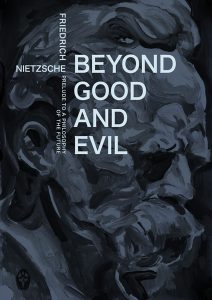
I’m always juggling books, but lately I’ve been stuck into Beyond Good and Evil by Friedrich Nietzsche. Surprisingly readable, though abstruse at times. To follow his ideas more closely, I think I’d need a classical education and years of training in western philosophy. Some of his arguments strike me as unsympathetic and even reprehensible – but the prose is electric and the genius and erudition of this German mega-mind seems to leap up from every page. It’s a rare book that invigorates me at the same time that it makes me feel stupid and angry. I should probably add that my reading tastes generally aren’t so highbrow.
When you think about your childhood, what book comes to mind?
The Cat in the Hat by Dr. Seuss struck deep. Thing One and Thing Two were disturbing and beguiling in about equal measure. Later I discovered J.R.R. Tolkien and Stephen King, still two of my favorites.
Can you remember the first story you ever wrote?
Not really. I don’t think I wrote a lot of fiction as a child, and what little I did write was very bad. I wrote letters, lots of them, to relatives and friends.
What did you want to be when you were growing up?
A writer.
What do you think your school aged self would think of the present day you?
At first sight he would cry out in horror and collapse into a cataleptic heap on the floor. Later, after regaining consciousness, he might enjoy reading the books he hadn’t yet written, because they are right up his alley. He’d start lecturing his history teachers and they’d find him even more insufferable than he actually was.
If you could wrap up a single book and gift it to yourself as you left education – which book would it be?
I’ll say any collection of essays or journalism by H.L. Mencken, George Orwell, or Mark Twain. It took me a while to discover that if you put yourself into the hands of a supremely gifted writer, you don’t need to bother asking, “What’s it about?” The subject doesn’t matter: you can bet that it will be sublime.
Does your reading have routine? Is there a particular time or place that you like to read?
Not really. I read all the time: in bed, on the couch, on the subway, at my desk. I listen to audio-books because I like to walk and ‘read’ simultaneously.
 Which book has had the biggest impact on your career so far?
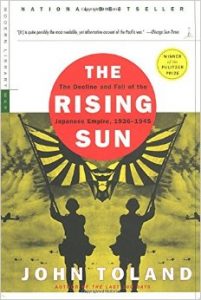
The Rising Sun by John Toland was the first big work of history I read. I was about age 12 or so; my family was living in Tokyo. All the gaijin (foreign expat) adults I knew had read the book, or anyway they were all talking about it. Out of curiosity I picked it up, and then amazed myself by racing through the entire book (more than a thousand pages long) in about a week. After that I never stopped reading history. That was my introduction to the Pacific War.
What two pieces of advice would you give a young aspiring writer?
Ask yourself, do I have the right type of personality to be happy in this line of work? Even if you have plenty of talent and discipline, you need to find out whether you’re the type of person who can thrive in a career that unfolds largely inside your own mind. This is a vocation for natural-born introverts.
Second, read the authors you want to emulate with the attitude of a forensic analyst. Make copious margin notes; draw diagrams; keep lists; take their prose apart and then reverse-engineer it. Every writer has a bag of tricks, and you need to know exactly what’s in that bag. Don’t be afraid to copy their techniques — and when I say copy, I mean precisely copy. (You must not copy text, of course – but it’s not plagiarism to copy technique). As you gain experience, you can trust your own instincts to a greater degree, but you should never stop pillaging the work of other writers — and don’t be shamefaced about it, because they all looted the writers who wrote before them.
Do you have any books that you strongly associate with someone important in your life?
I’ve discovered many contemporary YA novels by reading to and with my son, Henry. I don’t think I would have read The Red Pyramid by Rick Riordan or The Raven Boys Maggie Stiefvater if not for him, but I’m glad I did. I think a lot of us grown-ups nurture the conceit that ‘classic’ children’s books are better than what writers are turning out nowadays, but that’s just generational chauvinism masquerading as nostalgia.
What book have you recommended the most to friends and family?
History of the United States of America During the Administrations of Jefferson and Madison by Henry Adams. His editor should have steered him toward a pithier title – but in a century and a half, no historian has surpassed his analysis of the politics of the early American republic, and his talent for storytelling is Homeric.
Do you prefer fiction or non-fiction?
Nonfiction, generally. A story hits harder when it’s true, and there are no shortage of great stories and subjects in the actual world. Even a mediocre writer can produce a fascinating work of nonfiction, if the subject is sufficiently interesting; and a great writer (John McPhee!) can take a seemingly humdrum subject and make it spellbinding. I find most literary novels boring and self-indulgent, and most commercial novels sterile and clichéd. But when fiction is good, it’s magical.
Do you think reading is important?
I’d be interested to meet the author who answers “no” to this question. Yes, reading is important. I like good movies, and we are certainly living in a golden age of television — but a good book intrinsically engages the imagination at a deeper level than any film, TV series, or YouTube video. If a million people read a book by J.K. Rowling, the protagonist will have a million different faces. Each reader’s unique mental processes are put to work constructing the images, voices, sounds, and settings, using Rowling’s text as the architectural blueprint. But if 100 million people watch a Harry Potter movie, they all walk out of the theatre with Daniel Radcliffe in mind (not that he’s a bad-looking dude, even with the scar).
 What’s the best book you’ve read in the last 6 months?
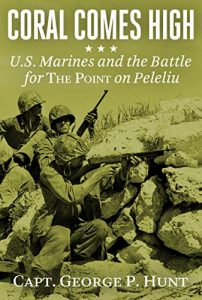
Coral Comes High by George P. Hunt, a largely forgotten combat memoir by a marine officer who fought on Peleliu, an island in the Pacific, in 1944. There are hundreds of such books, obscure memoirs long out of print, that are more vivid, valuable, and entertaining than nine-tenths of the new histories published each season about the Second World War — but no one is marketing them, so almost no one reads them.
Do you prefer real books or digital books?
Real books. I like taking notes in the margins, which means that I need to own books rather than borrow them from a library. I read newspapers, magazines, and blogs online, but I’ve never read a single e-book. I’m also addicted to walking and listening to audiobooks, but an audiobook does not engage me unless it’s read by a virtuoso reader, like Grover Gardner.
Name a book that you feel every human should have to read by law.
That’s not what the law is for. Depending on what happens next Tuesday, it might be Trump: Art of the Deal.
What is the book that you feel has had the single biggest impact on your life?
If I must name one, I’ll say The Adventures of Tom Sawyer by Mark Twain. I still measure every writer against Mark Twain, and haven’t found a better one. But George Orwell was in the same league, so I’d name 1984 as a runner-up. I should also mention Patrick O’Brian’s Aubrey-Maturin novels, which are among the very best historical novels I’ve read, because they started me down the path that led to my first book, Six Frigates.
Are there any books you haven’t mentioned that you feel would make your reading list?
In recent years I’ve tried to keep up with some of the stupefying developments in science, especially physics. Recently I’ve enjoyed Our Mathematical Universe by Max Tegmark and The Singularity is Near by Ray Kurzweil, and would recommend both books enthusiastically. Writers and scholars in the humanities have barely begun to confront the emerging consensus that we live in some form of a Multiverse, and how that threatens to overturn fundamental assumptions underlying our various disciplines.
What books or subject matter do you plan on reading in the next year?
I’ve got a book to finish, which means that most of my reading in the next year will be related to my own subject. I intend to read a lot more World War II journalism and memoirs. I’m looking forward to tackling A.J. Liebling: World War II Writings by A.J. Liebling. Recently I’ve received an advanced reading copy of a memoir by John L. McCrea, one of FDR’s wartime military aides, entitled Captain McCrea’s War. I’m about to crack open In the Ruins of Empire by Ronald Spector, about the immediate aftermath of the war in Asia; judging by his previous work, I expect it will be a rigorous and lucid study of a neglected subject.
If you were to write an autobiography – what would it be called?
That book isn’t going to be written, so it won’t have a title.