Books Like Harry Potter: Magical Boarding School Books to Read Instead
In this list
15 books
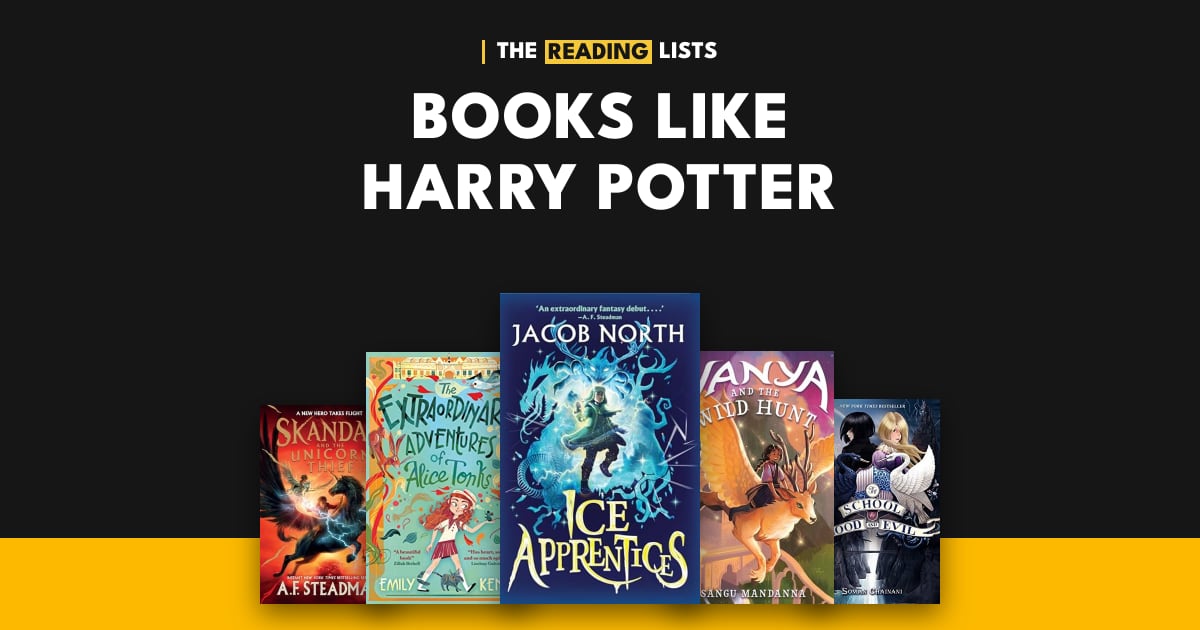
- Ice Apprentices · Jacob North
- The Extraordinary Adventures of Alice Tonks · Emily Kenny
- Vanya and the Wild Hunt · Sangu Mandanna
- Skandar and the Unicorn Thief · A.F. Steadman
- The School for Good and Evil · Soman Chainani
- The Worst Witch · Jill MurphyRecommended 3 times
- Nevermoor: The Trials of Morrigan Crow · Jessica Townsend
- Amari and the Night Brothers · B.B. Alston
- Chronicles of Whetherwhy: The Age of Enchantment · Anna James
- Greenwild: The World Behind the Door · Pari Thomson
- Crookhaven: The School for Thieves · J.J. Arcanjo
- Shadow Thieves · Peter Burns
- The Percy Jackson Series · Rick Riordan
- Inkheart · Cornelia Funke
- A Series Of Unfortunate Events · Lemony Snicket
Harry Potter* was the book of a generation. But since it became public that its author is a problematic figure, many parents would rather give their children something else to read. The good news is that there are plenty of books like Harry Potter*, and many of them are just as magical.
Most of our picks are set in magical boarding schools, many of them in the UK, with secret lessons, strange teachers and children who turn out to be more than they seem. We’ve included books by authors from a wide range of backgrounds and a couple of schools for thieves with no magic at all. Finally, three older favourites that Harry Potter* fans recommend.
Magical boarding schools

Oswin Fields lives in Tundra, the last settlement in a world of ice, and he is its only stray, rescued from the Endless Expanse outside. When he is invited to study magic at Corridor, where the ice apprentices live and train to protect Tundra, it feels like the start of everything. Then he learns that his uncle was an infamous traitor, and the beasts begin to strike.
An outsider at a school of magic, a secret about his family and a world that needs saving: this is the closest thing on the list to the feeling of opening the first Harry Potter* book. Jacob North is a trans man, and he wrote the kind of magical adventure with LGBTQIA+ characters he longed for as a child. It’s the first in a series. Ages 9 to 12.

Alice is starting at Pebblewood, a British boarding school by the sea that her mum and her gran went to before her. It’s very Hogwarts-like. New schools are hard enough for anyone, and harder still for an autistic girl who finds noise and crowds overwhelming. Then Alice discovers she can talk to animals, and they need her help.
Emily Kenny is autistic herself, and Alice is one of the most real and lovable heroines in children’s books. Ages 8 to 12.

Vanya is a British-Indian girl from a small English town, and she is being hunted by the Wild Hunt, a dark force that has been chasing her. Her parents send her to Auramere, the magical library and school they went to, hidden behind enchanted doorways in the mountains of south India. But Auramere isn’t as safe as they thought, and Vanya has to find the Hunt’s leader before they destroy the only place she has ever belonged.
Talking books, waterfalls in the library and a brown, bookish, neurodivergent heroine. Sangu Mandanna grew up in Bangalore and now lives in Norwich, and has written about her own ADHD. Ages 9 to 12.

Thirteen-year-old Skandar Smith, from Margate, has always dreamed of hatching a unicorn and training as a rider at the Eyrie, the school for unicorn riders on a secret island off the coast. These aren’t sweet unicorns, though: they are bloodthirsty and deadly. When the most powerful one is stolen, Skandar finds himself on the Island, hiding a forbidden kind of magic.
Training, treehouse dorms, elemental magic and a dark rider to stop: one of the biggest children’s fantasy series since Harry Potter*. Ages 8 to 12.

Best friends Sophie and Agatha are taken to a school that trains the heroes and villains of fairy tales. Beautiful Sophie is sure she belongs in the School for Good. Gloomy Agatha seems made for the School for Evil. But when they arrive, they’re put in the opposite schools.
Funny, twisty and much darker than it looks, and now a Netflix film. Soman Chainani is Indian-American and gay. Ages 10 and up.

Mildred Hubble is the clumsiest pupil at Miss Cackle’s Academy for Witches, a castle-like boarding school where she crashes her broomstick, gets her spells wrong and makes an enemy of snobbish Ethel Hallow.
The original British magical boarding school story, published in 1974, more than twenty years before Harry Potter*. This one is for younger readers than Harry Potter*: the books are short and full of Jill Murphy’s own pictures, so it’s perfect for children aged 6 to 9 who aren’t ready for Hogwarts yet, or as a first chapter book to read together.
More magical schools and secret worlds

Morrigan Crow is cursed, blamed for every bad thing that happens in her town and doomed to die on her eleventh birthday. Instead, a strange man called Jupiter North whisks her away to Nevermoor, a magical city where she must compete in four dangerous trials against hundreds of other children to win a place in the Wundrous Society.
Not a boarding school, but the Wundrous Society is the next best thing, and Nevermoor is funny, warm and packed with invention. If you loved discovering Hogwarts, this is the series to read next. Ages 9 to 12.

Amari Peters, 13, from Atlanta, finds a clue left by her missing brother that leads her to the secret Bureau of Supernatural Affairs. To find him, she has to get through the Bureau’s summer training programme, sharing a dorm with a were-dragon, while hiding the fact that her own magic is illegal.
B.B. Alston wrote it because, growing up, he couldn’t find any children’s fantasy books with a Black main character. Ages 8 to 12.

In the world of Whetherwhy, everyone has magic inside them, grown from the changing seasons. When Juniper discovers she is an Enchanter, she is invited to study at Thistledown Academy in the capital city of Stormgrove, while her twin brother Rafferty follows her there and takes an apprenticeship at a bookbindery.
A magic school, seasonal magic and a sibling story at its heart, from the author of the Pages & Co. series. It was an instant New York Times bestseller. Ages 8 to 12.

Daisy Thistledown has been left at a London boarding school while her mother, a photojournalist, chases a dangerous story in the Amazon. When her mother disappears, Daisy escapes, and the search takes her through a hidden doorway into the Greenwild, a secret world of plant magic. There she discovers that her mother is one of many Greenwilders to go missing.
Lush, magical and full of adventure, it won the Waterstones Children’s Book Prize. Ages 8 to 12.
Boarding schools for thieves (no magic)

Gabriel is a pickpocket, and a good one. When the headteacher of Crookhaven spots his talent, he is invited to join a secret boarding school where children learn to be thieves.
There’s no magic, but everything else that makes a great school story is here: secret lessons, rivals, loyal friends and a mystery at the heart of the school. It was shortlisted for the Waterstones Children’s Book Prize and has been made into a BBC series. J.J. Arcanjo is half Portuguese and half English, and grew up between the Algarve and Devon. Ages 9 to 12.

Tom is a pickpocket on the streets of an alternative London, in a world where France won the Napoleonic Wars. Then a mysterious man known as the Corsair takes him to Beaufort’s School for Deceptive Arts, a boarding school for thieves high in the snowy Alps.
Again, no magic, but plenty of what made Hogwarts so much fun: a cosy common room, Yule celebrations in the snow, a school with its own rules and a boy who discovers he belongs there. Expect heists, cons and set pieces you won’t see coming. Published in the US as The School for Thieves. Ages 9 to 12.
What Harry Potter* fans recommend

Nathan McLewee:
The Percy Jackson series should be familiar to most Harry Potter* fans, as the books are notable for having many similarities. Percy Jackson tries to live a normal life.. well as normal as normal can be, considering he’s a half god. Just like Harry Potter*, the Percy Jackson books incorporate life as we know it with a fantasy twist, in this case inspired by ancient Greek stories and gods. The Percy Jackson series is well worth a read and we’d thoroughly recommend it.
Alwyn Hamilton
When Hogwarts lets out for the summer, head on over to Camp Halfblood! Percy, Annabeth and Grover rival the original Golden Trio too.

Emma Pocock:
Inkheart is part of a series of three books, and often Meggie – like Harry – is in mortal danger. The focus on family and the bond between families seen in Harry Poter is equally prominent in Inkheart, and the magical element to the story is immersed within the ‘real’ world perfectly.

Steve Vander Ark:
But for something a bit less, shall we say, uplifting, I always turn to the Series of Unfortunate Events. No one who has only seen the film can ever appreciate the intricate and delightful misery Daniel Handler –er, Lemony Snicket delivers starting with the Bad Beginning and wandering helplessly through the next twelve books. Yes, there are thirteen books altogether, not surprisingly, and by the end of the series, aptly named The End, we readers have been horrified, terrified, and satisfied in equal measure. Snicket’s plots are deliciously, gloriously twisted.
If you enjoyed this reading list, you may else enjoy the best fantasy YA books.
As an Amazon Associate we earn from qualifying purchases made through links on this page.