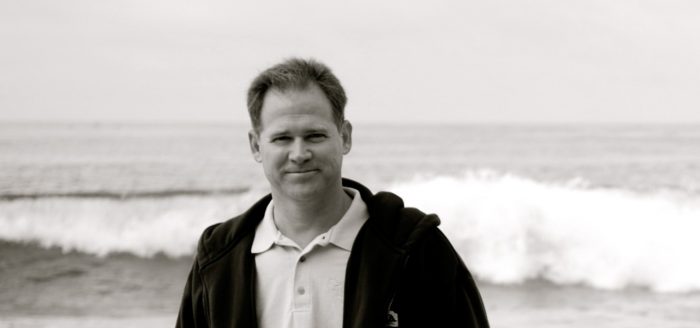
Brian Dunning: That Perfect Turn Of Phrase
Brian Dunning’s reading list
18 books mentioned in this interview
- Grunt · Mary Roach
- Scuffy the Tugboat · Gertrude Crampton
- The Little Engine That Could · Watty Piper
- The Demon Haunted World: Science as a Candle in the Dark · Carl SaganRecommended 4 times
- Fads and Fallacies in the Name of Science · Martin Gardner
- Predictably Irrational · Dan ArielyRecommended 7 times
- I Contain Multitudes
- Packing for Mars
- Stiff
- The Calculus Diaries
- The Canadian UFO Report · Chris A. Rutkowski and Geoff Dittman
- The Martian · Andy WeirRecommended 5 times
- Snow Crash · Neal Stephenson
- The Mysterious Stranger · Mark Twain
- An Island To Oneself
- Flim-Flam · James Randi
- The Adventures of Huckleberry Finn · Mark TwainRecommended 12 times
- Searching for Sasquatch
Brian Dunning is an American writer and producer who focuses on science and skepticism. He has hosted a weekly podcast, Skeptoid, since 2006, and he is an author of a series of books on the subject of scientific skepticism, some of which are based on the podcast. Skeptoid has been the recipient of several podcast awards such as the Parsec Award. Brian Dunning also created a Skeptoid spin-off video series, inFact, available on YouTube. Brian Dunning has produced two educational films on the subject of critical thinking, Here be Dragons in 2008 and Principles of Curiosity in 2017. Please enjoy my interview with Brian Dunning.
How do you describe your occupation?
On my Facebook page it says “Typist” because that is, in point of fact, what I actually do all day. The net result of all that typing is audio and video podcasts and documentary films for my nonprofit, Skeptoid Media, which provides free educational materials for teachers. I’m probably best known for my weekly podcast Skeptoid about the science behind urban legends, now enjoying its 11th year.
Talk us through a typical day for you…
I roll in between six and seven in the morning. Managing the day-to-day operations of the nonprofit takes about half my time, as I do nearly everything myself. Way too much juggling for my taste. Then, as soon as I can each day, I start on the current workload of research and writing. That’s where the real fire and the real fun is. I always have at least two podcast episodes in progress, and at least two videos on my plate (right now it’s a 3-minute short explainer and a 2-hour feature documentary). Writing, writing, writing, writing, writing. It’s brutal but I love it.
What are you reading at the moment and what made you want to read it?
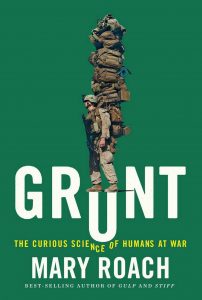
I’m reading Grunt by Mary Roach, and had to read it because I had so much fun with two of her previous books. It doesn’t disappoint.

Can you remember the first book you read by yourself?
I can’t. I’m told that I was an early reader and I believe I was reading before my hippocampus was forming permanent memories, so whatever it was is lost. My mom loaded us up with the Little Golden Readers, so it was probably Scuffy the Tugboat by Gertrude Crampton or The Little Engine That Could by Watty Piper or very possibly a Dr. Seuss.


Are you a page folder or a bookmarker?
Page folder. Sorry. I know, I suck.
When did you fall in love with reading?
Fourth grade, I bought Island at the Top of the World by Ian Cameron because, in the little catalogue they passed out in class, the book had photos from the new Disney movie on the jacket. I thought that looked cool. Initially, I was terribly disappointed that the book was so different from the movie, but I very quickly learned that it was far, far better than the movie. It remains one of the great adventure novels I’ve ever read.
Recently I tracked down a copy bearing its original pre-movie-adaptation title, The Lost Ones, before Disney defaced it. That’s the one I keep on my shelf.
If you could gift yourself books at age 16 and age 25 – what would they be and why?
I think at 16 I would have taken books away and made myself get out into the world more! But at 25 I was in the midst of wasting the better part of a decade writing for TV and movies in Hollywood – largely unsuccessfully, of course. Although I don’t discount the value of the experience gained, I think the time could have been better spent if I’d veered into science sooner. I would have given myself the books discussed below, and gotten myself kickstarted on my current career sooner.
What are perfect reading conditions for you?
An empty slot on my calendar! Which is sadly all too hard to come by. I think I read best with earplugs in a noisy environment. For me, that builds a more solid wall between myself and any distractions. Other than that, it doesn’t really matter. Feet up is good.
For someone starting out in your career, which three books would you make required reading and why?
To get people excited about teaching and communicating science and scientific thinking, you have to introduce them to it being done well. But that’s best done in articles and shorter papers. What we can do with books, though, is hear the stories of people who have been writing those articles.
I will start with the standard, that almost all of my colleagues would include, and that’s The Demon Haunted World: Science as a Candle in the Dark by Carl Sagan. That’s the best way to shake people and let them know that there’s a whole world they’ve been missing simply because they’ve been going with the flow and not seeing the world through the lens of scientific skepticism.
Next, I would give them Fads and Fallacies in the Name of Science by Martin Gardner. Gardner illuminates some fraud in pop culture that we all recognize, and then you flip back to the title page and realize the book was written almost 70 years ago! And you realize how little things have changed, and that the human mind is always the human mind.
Beyond those, you can go in a lot of different directions. One direction that I thoroughly enjoyed was Predictably Irrational by Dan Ariely. Dan is a behavioural economist and one of my favourite guys, and he gives really fun descriptions of the sociological experiments his lab has conducted and why it’s so easy to understand how foolish people insist on being. A great wakeup call.
- The Demon Haunted World: Science as a Candle in the Dark by Carl Sagan
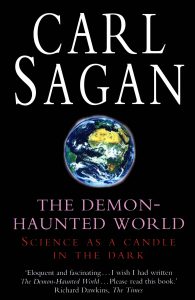 The Demon Haunted World: Science as a Candle in the Dark by Carl Sagan
- Fads and Fallacies in the Name of Science by Martin Gardner
 Fads and Fallacies in the Name of Science by Martin Gardner
- Predictably Irrational by Dan Ariely
 Predictably Irrational by Dan Ariely
If you could invite 5 authors (dead or alive) to a dinner party – who would they be and why?
Mark Twain has to be at the top of any such list, not just because he’d be a lot of fun and I’ve enjoyed his work so much, but because I would hope and expect to glean some new nugget of human insight from him. He was the most incisive critic of human folly we’ve had.
I think I would use up the rest of my five by taking advantage of those who do what I’m trying to do, and doing it more successfully. I’d grab Ed Yong (I Contain Multitudes) who is tearing it up; Mary Roach (Packing for Mars, Stiff) who successfully transitioned from science writing to mass-market writing; Jennifer Oullette (The Calculus Diaries) who does something I have always done: learn about something you don’t know anything about by writing a book about it; and finally JK Rowling, whose books have nothing to do with what I do, and which I’ve never read a single one of, but only because I really wish I was a super-successful fiction author like her.


What was the last book you purchased, and why did you buy it?
In my work, I buy books almost every week. I usually don’t get to read all of them, mostly just particular chapters, whatever touches on the particular point of history or science that I’m writing about. And I usually buy them in eBook form, just because I typically need them immediately. But oh, I do love it when I have the time to wait for some old print edition, and I find it used online! Sometimes they are oddball books, and it so happens that my most recent acquisition is The Canadian UFO Report by Chris A. Rutkowski and Geoff Dittman, 2006. It’s pretty painful.

What is your favourite thing about reading?
Finding that perfect turn of phrase. That’s one of the things I most admire about other authors, is when they can put together a combination of words that’s never been done before that somehow, magically, communicates so much more than do the words themselves.
What’s the best book you’ve read in the last 6 months?
The Martian by Andy Weir. It’s a true celebration of science literacy, something that I think would benefit the world tremendously if everyone had it. But most don’t, everyone’s brain is wired a little differently and most just don’t seem to have that same excitement. The world is poorer for it.

If you could insert yourself into any book, which would you pick and why?
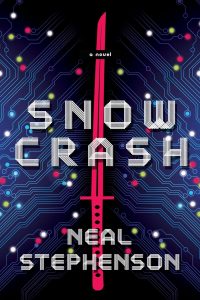
You’re basically asking how I would like to be inserted into the Matrix. And if that’s my option, then I might choose to be the character based on L. Ron Hubbard in Snow Crash by Neal Stephenson. The second choice would be the angel Satan from The Mysterious Stranger by Mark Twain. Those are two fine examples of omnipotence that we’d all enjoy.
If that’s too stereotypical, then I’d go the other way, and be Tom Neale in his autobiography An Island To Oneself, telling of his adventures living alone on a remote atoll for years and years in the South Pacific.


Name a book that you feel everyone would benefit from reading and explain why.
Flim-Flam by James Randi. Almost everyone you know fails to question so much of the pop nonsense around them, whether it’s the fact that some product they buy is snake oil, or some belief in which they invest a lot of faith is some pre-scientific esoteric mumbo jumbo. Randi doesn’t advocate for cynicism, but he does pull back a lot of curtains that will surprise a lot of readers and make them do double-takes at things they took for granted throughout their daily lives.

What is the book that you feel has had the single biggest impact on your life? What impact did it have?
The Adventures of Huckleberry Finn by Mark Twain. And I can even point to a specific moment where my horizons really expanded. I believe I was ten years old, and I’d read the book before but hadn’t been aware of most of its subtext. In the chapter “You Can’t Pray a Lie”, Huck makes the deliberate decision to do the right thing, well aware that it means he will go to hell. In that case, the decision was to stand by the unfortunate and not take the easy route of joining the bullies. Moreover, it was in contempt of what others thought he should do, including the Bible, and authority for which Huck was only beginning to lose respect. It was the first time that I think I truly drew a meaningful message from a book, and it’s one that I’ve kept in mind and tried to adapt and employ in my own life.

Which book sat on your shelf are you most excited about reading next and why?
I have had Searching for Sasquatch by my friend Brian Regal on my bedside table for probably two years. So much work-related reading gets in the way that I never get a chance to pick it up until my wife is already asleep and I’m not allowed to turn on a reading lamp. So I keep hinting for him to send me the eBook version. Don’t be fooled by its title; it’s not a book that assumes the reality of some cryptid beast. Instead, it’s a history of the fascinating personalities who have made up that part of our culture. Understanding the people involved is always the best way to understand any story.

If you’d like to learn more about Brian Dunning, you can find him on his website, Facebook and Twitter.
As an Amazon Associate we earn from qualifying purchases made through links on this page.
You might also like
Jim Al-Khalili: A Scientific Perspective
Interview · 7 November 2019
Paul Williams: A life immersed in creative writing
Interview · 27 April 2025
Pedro Domingos: Exploring the Nexus of Reading and AI Innovation
Interview · 31 May 2023
Kim Brown Seely: A Shared Connection with Humanity
Interview · 2 January 2021