
The Best Books About Space Exploration
In this list
9 books
- Atmosphere · Taylor Jenkins Reid Taylor Jenkins Reid’s
- The Right Stuff · Tom Wolfe While
- Hidden Figures · Margot Lee Shetterly Another
- Orbital · Samantha Harvey This
- The Martian · Andy Weir While
- Packing for Mars · Mary Roach Bestselling
- From the Earth to the Moon · Jules Verne No
- Rocket Boys (The Coalwood Series #1) · Homer H. Hickam Jr. This
- Apollo 8: The Thrilling Story of the First Mission to the Moon · Jeffrey Kluger Kluger’s
There’s something magical about stories that take us beyond Earth’s atmosphere. Whether it’s the triumph of human ingenuity, the romance of discovery, or the raw courage of those who dare to venture into the unknown, space exploration has captured our collective imagination for decades. While history books give us the facts, it’s through fiction and fictionalized accounts that we often truly feel the heart-pounding excitement, the profound loneliness, and the breathtaking wonder of reaching for the stars.
From intimate character studies of astronauts to sweeping tales of the space race, the books listed below offer something for every reader who’s ever looked up at the night sky and wondered “what if?”

Taylor Jenkins Reid’s 2025 historical fiction romance takes us into NASA’s Space Shuttle program in the early 1980s, following Joan Goodwin as she fights to become one of the first female astronauts. The story cuts back and forth between a disaster in 1984 and Joan’s journey through the space program, with Reid keeping the tension high in what may be her most propulsive novel yet. This fast-paced, emotionally charged story follows one ambitious young woman finding both her voice and her passion in the male-dominated world of NASA.
What makes Atmosphere particularly compelling is Reid’s signature ability to blend personal drama with historical setting. The novel balances Joan’s professional challenges as a woman breaking barriers in aerospace with her personal relationships and romantic life. Reid has a gift for making historical periods feel immediate and alive, and her portrayal of the dedication, sacrifice, and sheer determination required to reach space will leave you both inspired and emotionally invested in Joan’s journey to the stars.

While technically nonfiction, Wolfe’s masterpiece reads like the most gripping novel you’ve ever encountered. This Pulitzer Prize-winning book chronicles the early days of the U.S. space program and the test pilots who became America’s first astronauts. Wolfe’s distinctive narrative style brings these larger-than-life figures down to earth while simultaneously elevating them to mythic status.
The book captures the unique blend of arrogance, courage, and technical skill that characterized the men who first broke the sound barrier and later ventured into space. Wolfe doesn’t just tell you what happened; he makes you feel the weight of those early rockets, the tension in Mission Control, and the almost reckless bravery required to strap yourself to what was essentially a controlled explosion. It’s essential reading for anyone who wants to understand the cultural and psychological landscape that made the space race possible.

Another “nonfiction that reads like fiction” entry, Hidden Figures tells the previously untold story of the African American women mathematicians who played crucial roles in NASA’s early space missions. Katherine Johnson, Dorothy Vaughan, and Mary Jackson were brilliant minds working behind the scenes during some of the most pivotal moments in space exploration history.
Shetterly’s storytelling transforms complex mathematical concepts and bureaucratic struggles into a page-turning narrative about determination, intelligence, and breaking through multiple barriers of discrimination. The book reveals how these women’s calculations literally helped put Americans in space, while they themselves were fighting for basic recognition and equality. It’s both a celebration of unsung heroes and a fascinating look at the human computers who made space travel possible before electronic computers took over.

This contemplative novel won the prestigious Booker Prize in 2024 — the first book set in space to achieve this honor. Taking place over the course of one day aboard the International Space Station, the novel follows six astronauts and cosmonauts as they orbit Earth sixteen times in twenty-four hours. At just 136 pages, this compact yet beautifully expansive novel invites us to observe Earth’s splendor while reflecting on the individual and collective value of every human life.
Harvey’s prose is both beautiful and meditative, offering readers a unique perspective on what it might feel like to watch sixteen sunrises and sunsets in a single day while suspended between Earth and the cosmos. Rather than focusing on dramatic space adventures, Orbital examines the psychological and philosophical impact of seeing our planet from above. The book captures both the routine nature of life aboard a space station and the profound sense of perspective that comes with observing our “silent blue planet” from space.

While technically science fiction, Weir’s debut novel is grounded in such realistic scientific detail that it feels like a fictionalized account of a very possible future mission to Mars. The story follows astronaut Mark Watney, who is stranded on Mars and must use his ingenuity, humor, and scientific knowledge to survive until rescue is possible.
What makes The Martian special is its perfect balance of technical accuracy and human emotion. Weir doesn’t dumb down the science, but he presents it through Watney’s witty, determined voice in a way that makes complex problem-solving genuinely exciting. The book captures both the isolation of being truly alone in space and the incredible resourcefulness of the human spirit. It’s a love letter to scientific thinking and problem-solving, wrapped up in a survival story that will keep you turning pages late into the night.

Bestselling science writer Mary Roach brings her signature humor and curiosity to the realities of space travel in this delightfully irreverent look at what it’s really like to be an astronaut. While based on real experiences and extensive research, Roach’s storytelling approach reads like fiction, making even the most mundane aspects of space travel fascinating and often hilarious.
From the challenges of using the bathroom in zero gravity to the psychological effects of long-duration spaceflight, Roach covers the aspects of space exploration that more serious accounts often skip. Her book demystifies the experience of being an astronaut while maintaining a deep respect for the people who choose this extraordinary career. It’s both educational and entertaining, perfect for readers who want to understand the human side of space exploration without getting bogged down in technical details.

No list of space exploration fiction would be complete without the grandfather of space travel literature. Verne’s 1865 novel was remarkably prescient, predicting many aspects of actual lunar missions more than a century before they happened. While the science is outdated by today’s standards, the spirit of adventure and human curiosity remains timeless.
Reading Verne today offers a fascinating glimpse into how our ancestors imagined space travel, and it’s remarkable how many of his predictions proved accurate. The book captures the excitement and ambition that would eventually lead to the real space race, and Verne’s sense of wonder and possibility remains infectious. It’s both a historical curiosity and a rollicking adventure story that helped inspire generations of scientists and dreamers.
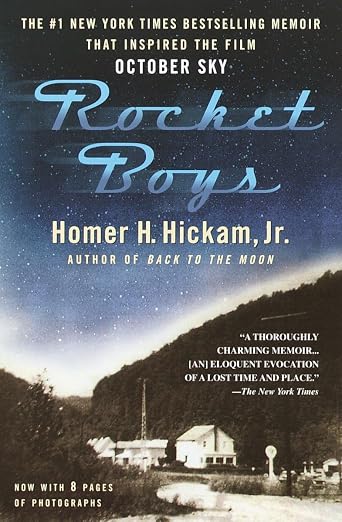
This memoir reads like the most inspiring coming-of-age novel you’ve ever encountered. Hickam tells the true story of how he and his friends in a small West Virginia mining town became obsessed with building rockets after watching Sputnik cross the sky in 1957. What started as teenage experimentation eventually led Hickam to become a NASA engineer, making this both a personal story and a testament to the power of the space program to inspire young minds.
The book captures the excitement of the early space age from the perspective of ordinary Americans watching history unfold above their heads. Hickam’s storytelling brings small-town 1950s America to life while showing how the space race sparked imagination and ambition in the most unlikely places. It’s a celebration of curiosity, determination, and the American dream, wrapped up in the very real story of how a coal miner’s son reached for the stars and achieved his goals.
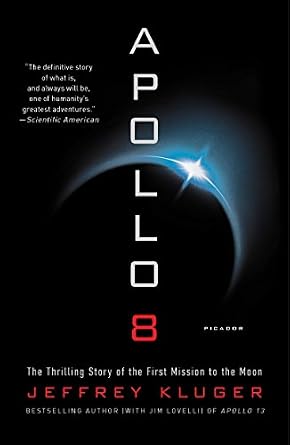
Kluger’s masterful account of the Apollo 8 mission reads like a thriller, even though we know how it ends. This was the first human mission to leave Earth’s orbit and travel to the Moon, a bold and dangerous gamble that NASA took in December 1968. The book follows astronauts Frank Borman, James Lovell, and William Anders as they become the first humans to see the far side of the Moon and capture the iconic “Earthrise” photograph.
What makes this book special is Kluger’s ability to convey both the technical complexity and the human drama of this historic mission. He brings the reader inside Mission Control and the spacecraft itself, making you feel the weight of the risks these men were taking and the magnitude of what they achieved. The book captures a pivotal moment in space exploration when NASA took a leap of faith that changed our perspective on Earth and our place in the universe forever.
These books remind us that space exploration is ultimately a deeply human endeavor. Whether they’re telling the stories of real pioneers who risked everything to push the boundaries of what’s possible, or imagining future adventures among the stars, the authors capture something essential about our species’ irrepressible urge to explore and discover.
Each of these books offers a different window into the world of space exploration, from the technical challenges and personal sacrifices to the moments of transcendent beauty and profound discovery. They remind us that behind every rocket launch, every orbital mission, and every step on an alien surface, there are human beings driven by curiosity, courage, and the simple desire to see what’s out there.
As an Amazon Associate we earn from qualifying purchases made through links on this page.
You might also like

The Best Books for Fans of Taylor Jenkins Reid
Reading list · 21 February 2026
Brian Dunning: That Perfect Turn Of Phrase
Interview · 3 November 2017

Books Like Project Hail Mary: 10 Science Fiction Novels to Read Next
Reading list · 3 November 2026

The Best Books for Fans of Colleen Hoover
Reading list · 30 August 2025