The Best Economics Books for Beginners
In this list
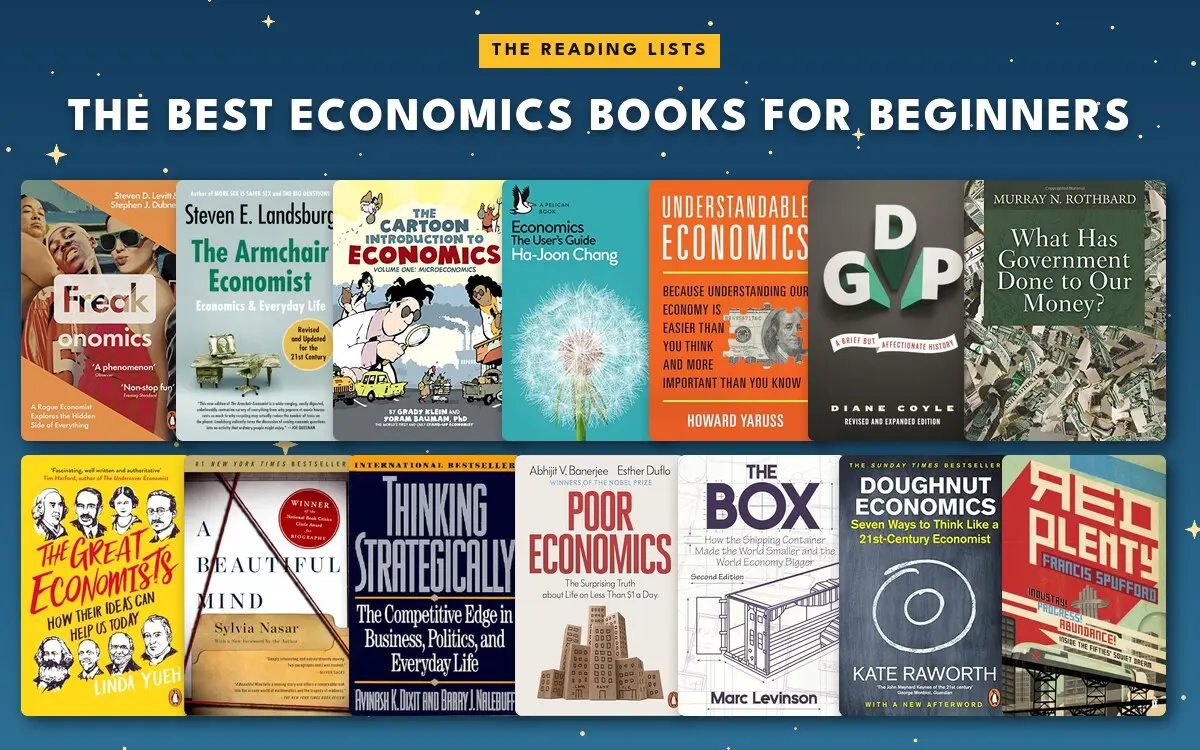
18 books
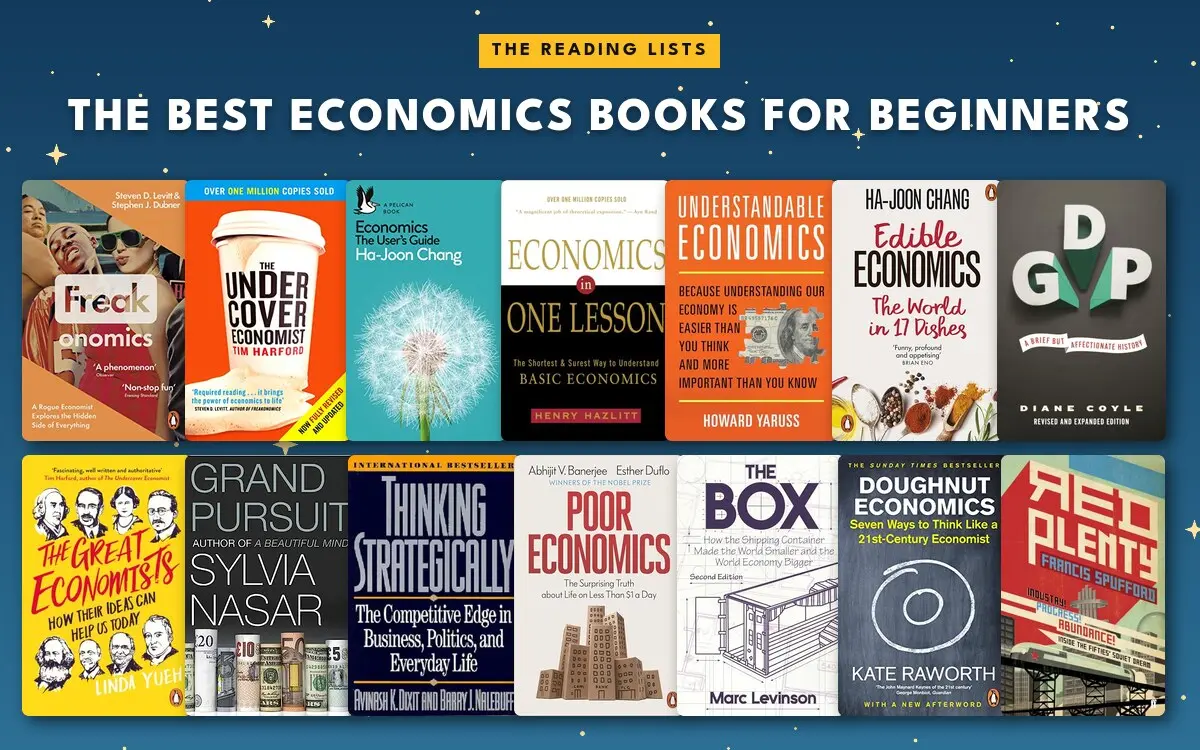
- Freakonomics · Steven D. Levitt and Stephen J. Dubner
- The Undercover Economist · Tim HarfordRecommended 5 times
- The Armchair Economist · Steven E. Landsburg
- The Cartoon Introduction to Economics: Microeconomics · Grady Klein and Yoram Bauman
- Economics: The User's Guide · Ha-Joon Chang
- Economics in One Lesson · Henry Hazlitt
- Understandable Economics · Howard Yaruss
- Edible Economics · Ha-Joon Chang
- GDP: A Brief but Affectionate History · Diane Coyle
- What Has Government Done to Our Money? · Murray N. Rothbard
- The Great Economists · Linda Yueh
- Grand Pursuit · Sylvia Nasar
- A Beautiful Mind · Sylvia Nasar
- Thinking Strategically · Avinash K. Dixit and Barry J. NalebuffRecommended 4 times
- Poor Economics · Abhijit V. Banerjee and Esther Duflo
- The Box · Marc Levinson
- Doughnut Economics · Kate RaworthRecommended 3 times
- Red Plenty · Francis Spufford
Economics shapes almost everything: what we pay for food and housing, whether we can find work, how governments tax and spend, and why some countries are rich while others stay poor. But most economics books are long, dry or full of equations. These are the best economics books for beginners: readable, often funny introductions that need no maths and no background in the subject.
We asked a panel of economists and economics writers, including Tim Harford, Linda Yueh and Soumaya Keynes, which books they would recommend to someone starting out. Their recommendations are below, together with a few newer favourites, grouped by what you want to learn.
What makes a good economics book for beginners?
A good first economics book is accessible, interesting and broad. It explains ideas with stories and everyday examples rather than graphs, and it shows you how economists think: about incentives, trade-offs and the consequences you don’t see at first. It’s also worth reading more than one point of view, because economists disagree, sometimes fiercely. This list includes books from the free-market Austrian school as well as books that argue for a bigger role for the state.
Our top 3:
- Best first book on economics: Economics: The User’s Guide by Ha-Joon Chang
- Most fun introduction: Freakonomics by Steven D. Levitt and Stephen J. Dubner
- Best book on the big ideas: The Great Economists by Linda Yueh
Fun, easy introductions to economics

An economist and a journalist use economic thinking to answer strange questions, from why drug dealers live with their mothers to what sumo wrestlers have in common with schoolteachers.
What you’ll learn: How incentives shape behaviour, often in ways nobody intended, and how careful use of data can overturn common sense. It’s the book that made economics popular reading.
Linda Yueh:
Freakonomics adeptly presents the fascinating and often counter-intuitive findings from microeconomic studies for a general audience. Each chapter describes a piece of economic research, such as why drug dealers live with their mothers. The insights from these studies introduce the reader to the role of incentives, among other aspects of microeconomics. Co-written by an economist and a journalist, it is an accessible book for beginners to become familiar with microeconomics. It is about how people and organisations interact with each other, that makes up one half of the economics field. The other part is macroeconomics.
Best for: a fun first taste of economics · Published: 2005

The Financial Times columnist explains the economics behind everyday life: why your cappuccino costs what it does, how supermarkets set prices, and why some countries stay poor.
What you’ll learn: The basics of markets, prices, scarcity and competition, told through things you see every day. Harford is one of the clearest writers on economics, and this is the best place to start with him.
Best for: understanding the economics of everyday life · Published: 2005

Short, provocative chapters that apply economic logic to everyday puzzles, from why popcorn costs so much at the cinema to whether seatbelts make driving safer.
What you’ll learn: To think like an economist: that people respond to incentives, and that the obvious effect of a policy is often not the whole story.
Tim Harford:
The Armchair Economist is pugnacious and slightly dated but wonderfully clear and witty. A perfect introduction to why economics can be such fun.
Robert Murphy:
Although I am a fan of the Austrian School of economics, this selection is from a master in the Chicago School tradition. Landsburg teaches short yet powerful lessons using funny examples and memorable thought experiments.
Best for: puzzles and thought experiments · Published: 1993, revised 2012

An illustrator and a “stand-up economist” turn microeconomics into a 200-page comic, covering the optimising individual, game theory and how prices work.
What you’ll learn: The core ideas of a first-year microeconomics course, from supply and demand to competition, explained with jokes and pictures rather than equations.
Tim Harford:
The Cartoon Introduction to Microeconomics is a fun, engaging take on economic ideas – a kind of illustrated textbook and very well done.
Best for: visual learners and students · Published: 2010
How the economy works: where to start

The Cambridge economist’s friendly guide to what economics is, how the economy works and why economists disagree, written for complete beginners as part of the Pelican series.
What you’ll learn: A short history of capitalism, the main schools of economic thought from classical to Keynesian and Austrian, and the key facts about production, work, inequality and government. Chang’s message is that economics is too important to be left to economists.
Best for: a complete, balanced first course · Published: 2014

A short classic from 1946 that sums up economics in a single lesson and then applies it to minimum wages, tariffs, rent control and public spending.
What you’ll learn: To look beyond the immediate, visible effects of a policy to its long-term and unseen consequences, for everyone it affects. It’s written from a free-market point of view.
Alberto Mingardi:
“Economics in One Lesson” was first published by Henry Hazlitt in 1946. True, the examples Hazlitt uses can’t but reveal the age of the book. And yet this short work in many ways is still an unsurpassed primer in economics. Economist Deirdre McCloskey explained that “economics is the science of the post-magical age. Far from being unscientific or hoopla-hoo, it is deeply anti-magical. It keeps telling us that we cannot do it, that magic will not help.” To me, no book epitomises that better than Hazlitt’s, which relentlessly points out the misconceptions behind the application of “magical thinking” to our material life, and the tremendous dangerous it can generate.
Robert Murphy:
As the title suggests, this book literally summarizes all of economics in a single lesson, which can be stated very briefly: The good economist focuses not just on the short-run and obvious consequences of a government policy or event but traces out the long-run and unseen consequences as well. Then Hazlitt applies the lesson to numerous topics, such as the minimum wage, tariffs, and public works spending. Many readers still consider this the single best introduction to economics for the intelligent layperson.
Best for: a short, classic primer · Published: 1946

A jargon-free guide to the economy today, using analogies and real-world examples rather than formulas.
What you’ll learn: What tax cuts really do, how central banks work, whether national debt is a threat, and the benefits and drawbacks of free trade, so you can follow the news and judge economic policies for yourself.
Best for: making sense of economic news · Published: 2019

Chang explains big economic ideas through food, from garlic and anchovies to chocolate and carrots, mixing recipes and memories with free trade, inequality and climate change.
What you’ll learn: How everyday ingredients tell the story of trade, colonialism, development and work, and why economic “common sense” is often wrong. It’s the most enjoyable way into economics on this list.
Best for: food lovers · Published: 2022

A short history of the most important number in economics: how gross domestic product was invented, what it measures and what it leaves out.
What you’ll learn: How hard it is to measure an economy, and how the way we measure it shapes what governments do.
Soumaya Keynes:
In this short and accessible book, Diane Coyle (see Diane Coyle’s reading list) delves into how one of the most commonly used measures of economic activity is constructed. It’s difficult to read much about economics without coming across a mention of GDP, or gross domestic product. This book explains what it does and does not measure, and in doing so highlights its value and its shortcomings. Readers should come away with an idea of just how hard it is to measure the economy, as well as a sense of how the way we choose to do it shapes the way we look at the world, and ultimately the policy choices our governments make.
Best for: understanding the headlines about growth · Published: 2014, revised 2015

A short, combative classic on money, banking and inflation from one of the leading economists of the Austrian school.
What you’ll learn: Where money comes from, how governments and central banks change its value, and the Austrian school’s explanation of inflation and the business cycle.
Robert Murphy:
This short book combines history and economic theory. It explains to an American audience the source of inflation and the business cycle. The content is high-brow but Rothbard’s breezy style makes it feel like a true-crime story.
Best for: understanding money and inflation · Published: 1963
The great economists and their big ideas

Twelve great economists, from Adam Smith and Karl Marx to John Maynard Keynes and Douglass North, and what their ideas can teach us about today’s problems. Published in the US as What Would the Great Economists Do?
What you’ll learn: The ideas that built modern economics, through short biographies, and how each thinker might answer a question we face now, such as whether we face a slow-growth future.
Linda Yueh:
My book was written to introduce the economic ideas that have changed the world to a general audience, so although it is awkward to select one’s own work, it is an accessible introduction to macroeconomics. Macroeconomics is about how the economy operates and what drives growth and prosperity. This book makes this subject easy to comprehend by introducing the reader to the colourful lives of the great economists who had come up with the ideas that have transformed the way that we live and can help with our current challenges.
Each chapter tackles a big question in a bite-sized way, such as ‘do we face a slow growth future?’, so it is modular reading with short biographies of successful thinkers. It covers 250 years of history – starting with the Industrial Revolution in the 18th century all the way to how technology and the digital age affect our lives in the 21st century.
Best for: an introduction to macroeconomics · Published: 2018

The author of A Beautiful Mind tells the story of economics through the lives of the people who made it, from Karl Marx to Milton Friedman.
What you’ll learn: How economic ideas grew out of their times, and how the economists who had them were shaped by their own lives and failings.
Soumaya Keynes:
This is a wonderfully written series of portraits of some of the most famous economists, from Karl Marx to Milton Friedman. It weaves together stories of their lives with explanations of their ideas, showing the importance of historical context for understanding why they thought what they did. It also highlights how these great men and women studying society were human themselves, shaped by their personal experience and vulnerable to very human failings. It’s pretty long but worth the investment – it’s the book I most wish I had read before studying economics.
Best for: history lovers · Published: 2011

The biography of John Nash, the mathematician whose work on game theory won him the Nobel Prize in economics, and whose struggle with schizophrenia became an Oscar-winning film.
What you’ll learn: The basic ideas of game theory, the study of strategic decisions, through a moving human story.
Linda Yueh:
Game theory is an important branch of economics that has broad applications to conflict resolution, politics, and other practical areas. This biography by a journalist of the Nobel Prize-winning economist John Nash is a great introduction to this field. Nash’s pioneering work was in non-cooperative games, e.g., when players are in competition and there is no authority figure to oversee their interactions, which is often the case in real life. Nash suffered from paranoid schizophrenia which delayed recognition for his many contributions. His redemption forms the heart of this book and the movie that it inspired, starring Russell Crowe. Game theory is mathematical and difficult for beginners, so this biography is an accessible introduction to this field. Biographies can be a good entrée into a new subject, and this one would work well for beginners.
Best for: a way into game theory · Published: 1998

Two economists teach game theory without the maths, using examples from sport, business, politics and even dating.
What you’ll learn: How to think strategically when other people are thinking too: when to cooperate, when to bluff, and how to make threats and promises others believe.
Tim Harford:
Thinking Strategically is the book that really made me fall in love with economics. Using economics to understand sport, business and even dating.
Best for: strategy and game theory · Published: 1991
Economics in the real world

Two Nobel Prize-winning economists ask what really helps the world’s poorest people, using evidence from experiments around the world. Now revised, with two new chapters.
What you’ll learn: How randomised controlled trials test which anti-poverty policies work, and why the poor make the choices they do.
Soumaya Keynes:
This book asks one of the most fundamental questions within economics, which is how to help poor people get richer. Economists Abhijit Banerjee and Esther Duflo describe results from “randomised control trials”, a way to uncover just how poverty-busting policies really are. Without them, they explain, it can be easy to make bad assumptions about what really helps the poorest, and even well-meaning interventions can have nasty consequences. Readers should come away with a sense of how economists marshall data and careful thinking to solve practical problems, as well as a thoroughly shaken set of assumptions about how the world works.
Best for: development and global poverty · Published: 2011, revised 2025

The surprisingly gripping story of the shipping container, and how a simple metal box transformed trade and globalisation.
What you’ll learn: How one innovation changed where things are made and how cheaply they travel, and the battles with unions, ports and regulators it took to get there.
Alberto Mingardi:
The Box: How the Shipping Container Made the World Smaller and the World Economy Bigger by Mark Levinson is not a book in economic theory. It is a historical reportage, focused on the development of the container, including the regulatory struggles which almost thwarted its success. This is a book on an apparently mundane topic, that forces us to look at innovations, how they succeed, how they are confronted, not in abstract term but in the concrete circumstances of history. Those among us with antiquary passions may enjoy Samuel Smiles’s biographies of great inventors, like his splendid “Men of invention and industry” (1884). Levinson’s book is as close as you can get to a contemporary equivalent of those.
Best for: understanding globalisation · Published: 2006, second edition 2016

An Oxford economist argues that economics needs a new goal: meeting everyone’s needs without overshooting what the planet can bear.
What you’ll learn: Seven ways to think like a 21st-century economist, and why endless GDP growth is the wrong target. A readable, hopeful challenge to the textbooks.
Best for: economics and the environment · Published: 2017

Part novel, part history: linked stories about the Soviet Union’s dream of a planned economy that would out-produce the West in the 1950s and 1960s.
What you’ll learn: Why central planning ran into trouble, told through the planners, scientists and ordinary people who lived with it.
Alberto Mingardi:
One great debate in the social sciences, in the 20th century, was the socialist calculation debate. An Austrian economist, Ludwig von Mises, in the early 1920s made the argument that socialism couldn’t work, as it got rid of private property in the means of production and therefore made price formation through by the bargaining in the market impossible. This leads to a terrible allocation of resources. After Mises started it, the debate was vivid and harsh and saw many a great economist taking sides and learning from each other.
Now that the Soviet Union had a planned economy is somewhat a vague memory and for most of the young people not even that. “Red Plenty” by Francis Spufford is a beautiful collection of stories that highlight the nature of economic planning in Russia in the 1950s and 1960s, its leadership’s struggle to overcome the most obvious shortcomings and explain how they affected the common people’s everyday life. This novel is a beautiful read and has quite a few economic lessons for the readers.
Best for: readers who prefer stories · Published: 2010
Economics books for beginners: FAQs
What is the best economics book for beginners?
For a complete, balanced introduction, start with Economics: The User’s Guide by Ha-Joon Chang. If you’d rather start with something light and fun, Freakonomics or Tim Harford’s The Undercover Economist will get you hooked.
How should a beginner start learning economics?
Start with one readable overview, such as Chang’s Economics: The User’s Guide, then follow your interests: Freakonomics-style books for everyday puzzles, The Great Economists for the big ideas, or Poor Economics for real-world policy. Reading the economics pages of a good newspaper alongside will help the ideas stick.
What’s the difference between microeconomics and macroeconomics?
Microeconomics is about how individuals and businesses make decisions and how markets set prices. Macroeconomics is about the economy as a whole: growth, unemployment, inflation and what governments and central banks do. Freakonomics and The Cartoon Introduction to Economics are good on micro; The Great Economists and GDP are good on macro.
Do I need to be good at maths to read economics books?
No. Every book on this list is written for general readers and uses little or no maths. University economics does use a lot of maths, but you can understand the main ideas without it.
Which economics books do economists recommend for beginners?
Our panel’s most recommended books were Economics in One Lesson, The Armchair Economist and Freakonomics. Tim Harford says Thinking Strategically is the book that made him fall in love with economics, and Soumaya Keynes says Grand Pursuit is the book she most wishes she had read before studying economics.
Are old economics books still worth reading?
Yes. Economics in One Lesson (1946) and What Has Government Done to Our Money? (1963) still explain core ideas clearly, even if their examples are dated. Pair a classic with a newer book like Edible Economics or Doughnut Economics to see how the debate has moved on.
Meet the expert panel
We asked a panel of economists and economics writers which books they would recommend as the best economics books for beginners.

Tim Harford
Tim Harford is a senior columnist for the Financial Times, a bestselling author and a broadcaster. His books include The Undercover Economist, which is also the name of his FT column in which Tim shares economic ideas behind everyday experiences. Tim is a believer that the power of economics can be used for good and has made his case in all of his speaking performances, including at TED and Sydney Opera House.

Soumaya Keynes
Soumaya Keynes is an economics columnist at the Financial Times and was previously US economics editor at The Economist. She did research on the public finances and pensions at the Institute for Fiscal Studies, and has an M.Phil. and B.A. in Economics from Trinity College, Cambridge.

Robert Murphy
Robert Murphy is an economist, consultant and author, and a senior fellow at the Ludwig von Mises Institute. He has worked with the Institute for Energy Research, the Independent Institute and the Pacific Research Institute. Robert received a BA in economics at Hillsdale College in 1998 and a Ph.D. in economics at New York University in 2003.

Linda Yueh
Linda Yueh is Fellow in Economics at St Edmund Hall, Oxford University, and Adjunct Professor of Economics at London Business School. Previously, she was Chief Business Correspondent for BBC News and host of Talking Business with Linda Yueh for BBC TV, and Economics Editor and anchor at Bloomberg TV. Her books include The Great Economists: How Their Ideas Can Help Us Today.

Alberto Mingardi
Alberto Mingardi is Director General of the Italian free-market think tank Istituto Bruno Leoni and teaches the history of political thought at IULM University in Milan. He is also a Presidential Scholar in Political Theory at Chapman University and an adjunct fellow at the Cato Institute.
For more, see the most important economics books and our economics books category.
This post contains affiliate links. If you click on one and make a purchase, The Reading Lists may earn a small commission. This comes at no additional cost to you and helps keep our site running. Thanks for your support!
As an Amazon Associate we earn from qualifying purchases made through links on this page.