The Best of the Booker Prize for 2025
With just over a month until this year’s winner of the Booker Prize is announced, now is the perfect time to familiarise yourself with the shortlist and make your own prediction! Since its inception in 1969, this prestigious award has become the gold standard for literary fiction in the English-speaking world, launching careers, sparking debates, and introducing readers to some of the most extraordinary storytelling of our time.
What began as the Booker-McConnell Prize (named after its founding sponsor) has evolved into simply “the Booker Prize,” but its prestige has only grown. Originally open only to writers from the Commonwealth, Ireland, and Zimbabwe, the prize expanded in 2014 to include any writer of any nationality, as long as their work is written in English and published in the UK or Ireland. This shift transformed it into a truly global celebration of fiction, bringing diverse voices and perspectives to the forefront of literary conversation.
What makes the Booker so special? It’s not just the £50,000 prize money (though that certainly helps). It’s the way it consistently identifies novels that push boundaries, challenge readers, and stand the test of time. Past winners read like a who’s who of contemporary literature: Salman Rushdie, Margaret Atwood, Hilary Mantel, Arundhati Roy. A Booker shortlisting alone can multiply a book’s sales tenfold and change an author’s life forever.
This year’s shortlist is particularly fascinating. The judges, led by acclaimed author Roddy Doyle, whittled down 153 submissions to just six exceptional works. What’s striking about the 2025 selection is its mix of seasoned literary heavyweights and the international scope, with authors from India, Britain, Hungary, and America making the cut. These are writers, as Doyle puts it, who are “in total command of their own store of English, their own rhythm, their own expertise.”
So, let’s take a look at each of the shortlisted books vying for this year’s crown.

Susan Choi brings us her sixth novel, a deeply personal work that spirals outward from her own experiences growing up in the Midwest. The daughter of a Korean father and a Russian-Jewish mother, Choi has crafted a story that began as a short story in The New Yorker and grew organically from there. As she describes it, the book “kind of wrote itself like a snail shell. It just kept spiraling outward in both directions.”
What makes this a contender? Choi is a master of capturing the complex terrain of identity, family, and belonging. Her writing has a way of making the personal feel universal, and in an increasingly diverse literary landscape, stories that honestly explore the immigrant experience and cultural hybridity resonate deeply with readers and critics alike.

If there’s a front-runner on this list, it might be Kiran Desai. She’s already won the Booker once, in 2006 for The Inheritance of Loss, making her the youngest winner at that time. Winning again would be a rare achievement—only a handful of authors have won the prize twice. But this isn’t just about her track record; it’s about an extraordinary novel that took nearly two decades to write.
The Loneliness of Sonia and Sunny follows two young Indians whose paths intersect and diverge over several years before they eventually fall in love. The judges describe it as “a magical realist fable within a social novel within a love story,” which gives you a sense of its ambitious, layered structure. This is a globetrotting epic that explores the Indian diaspora in America with depth, humor, and heart.
Why it could win? Desai has proven herself as one of the finest novelists of her generation, and the patience she brought to this project shows in its richness. It’s the kind of sweeping, generous novel the Booker loves to celebrate.

Sometimes a headline is all it takes to spark a novel. For Katie Kitamura, it was “A stranger told me he was my son.” That single, unsettling sentence became the seed for Audition, a novel that explores how a single encounter can completely overturn everything you understand about yourself and your place in the world.
Kitamura’s work has already caught the attention of Hollywood; a live-action adaptation starring Lucy Liu and Charles Melton is in the works. But the book stands on its own as a taut, psychologically complex exploration of identity, family, and the stories we tell ourselves.
What makes it a contender? Kitamura writes with precision and emotional intelligence. Her novels excavate the fault lines in seemingly stable lives, and Audition promises to be her most ambitious work yet, tackling questions of parenthood, truth, and the elasticity of family bonds.
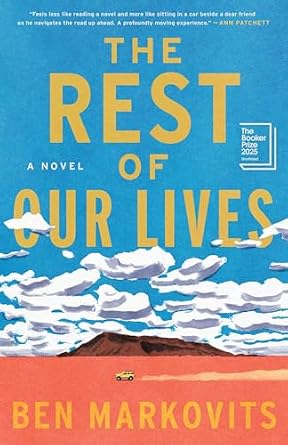
Before becoming a novelist, Ben Markovits was a professional basketball player, and perhaps that athletic discipline shows in his lean, purposeful prose. For his latest novel, he draws on a universal experience: watching your children grow up and feeling a chapter of family life coming to an end.
The judges describe The Rest of Our Lives as “a remarkably satisfying road trip full of strangers, friends, and self-discovery.” There’s something quintessentially American about the road trip novel, but in Markovits’ hands, it becomes a meditation on middle age, parenthood, and the inevitable transitions that mark our lives.
Why it could win? The Booker has increasingly recognized that “literary fiction” doesn’t mean inaccessible or obscure. This novel promises to be both deeply felt and genuinely readable, with the kind of clear-eyed wisdom about ordinary life that can feel revolutionary on the page.

Andrew Miller is no stranger to the Booker shortlist; his novel Oxygen made the cut back in 2001. Now, with his 10th novel, he returns with a story set during the UK’s Big Freeze of 1962-63, one of the coldest winters on record. The novel follows two young couples navigating not just the brutal weather, but the difficulty of loving in an unlovely world.
Miller writes with elegance and restraint, finding drama in the quiet moments and beauty in harsh landscapes. The historical setting gives him room to explore how people endure, adapt, and find connection even in the bleakest circumstances.
What makes it a contender? Miller’s consistency and craftsmanship. This is a novelist who has spent decades honing his art, and The Land in Winter represents the work of a writer at the height of his powers, turning a moment in British history into something that speaks to our current moment.
Flesh (Ed: Announced as the winner)

Like Andrew Miller, David Szalay is returning to the Booker shortlist for a second time (his first was All That Man Is in 2016). This time, he brings us to Hungary, following a young man named István from his teenage years into adulthood. It’s been described as “spare and detached on the page, lush in resonance beyond it,” a kind of immigrant bildungsroman with echoes of Albert Camus.
Szalay himself embodies the internationalism that defines modern literature. Born in Canada, he has lived in Lebanon, Belgium, and Hungary, and this geographical restlessness infuses his work with a sense of displacement and searching.
Why it could win? Szalay writes with uncommon clarity and control, creating worlds that feel lived-in and authentic. Flesh promises to be a coming-of-age story that transcends its genre, offering insights into masculinity, identity, and the immigrant experience that feel both specific and universal.
And the winner is …
The anticipation is part of the magic. All six shortlisted authors receive £2,500 and a specially bound edition of their book, but only one will walk away with the grand prize of £50,000 and, more importantly, the title of Booker Prize winner.
Mark your calendars: the winner will be announced on Monday, November 10, 2025, in a ceremony broadcast on BBC Radio 4 and livestreamed on the Booker Prizes’ social channels. It’s a night that will change one author’s life and send book lovers rushing to stores and libraries to discover what all the fuss is about.
Until then, we have six extraordinary novels to explore, each offering a different window into the human experience. Whether you’re drawn to the personal histories of Choi, the epic sweep of Desai, the psychological complexity of Kitamura, the road-trip wisdom of Markovits, the historical elegance of Miller, or the spare poetry of Szalay, this year’s shortlist promises riches for every kind of reader.
As an Amazon Associate we earn from qualifying purchases made through links on this page.