The Best Books About Pirates
In this list
15 books
- Under the Black Flag · David Cordingly
- The Republic of Pirates · Colin Woodard
- Black Flags, Blue Waters · Eric Jay Dolin
- Enemy of All Mankind · Steven Johnson
- Thomas Jefferson and the Tripoli Pirates · Brian Kilmeade
- Buccaneers of the Caribbean · Jon Latimer
- The Golden Age of Piracy · David Head
- Pirates of Barbary · Adrian Tinniswood
- Pirates and Privateers in the 18th Century · Mike Rendell
- Blackbeard: The Hunt for the World’s Most Notorious Pirate · Craig Cabell, Allan Richards and Graham A. Thomas
- Pirate Hunters · Robert Kurson
- The Invisible Hook · Peter T. Leeson
- A General History of the Pirates · Captain Charles Johnson
- Pirate Women · Laura Duncombe
- Born to be Hanged · Keith Thomson
Welcome to our article on the best books about pirates! If you’re interested in learning about the history of pirates and their impact on the world, these non-fiction books are a great place to start. From tales of famous pirates such as Blackbeard and Captain Kidd, to the golden age of piracy and the role of pirates in shaping international trade, these books cover a wide range of topics related to the fascinating world of pirates.
Pirates are people who engage in maritime piracy, which is the act of stealing from or attacking ships at sea. Pirates have been active throughout history, and have been a significant force in shaping international trade and relations between countries. The most famous pirates in history include names like Blackbeard, Captain Kidd, and Anne Bonny, among others. While pirates may be romanticized in popular culture, in reality, they were often ruthless and violent individuals who posed a serious threat to ships and sailors.
Whether you’re a history buff or simply looking for a thrilling read, these books are sure to satisfy your curiosity and keep you entertained.
So let’s dive straight into the best books about pirates…

Under the Black Flag: The Romance and the Reality of Life Among the Pirates by David Cordingly is a comprehensive and engaging history of the golden age of piracy, featuring some of the most famous pirates in history such as Blackbeard, Captain Kidd, Sir Francis Drake, and Mary Read and Anne Bonny. Written by an expert on pirates, this book delves into the spellbinding truth behind the legends of these notorious seafarers, including their weapons, ships, and tactics.
In addition to its historical accuracy, Under the Black Flag is also a wildly entertaining read, with gripping accounts of high seas adventure and thrilling battles. This book is not only a definitive resource on the subject of piracy, but also a captivating and enjoyable read that is sure to appeal to anyone interested in the romanticized and often misunderstood world of pirates.
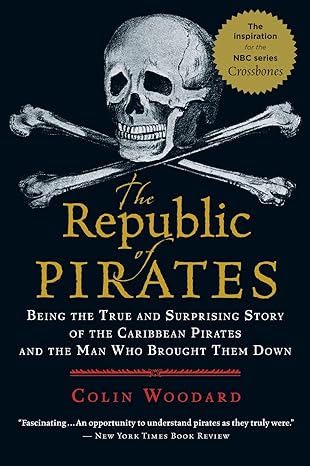
The Republic of Pirates by Colin Woodard is a historical biography of the notorious Caribbean buccaneers who established a crude but distinctive democracy in the Bahamas in the early eighteenth century. This group of pirates, known as the “Flying Gang,” included infamous figures such as Edward “Blackbeard” Teach, “Black Sam” Bellamy, and Charles Vane, as well as former sailors, indentured servants, and runaway slaves.
During this time, the Pirate Republic disrupted trade routes, raided slave ships, and created a zone of freedom in which servants were free, blacks could be equal citizens, and leaders were chosen by a vote. For a brief period, the Republic was successful and the pirates became heroes to the people. However, their success ultimately shook the foundations of the British and Spanish Empires and ultimately led to their downfall.
Using extensive research from the archives of Britain and the Americas, Woodard tells the fascinating and untold story of the Pirate Republic and its role in fanning the democratic sentiments that would later drive the American revolution. This enthralling tale is filled with intrigue, gold, treachery, and double-dealing, and has been praised as a captivating read by the Portland Press Herald.

Black Flags, Blue Waters: The Epic History of America’s Most Notorious Pirates by Eric Jay Dolin is a captivating and dramatic exploration of the “Golden Age” of American piracy, spanning the late 1600s to the early 1700s. During this time, lawless pirates roamed the coastal waters of North America and beyond, and the book tells the surprising history of their exploits and the ways in which they were supported and opposed by American colonists.
Dolin, a best-selling author and expert on the subject, uses engaging storytelling and careful research to bring to life the star pirates of this period, including Blackbeard, Captain Kidd, and the sadistic Edward Low. Through a series of thrilling episodes filled with both roguish glamour and extreme brutality, he paints a nuanced and complex picture of these seafaring outlaws, upending popular misconceptions and cartoonish stereotypes.
Set against the backdrop of the Age of Exploration, Black Flags, Blue Waters is a “tour de force history” that offers a unique and exciting look at the precarious nature of American colonial life through the lens of piracy. Filled with surprising tales of vicious mutineers, imperial riches, and high-seas intrigue, this book is sure to appeal to those who are adventure-hungry and interested in the rich history of American piracy.

Enemy of All Mankind: A True Story of Piracy, Power, and History’s First Global Manhunt by Steven Johnson is a thrilling and suspenseful account of one of the most notorious pirates in history, Henry Every, and the impact of his crimes on the global economy. From the bestselling author of The Ghost Map and Extra Life, this book tells the story of Every’s attack on an Indian treasure ship and its far-reaching repercussions.
The press published wildly popular—and often inaccurate—reports of Every’s nefarious adventures, and the British government offered large bounties for his capture. However, Johnson argues that Every’s lasting legacy was his role in triggering a major shift in the global economy, and he uses the pirate’s story to explore the emergence of the East India Company, the British Empire, and the modern global marketplace.
In the same vein as Johnson’s classic nonfiction historical thriller The Ghost Map, Enemy of All Mankind is a “thoroughly engrossing” and densely interconnected tale that traces the path from a single struck match to a global conflagration. This is the gripping story of one of the most lucrative crimes in history, the first international manhunt, and the trial of the seventeenth century.

Thomas Jefferson and the Tripoli Pirates: The Forgotten War That Changed American History by Brian Kilmeade is the dramatic and little-known story of how America’s third president stood up to intimidation and the challenges posed by four Muslim powers. When Jefferson became president in 1801, American merchant ships were under attack by pirates from North Africa who captured American sailors and held them as slaves, demanding exorbitant ransom and tribute payments.
Unable to negotiate with the leaders of the Barbary states, who believed their religion justified the enslavement and plunder of non-Muslims, Jefferson decided to take action. He sent the newly established U.S. Navy and a detachment of Marines to blockade Tripoli, launching the Barbary Wars and marking America’s journey towards becoming a superpower.
Kilmeade and Yaeger bring this nearly forgotten slice of history to life through a series of suspenseful episodes, including Lieutenant Andrew Sterett’s cannon battle at sea, Lieutenant Stephen Decatur’s daring harbor raid, and General William Eaton’s 500-mile march from Egypt to Derne, where the Marines launched a surprise attack and raised the American flag in victory on foreign soil for the first time. This New York Times bestseller is a must-read for anyone interested in American history and the rise of the nation as a global superpower.

Buccaneers of the Caribbean: How Piracy Forged an Empire by Jon Latimer is a fascinating history of the seventeenth-century sea raiders known as buccaneers who controlled the Caribbean. Unlike pirates, buccaneers were privateers, licensed by the governments of England, France, and Holland to attack the Spanish in order to protect their New World colonies.
Latimer tells the story of these men, who followed few rules as they forged new empires and conducted daring raids, through the accounts of figures such as William Dampier, Sieur Raveneau de Lussan, Alexander Oliver Exquemelin, and Basil Ringrose. He portrays a world of madcap adventurers, daredevil seafarers, and dangerous rogues, who were often engaged in semi-legal private warfare with the approval of London, Paris, and Amsterdam.
The buccaneers played a significant role in shaping the Caribbean, from the switch from tobacco to sugar production, to their involvement in the slave trade and the growth of European empires. Latimer vividly describes the dramatic events of this time period, including Piet Hein’s capture of the Spanish treasure fleet, Cromwell’s failed Western Design to conquer Central America, and Henry Morgan’s raid on Panama City. This book is a thrilling and evocative look at the age of the buccaneers.

The Golden Age of Piracy: The Truth Behind Pirate Myths edited by David Head is a collection of essays that shines a light on the real pirates of the Caribbean, exploring the factors that contributed to their success in the seventeenth and eighteenth centuries and the ways in which they operated their plundering ventures. This book takes a rigorous and insightful approach to the study of piracy, which is often romanticized and shrouded in myth, and delves into the enduring popularity of pirates as pop culture icons.
The essays in this book, written by experts in the field, examine the role of empires in shaping the world of pirates, the efforts of governments to combat piracy, and the factors that led to its decline. They also delve into the ideas of gender and sexuality surrounding pirate stories, the fad for hunting pirate treasure, and the construction of pirate myths. Through these engaging and thought-provoking essays, readers will gain a new understanding of the dangerous men, and a few dangerous women, who terrorized the high seas.

Pirates of Barbary: Corsairs, Conquests and Captivity in the Seventeenth-Century Mediterranean by Adrian Tinniswood is a thrilling and entertaining exploration of the colorful and legendary pirates who operated in the Mediterranean during the seventeenth century. Although it might be easy to think of pirating as a romanticized way of life from the past, pirates have existed throughout history and reached the height of their power during the 1600s, when the Mediterranean was a hub of international trade.
In this book, Tinniswood, a historian and author, brings to life the exciting and surprising history of these pirates, showing how they were the scourge of Europe and how their legacy has shaped the modern world. He reveals the true story of these pirates, known as Barbary corsairs, and their role in shaping the Mediterranean and the world beyond it. From the bloody raids to the daring escapes, Pirates of Barbary is a “bloody good entertainment” that is sure to captivate readers interested in this fascinating period of history.

Pirates and Privateers in the 18th Century by Mike Rendell is a captivating exploration of the lives of the buccaneers who were feared by merchants in the eighteenth century. The book delves into the lifestyle of these pirates, examining the events that led to a “gold rush” of piracy, such as the sinking of the Spanish treasure fleet off the coast of Florida. It also looks at the role of individual island governors, such as Woodes Rogers in the Bahamas, in bringing piracy under control.
In addition to examining the historical reality of piracy, the book also looks at how the popular depiction of pirates in literature, plays, songs, and films has transformed thieves and murderers into swashbuckling heroes. It also considers the myth of buried treasure and provides a lively account of many of the pirates who dominated the so-called “Golden Age” of Piracy. Pirates and Privateers in the 18th Century is a must-read for anyone interested in the thrilling and often murky world of piracy.

Blackbeard by Craig Cabell, Allan Richards, and Graham A. Thomas is a new study that looks at the legend of Edward Teach Blackbeard, one of the most famous pirates of the so-called golden age of piracy. Through extensive research, the authors seek to uncover the man behind the legend and provide a clear historical perspective on Blackbeard and his times.
The book focuses on the roles played by Alexander Spotswood, the Governor of Virginia, and Lieutenant Robert Maynard of HMS Pearl in the pursuit of Blackbeard. It tells the story of how the hunt for Blackbeard was orchestrated, how he was tracked down, and the final fight in which he lost his life. Along the way, it also provides insight into the nature of piracy and the naval operations launched against it.
With vivid detail and fresh research, Blackbeard is a compelling read that brings to life the pursuit of the notorious pirate and the larger-than-life characters who played a part in this extraordinary story.

Pirate Hunters by Robert Kurson is a thrilling adventure that combines danger, deep-sea diving, historic mystery, and suspense. It tells the story of John Chatterton and John Mattera, two men who are willing to risk everything to find the Golden Fleece, the ship of the infamous pirate Joseph Bannister. Despite his notoriety during the Golden Age of Piracy in the seventeenth century, Bannister’s story and ship have been lost to history. If Chatterton and Mattera succeed in finding the Golden Fleece, it will be only the second time ever that a pirate ship has been discovered and positively identified.
However, the search for Bannister’s ship is not easy. The two men must use cutting-edge technology and travel the globe in search of historic documents and accounts of the pirate’s exploits. They must also face down dangerous rivals, navigate the tides of nations and governments, and confront experts. In order to succeed, they must learn to think and act like pirates themselves.
Filled with suspense and filled with fascinating characters, history, and adventure, Pirate Hunters is a fast-paced, unputdownable story that goes deep to discover long-lost truths and souls. It has been named one of the best books of the year by the Chicago Tribune and has received praise for its captivating story.

The Invisible Hook is a unique exploration of the world of pirates, using economics to understand and explain the behavior of these notorious seafarers. Through the stories of legendary pirate captains like Blackbeard and Calico Jack Rackam, author Peter Leeson delves into the customs and practices of pirates and argues that their seemingly chaotic and violent ways were actually driven by rational economic decisions.
In this engaging and entertaining book, Leeson also shows how pirates were pioneering figures, implementing early systems of workers’ compensation and democracy, and even practicing racial tolerance and equality. By illuminating the hidden economics behind pirate behavior, The Invisible Hook offers a fresh perspective on these notorious figures and their place in history.

In A General History of the Pirates, Captain Charles Johnson provides detailed accounts of the lives and exploits of various pirates during the late seventeenth and early eighteenth centuries. These accounts, which include information on the pirates’ backgrounds, appearance, and modus operandi, paint a vivid picture of the pirate lifestyle and help to illustrate the dangers and excitement of life on the high seas.
The book also examines the motivations of these pirates, and delves into the social and economic conditions that contributed to their rise to fame. Overall, A General History of the Pirates is a classic work that has had a lasting impact on popular perceptions of pirates and remains an important resource for those interested in the history of piracy.

Pirate Women is a groundbreaking exploration of the female pirates who have played a significant role in naval history, yet have often been overlooked and forgotten. Through a combination of extensive research and captivating storytelling, author Laura Duncombe brings to light the stories of these daring women, from ancient Norse warriors to Cheng I Sao, who commanded a fleet of 400 ships off China in the early 19th century.
The book not only tells the tales of these female swashbucklers, but also delves into the motivations and biases of the mythmakers who have recorded and passed down their stories through the ages. Duncombe examines how history is shaped and changes depending on who is recording it, making Pirate Women a unique and thought-provoking read.
Pirate Women is the first comprehensive survey of its kind, offering a wealth of exciting adventures and a new perspective on naval history. By pulling these women out of the shadows and into the spotlight they deserve, Duncombe has created a must-read for anyone interested in pirates, history, or the stories of strong and fearless women.

Born to be Hanged tells the story of a group of over 300 pirates who set out on a mission to raid the Pacific coastline and plunder Spanish gold in the 1680s, during the Golden Age of Piracy. Led by Captain Henry Morgan, the group crosses Panama on foot and attacks the Spanish Main in a series of daring assaults, becoming legends in the process.
Along the way, they evade Indigenous tribes, Spanish conquistadors, and even their own countrymen, all while facing the possibility of being hanged if captured. Keith Thomson brings this thrilling tale to life with his use of novelistic prose and extensive research, including previously unknown primary sources. This book offers a unique and exciting look at one of the most incredible pirate expeditions in history.
What is the History of Pirates?
Piracy has a long and varied history, dating back to ancient times. Piracy has occurred in every part of the world and throughout history, but it has been particularly prevalent in the waters of the Caribbean, the Mediterranean, and the coast of West Africa.
During the “Golden Age of Piracy” in the late 17th and early 18th centuries, pirates were a major threat to shipping and trade in the Caribbean and the eastern coast of the American colonies. These pirates were often former sailors who had turned to a life of crime and plunder on the high seas. They were known for their violence and their flamboyant lifestyle, and they frequently flew flags with skull and crossbones to intimidate their victims.
Pirates were often motivated by greed and a desire for adventure, and they used a variety of tactics to attack and plunder ships. They would often pretend to be merchants or fishermen in order to lure ships close, and then attack and plunder them when they were close enough. They also used boarding parties to take over ships, and they were known for their brutal treatment of prisoners.
In the 19th and early 20th centuries, piracy largely declined, due in part to the efforts of navies and law enforcement agencies to stamp out the practice. However, it has continued to occur in certain parts of the world, particularly in the waters off the coast of Somalia in recent years.
Why are Pirates so Popular Now?
Pirates have always been a popular topic in literature and popular culture. It is difficult to pinpoint exactly why pirates are particularly popular at this time, but some possible reasons include the romanticized, rebellious nature of pirates, the excitement and danger associated with their lifestyle, the interesting historical context of piracy, and the widespread depiction of pirates in various forms of media.
The rebellious and adventurous aspects of pirate life can be appealing to some, and the historical context of piracy provides a rich backdrop for stories. Additionally, pirates have become a part of popular culture and have been depicted in many different forms of media, which may have contributed to their enduring popularity.
Why are Books about Pirates so Interesting?
Books about pirates can be interesting for a variety of reasons. The adventurous and often dangerous nature of pirate life can be exciting to read about, and the historical context of piracy can provide a rich backdrop for stories. Additionally, pirates are often depicted as rebels who live by their own rules and fight against authority, which can be appealing to some readers.
The romanticized portrayal of pirates in literature and popular culture may also contribute to their appeal. Finally, the stories of pirates have been told and retold for centuries, and the enduring popularity of these stories may be due to their universal themes of adventure, danger, and the search for treasure.
If you enjoyed this reading list of the best books about pirates, you may also enjoy our list of the best books about vikings.
As an Amazon Associate we earn from qualifying purchases made through links on this page.