The Best Books for Understanding the Middle East
In this list
10 books
- A Peace to End All Peace · David Fromkin If
- From Beirut to Jerusalem · Thomas L. Friedman Winner
- The Arabs: A History · Eugene Rogan Eugene Rogan
- The Iron Wall: Israel and the Arab World · Avi Shlaim Avi Shlaim
- The Hundred Years’ War on Palestine · Rashid Khalidi Published
- No God but God · Reza Aslan To
- Persepolis · Marjane Satrapi Not
- Orientalism · Edward W. Said First
- Lawrence in Arabia · Scott Anderson This
- The Siege of Mecca · Yaroslav Trofimov In November
The Middle East is rarely out of the headlines. The war in Gaza, Israel’s assault on Lebanon, the ongoing confrontation with Iran, the ripple effects felt in capitals around the world — it can feel overwhelming and impossible to follow. So much of what we see on the news each day has roots stretching back decades, even centuries: to the fall of the Ottoman Empire, the drawing of colonial borders, the birth of Israel, the rise of political Islam, and the complex web of rivalries and alliances that have shaped every crisis since.
Some of the world’s finest historians, journalists, and scholars have spent their careers making sense of all this, and writing about it in ways that don’t require a PhD to understand. The books on this list represent the best of that work. Some are acknowledged classics that belong on every thinking person’s shelf. Some are more recent, written in direct response to the events unfolding today. All of them are authoritative, rigorously researched, and — crucially — written with the general reader in mind.
This is not a list of polemic or propaganda. These are books by serious scholars and reporters whose work has stood up to scrutiny, earned major awards, and been praised across the political spectrum. They approach a deeply contested region with honesty, nuance, and the respect it deserves. If you’ve ever wanted to truly understand what is happening in the Middle East — and why — these are the books to start with.

If you read just one book to understand how the modern Middle East came to be, make it this one. Fromkin’s landmark 1989 history — a finalist for both the Pulitzer Prize and the National Book Critics Circle Award — traces the critical years of 1914 to 1922, when Britain and France carved up the crumbling Ottoman Empire and drew the lines on the map that created Iraq, Israel, Jordan, Lebanon, and Syria. Those lines were drawn with breathtaking ignorance, arrogance, and self-interest, and the consequences have reverberated ever since.
Fromkin writes with the pace and clarity of a great thriller, and the book reads less like a history textbook than a story of breathtaking incompetence and diplomatic double-dealing. As diplomat Richard Holbrooke wrote: “Without knowledge of its backstory, no policymaker will get the region right.” Thirty-five years after its publication, A Peace to End All Peace remains the single most essential starting point for anyone trying to understand why the Middle East looks — and bleeds — the way it does today.

Winner of the 1989 National Book Award for nonfiction, this is the book that journalist Seymour Hersh called “the only book on the Middle East you need to read.” Thomas L. Friedman, a three-time Pulitzer Prize winner, spent ten years in the region as a correspondent for UPI and The New York Times — covering the Lebanese Civil War from Beirut and the first Palestinian Intifada from Jerusalem — and this is his firsthand account of what he saw, felt, and came to understand. As journalist Seymour Hersh put it: “If you’re only going to read one book on the Middle East, this is it.”
What makes it so enduring is the combination of rigorous reporting and genuine human empathy. Friedman doesn’t just explain events; he explains the psychological and cultural forces driving them. He brings both Israeli and Palestinian perspectives to life with equal seriousness, and his writing has the vividness and momentum of the very best narrative nonfiction. A new edition with an updated preface was published in 2024, making it more relevant than ever. This is essential reading.

Eugene Rogan is Professor of Modern Middle Eastern History at Oxford University, and this is his masterwork — a sweeping, comprehensive history of the Arab world from the Ottoman conquests of the sixteenth century through to the present day. Named a best book of the year by The Economist, the Financial Times, and The Atlantic when it was first published, and now in its third updated edition, it tells the history of the region from the Arab perspective rather than the Western one — a crucial difference that most other histories fail to make.
Rogan’s achievement is to make five centuries of complex history feel urgent, personal, and entirely accessible. He explains the rise and fall of empires, the trauma of Western colonialism, the failure of Arab nationalism, and the forces that shaped everything from the 1948 war in Palestine to the Arab Spring — all with the clarity and narrative skill of a born storyteller. This is the single best one-volume introduction to the Arab world in print, and it is indispensable for anyone trying to understand the present crisis.

Avi Shlaim is a professor emeritus of international relations at Oxford and one of the leading “New Historians” — a generation of Israeli scholars who, from the 1980s onwards, began applying rigorous archival research to question the established narratives of Israeli history. The Iron Wall is his major work: a detailed, authoritative account of Israel’s foreign and security policy from its founding in 1948 through to the present, built around the guiding philosophy of Zev Jabotinsky — that Israel could only secure its existence by building a position of overwhelming military strength before seeking peace.
This is not a polemic. It is a scholarly work that draws on state archives, official documents, and interviews with key figures, and it is widely praised as one of the most balanced and illuminating accounts of the Arab-Israeli conflict in print. The New York Times called it “fascinating,” noting that Shlaim “presents compelling evidence for a revaluation of traditional Israeli history.” For anyone trying to understand the strategic logic — and the missed opportunities — behind decades of conflict, this book is essential.

Published in 2020 and shortlisted for the Cundill History Prize, this is the first major history of the Palestinian-Israeli conflict told explicitly from the Palestinian perspective, written by one of America’s most distinguished scholars of the Arab world. Rashid Khalidi is the Edward Said Professor Emeritus of Modern Arab Studies at Columbia University, and he brings to this book both formidable academic credentials and something rarer: a deeply personal connection to the history he is telling, as a descendant of one of Jerusalem’s great families.
Spanning from the Balfour Declaration of 1917 to the present day, the book draws on family archives, diplomatic documents, and Khalidi’s own experiences to paint a portrait of a people who have spent a century fighting dispossession. The Financial Times called it “one of the great books on the Israeli-Palestinian question,” and it has become indispensable reading in the wake of the events of October 2023. Khalidi makes a rigorous, evidence-based case, and he is honest about the failures and mistakes of Palestinian leadership as well as the forces arrayed against them. This is a book that will genuinely change how you see the conflict.

To understand the Middle East, you need to understand Islam — not the distorted versions of it that dominate Western headlines, but the real thing: its history, its internal diversity, its reform movements, and the forces that gave rise to political Islamism. This is what Reza Aslan provides in this landmark work, first published in 2005 and now in a fully revised twentieth-anniversary edition. Aslan is an Iranian-American scholar of religion with degrees from Harvard, the University of California, and the University of Iowa, and he writes with both the authority of a specialist and the clarity of a gifted storyteller.
The book traces Islam from the life of the Prophet Muhammad through the great schism between Sunni and Shia, through the encounter with European colonialism, and into the modern era of political Islam and the global debate about the religion’s future. The New York Times called it “wise and passionate” and “an incisive, scholarly primer in Muslim history and an engaging personal exploration.” For anyone who wants to understand what’s really driving the conflicts in the region, this is the essential foundation.

Not all understanding comes from history books and policy analysis. Sometimes the most powerful route into a country’s story is through the eyes of a child living through it. That is exactly what Marjane Satrapi’s celebrated graphic memoir provides: a firsthand account of growing up in Tehran from the ages of six to fourteen, through the overthrow of the Shah, the Islamic Revolution of 1979, and the devastating Iran-Iraq War. One of the New York Times’s 100 Best Books of the 21st Century, Persepolis has been translated into dozens of languages and has sold millions of copies worldwide.
What makes this book so remarkable — and so valuable for understanding Iran and its relationship with the West — is the warmth, intelligence, and black humor Satrapi brings to events that could easily be rendered as pure tragedy. She is the great-granddaughter of one of Iran’s last emperors, the child of committed Marxists, and she watches her country transform around her with a child’s bewilderment and a born writer’s eye. Iran is the central force in the current crisis, and there is no better way to understand the human reality of that country than through this extraordinary book.
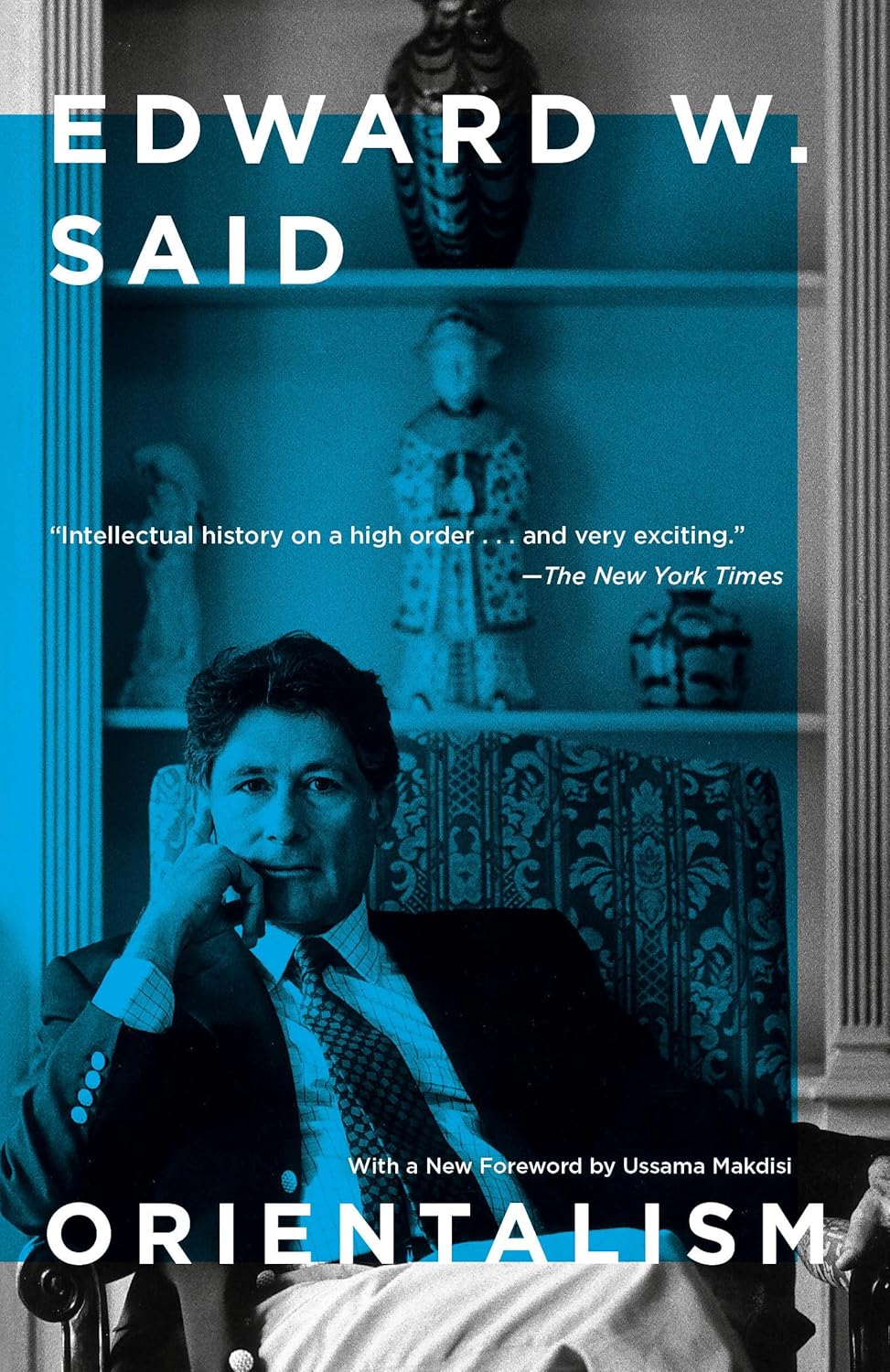
First published in 1978, this is one of the most influential books of the twentieth century — a work that fundamentally changed the way scholars, journalists, and policymakers think about the relationship between the West and the Arab and Islamic world. Edward Said, a Palestinian-American professor of literature at Columbia University, argued that the Western tradition of studying and representing “the Orient” is not neutral scholarship but a system of thought that reinforces power, distorts reality, and enables imperialism. It is, in short, a book about how the West has talked itself into misunderstanding the Middle East for centuries.
No book on this list is more challenging, and none is more important as a framework for reading everything else. Said’s argument has been debated, refined, and critiqued for nearly fifty years, but its central insight — that our perceptions of the Middle East are shaped by cultural assumptions that bear little relationship to reality — has only grown more relevant with time. Reading Orientalism will permanently change the way you read a newspaper, watch a news broadcast, or assess a political argument about the region.

This is narrative history at its finest: a sweeping, cinematic account of the First World War in the Middle East told through the stories of four extraordinary individuals, of whom T. E. Lawrence — Lawrence of Arabia — is the most famous. Scott Anderson, a veteran war correspondent, spent years researching this book, and the result is a richly detailed account of the years when the modern Middle East was being born: when the British were making promises they had no intention of keeping, when Arab nationalism was rising and being betrayed, and when the foundations for a century of conflict were being laid.
The book was widely acclaimed on publication in 2013 — a New York Times Notable Book and a finalist for the National Book Critics Circle Award in Biography. What makes it so powerful for the general reader is that Anderson never loses sight of the human beings at the center of the story. This is not just political history; it is a story about character, loyalty, ambition, and the catastrophic gap between what was promised to the people of the Middle East and what was actually delivered. Anyone who wants to understand why the region distrusts Western intentions — and with good reason — will find the answer here.

In November 1979, a group of armed Islamic militants seized the Grand Mosque in Mecca — the holiest site in all of Islam — and held it for two weeks in an event that shook the Muslim world to its foundations and had consequences that are still unfolding today. This book, by Wall Street Journal correspondent Yaroslav Trofimov, tells the full story for the first time: how it happened, who was responsible, how it was resolved, and — most importantly — what the Saudi government’s response to it set in motion. To prevent the siege from being seen as a failure of its Islamic credentials, the Saudi royal family dramatically accelerated its funding of radical Wahhabist Islam around the world.
The consequences of that decision — the spread of a harsh, intolerant form of the faith into countries as far apart as Pakistan, Indonesia, and the United States — are still with us today. Trofimov is a gifted journalist and the book reads like a thriller, but its importance lies in what it explains about the origins of modern jihadism and the role of Saudi Arabia in creating the conditions for both 9/11 and the rise of groups like ISIS. This is the book that answers the question so many people have been asking for decades: where did all this radicalism come from?
There is no quick fix for understanding a region as complex as the Middle East — no single article, no thirty-minute documentary, no social media thread that will do justice to centuries of history, religion, culture, and conflict. But there is a path towards it, and these ten books are some of the best guides available. Together they will give you a real understanding of how we arrived at this moment, and why the solutions are so terrifyingly hard to find.
As an Amazon Associate we earn from qualifying purchases made through links on this page.