
The Best Books on Conflict Resolution
In this list
10 books
- Getting to Yes: Negotiating Agreement Without Giving In · Roger Fisher
- Crucial Conversations: Tools for Talking When Stakes Are High · Kerry PattersonRecommended 3 times
- Nonviolent Communication: A Language of Life · Marshall B. Rosenberg
- Difficult Conversations: How to Discuss What Matters Most · Douglas Stone
- High Conflict: Why We Get Trapped and How We Get Out · Amanda Ripley This New York Times
- Never Split the Difference: Negotiating As If Your Life Depended On It · Chris Voss Chris VossRecommended 4 times
- The Anatomy of Peace: Resolving the Heart of Conflict · The Arbinger Institute If
- The Five Dysfunctions of a Team: A Leadership Fable · Patrick Lencioni While
- Boundaries: When to Say Yes, How to Say No to Take Control of Your Life · Dr. Henry Cloud and Dr. John Townsend Many
- How to Have Impossible Conversations: A Very Practical Guide · Peter Boghossian and James Lindsay Rounding
We’ve all been there—that uncomfortable moment when a conversation takes a wrong turn, tensions rise, and before you know it, you’re in the middle of a conflict you never wanted. Whether it’s with your partner, your boss, your teenager, or even that neighbor with the eternally barking dog, conflict is an inevitable part of life. The good news? It doesn’t have to be destructive. The right tools can transform those difficult moments into opportunities for growth, understanding, and stronger connections.
If you’re looking for practical, proven strategies to handle conflict more effectively, these books are your roadmap. Forget academic theories—these are engaging, accessible reads written by people who’ve spent decades helping real people navigate real conflicts.

Let’s start with the granddaddy of them all. Published in 1981 and still going strong with over 15 million copies sold worldwide, Getting to Yes is the book that changed how we think about negotiation and conflict resolution. The authors, from Harvard’s Negotiation Project, introduce a revolutionary idea: you don’t have to choose between getting what you want and getting along with people.
The book’s genius lies in its elegant simplicity. Fisher, Ury, and Patton teach you to separate the people from the problem, focus on interests rather than positions, invent options for mutual gain, and insist on objective criteria. It sounds straightforward, and it is, but it’s also profoundly effective. Whether you’re negotiating a business deal, discussing household chores with your spouse, or trying to resolve a dispute with a contractor, this principled approach helps you find solutions that work for everyone involved.
What makes this book so enduringly popular is that it works. The strategies aren’t manipulative tricks or power play. They’re based on respect, fairness, and the recognition that most conflicts arise from miscommunication rather than genuinely incompatible needs. It’s short, readable, and packed with examples that bring the concepts to life. If you’re only going to read one book on this list, many experts would say make it this one.

We all have those conversations we dread—the ones where opinions differ, emotions run high, and the stakes feel overwhelming. Maybe it’s asking for a raise, addressing your partner’s spending habits, or confronting a colleague who’s not pulling their weight. Crucial Conversations gives you the skills to handle these high-pressure moments with grace and effectiveness.
The authors, founders of VitalSmarts (now Crucial Learning), have spent years studying what separates people who navigate difficult conversations successfully from those who either avoid them entirely or handle them poorly. Their answer? The best communicators create a sense of safety that allows honest, productive dialogue to happen. When people feel safe, they can discuss anything. When they don’t, even simple topics become landmines.
The book introduces practical tools like the STATE method (Share your facts, Tell your story, Ask for others’ paths, Talk tentatively, Encourage testing) that give you a step-by-step approach to these challenging conversations. What readers love most is how immediately applicable the advice is. You can finish a chapter and use what you learned that same day. The book is filled with relatable scenarios from work and home, so you’re constantly seeing yourself in the examples. It’s become required reading in countless organizations precisely because it delivers results. When you learn to master crucial conversations, you’ll find that problems get solved faster, relationships strengthen, and that knot in your stomach before difficult talks starts to loosen.

With over 8 million copies sold in more than 35 languages, Marshall Rosenberg’s Nonviolent Communication has transformed relationships around the world. The book is based on a beautifully simple premise: most conflict stems from our inability to express our needs clearly and our failure to hear the needs of others. When we learn to communicate without judgment, blame, or criticism, we open the door to genuine connection and peaceful resolution.
Rosenberg introduces a four-step process: observing without evaluating, identifying and expressing feelings, connecting feelings to needs, and making specific requests. It sounds basic, but it’s remarkably powerful. Instead of saying “You never help around the house!” (which triggers defensiveness), you might say, “I notice the dishes have been left in the sink for three days, and I’m feeling overwhelmed because I need support in maintaining our home. Would you be willing to wash them after dinner tonight?” The difference in response can be dramatic.
What makes this book special is its heart. Rosenberg developed these techniques while working on racial integration in the American South and later used them in war-torn regions around the world. The stakes were literally life and death, yet the principles work just as well in everyday situations. Readers consistently report that Nonviolent Communication doesn’t just improve their external relationships—it transforms their relationship with themselves, helping them become more self-aware and self-compassionate. Yes, the book has its quirks (including some poetry you might want to skip), but the core message is life-changing. Even Microsoft CEO Satya Nadella made it required reading for his leadership team, crediting it with helping transform the company’s culture.

From the same Harvard Negotiation Project that brought us Getting to Yes, this book zeroes in on those conversations we’d rather avoid—the ones where you need to say “no,” apologize, give criticism, or address a problem that’s been festering for too long. The authors’ insight? Every difficult conversation actually contains three conversations: the “What Happened?” conversation, the Feelings conversation, and the Identity conversation.
The “What Happened?” conversation is about the facts and who’s to blame. The Feelings conversation deals with emotions (which we often try to suppress or ignore). And the Identity conversation touches on what the situation says about us—am I competent? Am I a good person? Am I worthy of love? Most of us never realize we’re having all three conversations simultaneously, which is why these discussions go off the rails so easily.
Stone, Patton, and Heen provide a practical framework for untangling this complexity. They teach you how to move from certainty to curiosity, how to express your feelings without drowning in them, and how to listen in ways that help others open up rather than shut down. The book is exceptionally well-organized and filled with before-and-after examples that show exactly how to apply these ideas. Readers love its clarity and the way it demystifies interactions that once seemed impossible to navigate. The third edition even addresses modern challenges like communicating across cultural divides and dealing with difficult conversations in the digital age. If you find yourself stuck in recurring conflicts or avoiding important conversations altogether, this book provides the roadmap out.

This New York Times bestseller takes a different approach to conflict resolution by examining why some conflicts escalate into destructive feuds while others remain productive disagreements. Amanda Ripley, an investigative journalist, spent years studying people trapped in what she calls “high conflict”—the kind of toxic, us-versus-them battle that consumes your thoughts, damages relationships, and seems impossible to escape.
Ripley’s genius is in showing us the difference between “good conflict” (which challenges us and helps us grow) and “high conflict” (which traps us in a downward spiral of blame and outrage). Through compelling real-life stories—from gang members to political rivals to people in bitter family feuds—she reveals the invisible forces that pull us into high conflict: conflict entrepreneurs who profit from division, the power of humiliation, and the false binaries that make us see every issue as black and white.
But this isn’t just diagnosis—it’s also prescription. Ripley shows how people successfully escape high conflict by rehumanizing their opponents, cultivating curiosity, and resisting the binary thinking that fuels these destructive patterns. The book feels particularly relevant in our polarized age, when political and cultural conflicts often devolve into the exact toxic dynamics Ripley describes. Readers report that it’s changed how they think about conflicts both personal and political, helping them recognize when they’re being pulled into high conflict and giving them tools to resist. It’s an engaging, hopeful read that combines rigorous research with page-turning storytelling.
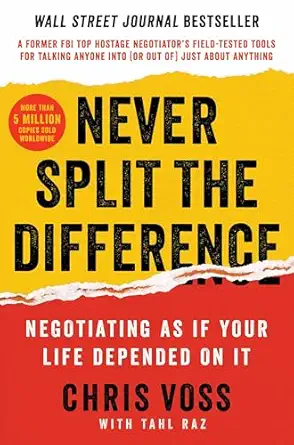
Chris Voss spent 24 years with the FBI, serving as the lead international kidnapping negotiator. In his work, the stakes couldn’t have been higher: people’s lives literally depended on his negotiation skills. Never Split the Difference distills everything he learned from those high-pressure situations into practical strategies anyone can use in everyday negotiations and conflicts.
Voss’s approach challenges conventional negotiation wisdom. He argues that we’re not the rational actors we think we are, that compromise often isn’t the answer, and that the real power lies in mastering the emotional and psychological aspects of negotiation. He introduces techniques like tactical empathy (deeply understanding and acknowledging the other side’s perspective), calibrated questions (queries designed to give your counterpart the illusion of control), and mirroring (repeating the last few words someone said to encourage them to elaborate).
What readers love most about this book is how immediately useful it is. Voss fills it with real stories from hostage negotiations that are genuinely riveting, then shows you exactly how to adapt those same techniques when you’re negotiating a salary, buying a car, or trying to get your kids to go to bed. The book has sold over 5 million copies, and for good reason—it works. Whether you’re dealing with a difficult client, a stubborn teenager, or a contentious divorce, Voss’s methods give you an edge. His writing is engaging, often humorous, and refreshingly honest about the mistakes he made along the way. It’s less about conflict resolution in the traditional sense and more about getting what you need while building rather than burning relationships.

If you’re tired of traditional business books and prefer learning through story, The Anatomy of Peace might be your perfect match. Written as a compelling narrative rather than a how-to manual, this book follows parents who’ve been called to a wilderness therapy camp because their children are in crisis. As they spend two days with the camp’s counselors, they discover that the real problem isn’t their teenagers—it’s the way they’ve been seeing and treating them.
The Arbinger Institute introduces a powerful concept: we’re either in a box (seeing others as objects to be used, obstacles to overcome, or irrelevancies) or out of the box (seeing others as people with needs, hopes, and fears as real as our own). When we’re in the box, everything we do to “solve” a conflict actually makes it worse. When we’re out of the box, solutions that seemed impossible become obvious.
This isn’t just about parenting—though readers report that it dramatically improves those relationships. The principles apply equally to workplace conflicts, marital disputes, and even international tensions. The story format makes the ideas stick in a way that straight instruction never could. You find yourself deeply caring about the characters and seeing your own patterns reflected in theirs. Some readers initially worry that the story approach might feel gimmicky, but they’re quickly won over by the depth of the insights and the emotional impact of the narrative. It’s the kind of book you’ll want to discuss with others—and many readers report buying copies for family members or colleagues because the concepts are so transformative.

While not exclusively about conflict resolution, Patrick Lencioni’s bestselling fable addresses one of the most common sources of workplace conflict: team dysfunction. Through the story of a new CEO trying to turn around a struggling executive team, Lencioni identifies five interrelated problems that destroy teamwork: absence of trust, fear of conflict, lack of commitment, avoidance of accountability, and inattention to results.
Here’s the counterintuitive part: Lencioni argues that healthy conflict is essential for effective teams. The problem isn’t that teams have disagreements; it’s that they avoid them. When people don’t trust each other enough to be vulnerable, they won’t engage in productive conflict. Instead, they stay silent, let resentments build, and ultimately fail to commit to decisions. The resulting dysfunction creates far more damage than any honest disagreement ever could.
The book is a quick read—you can finish it in an afternoon—but it’s packed with insights that change how teams operate. Lencioni provides both the fable and a practical section explaining how to apply the concepts. Leaders love it because it gives them a language for addressing team dynamics that previously felt too nebulous to tackle. Team members appreciate it because it explains why some teams click while others constantly struggle. If you’re dealing with workplace conflict that stems from unclear communication, lack of trust, or people avoiding difficult conversations, this book offers a proven framework for building a healthier team culture.

Many conflicts arise not from genuine clashes of interests but from unclear or violated boundaries. Dr. Henry Cloud and Dr. John Townsend’s Boundaries has helped countless people understand where they end and others begin—and why that distinction is crucial for healthy relationships.
The book addresses a fundamental truth: we can’t control other people, but we can control how we respond to them. When we fail to set appropriate boundaries, we end up resentful, exhausted, and stuck in cycles of conflict. We say yes when we mean no, we accept behavior we shouldn’t tolerate, and we take responsibility for problems that aren’t ours to solve. Then we wonder why our relationships feel so draining.
Cloud and Townsend, both Christian psychologists, approach boundaries from a faith-based perspective, but the principles resonate across belief systems. They tackle boundaries in marriage, with children, at work, and with yourself. Readers consistently report that the book helps them understand conflicts they’ve been having for years, often realizing that the issue wasn’t the other person’s behavior but their own failure to establish and maintain clear limits.
The chapter on common boundary myths is particularly valuable, addressing misconceptions like “If I set boundaries, I’m being selfish” or “Boundaries hurt relationships.” In reality, the opposite is true: clear boundaries create the safety and respect that allow relationships to flourish. This is an empowering read that helps you take responsibility for your own life while letting others take responsibility for theirs—a dynamic that resolves countless conflicts before they escalate.

Rounding out our list is a book designed for our current moment, when conversations across political, religious, or ideological divides often feel genuinely impossible. Boghossian and Lindsay, both college professors who’ve spent years studying how people change their minds, offer practical techniques for having productive conversations with people who see the world completely differently than you do.
The book introduces “Street Epistemology,” an approach that uses carefully crafted questions to help people examine their own beliefs rather than attacking those beliefs directly. Instead of trying to prove the other person wrong (which always backfires), you ask questions that invite reflection: “How did you arrive at that conclusion?” “What would change your mind?” “How confident are you in that belief, on a scale of 1 to 10?”
What makes this book different is its focus on conversations where the goal isn’t agreement—it’s mutual understanding and productive dialogue. Sometimes the best outcome is simply that both parties leave with a clearer sense of where the other is coming from. Boghossian and Lindsay are refreshingly honest about what works and what doesn’t, drawing on real examples (including plenty of failures) to illustrate their points.
If you’re exhausted by culture war conflicts, frustrated by family members who believe conspiracy theories, or simply want to have more productive political conversations, this book offers hope. Readers appreciate its specific, actionable advice and its refusal to take a partisan stance—the techniques work regardless of whether you’re talking to someone on the left or the right, religious or atheist, vegan or carnivore. It’s a toolkit for navigating the conflicts that define our era.
Conflict is inevitable, but suffering through bad conflicts isn’t. Each of these books offers proven strategies for turning difficult moments into opportunities for growth, understanding, and stronger relationships. Whether you’re dealing with workplace drama, family tensions, or personal disputes, you’ll find wisdom and practical tools in these pages.
Start with whichever book speaks to your current needs. Struggling with a specific difficult conversation? Pick up Difficult Conversations or Crucial Conversations. Feeling trapped in an ongoing feud? Try High Conflict. Need negotiation skills? Go with Getting to Yes or Never Split the Difference. Want to understand the deeper dynamics of conflict? Explore The Anatomy of Peace or Nonviolent Communication.
The beautiful thing about developing conflict resolution skills is that they compound over time. Every difficult conversation becomes a little easier. Every conflict becomes an opportunity to practice these new approaches. And gradually, you’ll find that not only do you handle conflicts better, you prevent many of them from happening in the first place.
As an Amazon Associate we earn from qualifying purchases made through links on this page.