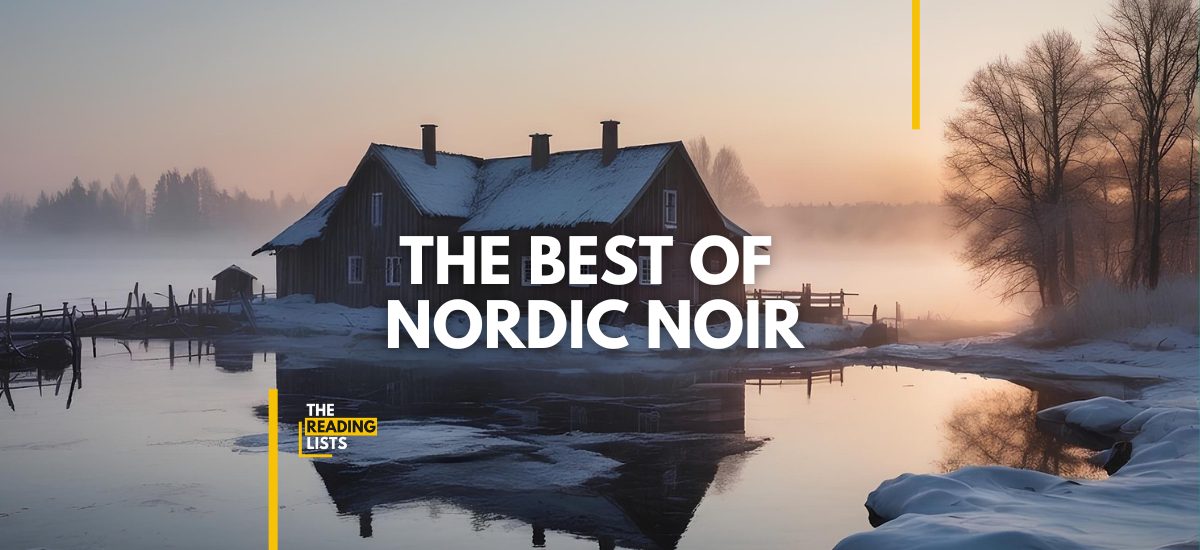
The Best of Nordic Noir
In this list
11 books
Nordic Noir has become one of the most beloved and internationally successful genres in publishing, and it’s not hard to understand why. There’s something about the combination of those stark, beautiful landscapes, those small and tightly wound communities, and that peculiarly Scandinavian tendency to look beneath the polished surface of a famously progressive society that produces crime fiction of unusual power and depth.
The genre has its roots in a conscious literary project: Swedish authors Maj Sjöwall and Per Wahlöö set out in the 1960s to use crime fiction as a vehicle for social criticism, and in doing so, they essentially invented the template for everything that followed. What distinguishes Nordic Noir from much of its English-language counterpart is its seriousness of purpose. These books aren’t just about who did it. They’re about why societies fail their most vulnerable members, how families carry their wounds across generations, and what it costs individuals to spend their lives confronting the worst of human behavior.
Then there are the detectives themselves. Forget the brilliant eccentric with the quirky hobby and the impeccable apartment. Nordic Noir’s investigators are defined by their damage: they drink too much, they’ve failed at relationships, they brood magnificently, and they carry their cases home with them. We root for them not because they’re superhuman but because they’re almost too human.
The following ten books represent the very best the genre has to offer, from the landmark novels that defined it to a few hidden gems that deserve a much wider audience.

The Girl with the Dragon Tattoo
Stieg Larsson • Sweden
If there’s one book that introduced millions of readers to the world of Nordic Noir, it’s this one. Stieg Larsson’s explosive debut weaves together a cold-case family mystery, corporate corruption, and one of fiction’s most unforgettable characters: Lisbeth Salander, a tattooed, fiercely independent hacker with a genius mind and a traumatic past. Set against the icy backdrop of Sweden’s wealthiest families, the novel grips you from page one and simply refuses to let go.
What makes this book so enduring is its combination of propulsive plotting and deep moral seriousness. Larsson — a journalist who spent his career exposing real-world extremists — packed the story with genuine fury at violence against women and systemic corruption. Lisbeth is thrilling precisely because she defies every expectation, and her unlikely partnership with disgraced journalist Mikael Blomkvist makes for one of crime fiction’s great odd-couple relationships. It’s the book that started a phenomenon, and it absolutely earns its place at the top of this list.

Faceless Killers
Henning Mankell • Sweden
Long before Larsson came along, Henning Mankell was quietly building one of crime fiction’s most beloved series around Kurt Wallander, a rumpled, world-weary detective in the small Swedish town of Ystad. Faceless Killers, the first in the series, begins with the brutal murder of an elderly farming couple and sets into motion an investigation that touches on immigration, racism, and the fractures running beneath Sweden’s famously tolerant society.
Wallander is a wonderfully human creation — divorced, unhealthy, constantly second-guessing himself, and genuinely troubled by the cases he investigates. He doesn’t swoop in with brilliant deductions; he grinds, makes mistakes, and carries the weight of his work home with him every night. Mankell’s Sweden feels lived-in and real, a country wrestling with its own contradictions, and that authenticity gives these books a resonance that goes far beyond the genre. If you’ve never tried Wallander, start here.

The Snowman
Jo Nesbø • Norway
Norwegian author Jo Nesbø is the undisputed master of the high-octane Nordic thriller, and The Snowman — the seventh novel featuring Oslo detective Harry Hole — is widely considered his finest achievement. When the first snow of winter falls and a woman disappears, leaving only a child’s snowman in the yard, Harry begins to suspect he’s on the trail of Norway’s first serial killer. The cat-and-mouse tension that follows is almost unbearably gripping.
Nesbø writes with the kind of cinematic pace that makes you feel like you’re watching a thriller unfold on screen, and Harry Hole is a magnificently flawed hero: brilliant, alcoholic, self-destructive, and impossible to look away from. The Norwegian winter setting — all frozen lakes, long darkness, and isolated farmhouses — becomes almost a character in its own right. Fair warning: this one will keep you up well past your bedtime. You might want to start the series from the beginning with The Bat, but The Snowman is where Nesbø hits his magnificent peak.

The Keeper of Lost Causes
Jussi Adler-Olsen • Denmark
Danish author Jussi Adler-Olsen brings something refreshingly different to the genre with this irresistible opener to his Department Q series (yes, the inspiration behind the compulsively viewable Netflix series of the same name). Detective Carl Mørck, brilliant but deeply difficult, is shuffled off to a basement department tasked with reviewing cold cases — essentially a dumping ground for a detective his colleagues can no longer tolerate. Together with his Syrian assistant Assad (a character so vivid and funny he practically leaps off the page), Carl reopens the case of a politician who vanished years earlier.
What sets Adler-Olsen apart is his wit. Department Q has a warmth and dark humor that makes it genuinely addictive in a way that differs from the bleaker end of the Nordic spectrum. The mystery itself is brilliantly constructed, with a second narrative thread following the missing woman that ratchets up the tension chapter by chapter. The series has been translated into more than 40 languages and published across the globe — once you read this first book, you’ll understand exactly why. A total joy.

The Ice Princess
Camilla Läckberg • Sweden
Camilla Läckberg’s debut novel introduced the world to Fjällbacka, a small picturesque Swedish coastal town that turns out to harbor some very dark secrets. When crime writer Erica Falck discovers the frozen body of a childhood friend in a bathtub, what initially appears to be suicide quickly unravels into something far more sinister. Working alongside local detective Patrik Hedström — who becomes a series regular and, eventually, Erica’s partner — she begins digging into the town’s buried past.
Läckberg has a gift for the cozy-turned-sinister atmosphere: Fjällbacka in winter is beautiful and claustrophobic in equal measure, and the tight-knit community’s secrets feel believably human rather than sensationally dark. The relationship between Erica and Patrik gives the series an emotional warmth that balances the darkness of the crimes, and Läckberg’s exploration of family dysfunction, childhood wounds, and the lies communities tell themselves gives the story real depth. She has become one of Sweden’s most successful literary exports — and this is the perfect place to start.

Jar City
Arnaldur Indriðason • Iceland
Iceland might seem like an unlikely setting for crime fiction, but Arnaldur Indriðason uses his country’s small size, remote landscapes, and tight social fabric to extraordinary effect. Jar City opens with the murder of a lonely, unpopular man in Reykjavik, and detective Erlendur’s investigation leads him into the country’s genetic research industry, a decades-old rape, and the terrible consequences that ripple forward through generations. It’s a bleakly beautiful book with a mystery at its heart that genuinely haunts you.
Erlendur is one of Nordic Noir’s most melancholy detectives — a man preoccupied with Iceland’s history of people lost in the wilderness, and with his own painful family past. There’s a stillness to Indriðason’s writing that feels distinctly Icelandic, unhurried and reflective, and the way he uses the tiny scale of Reykjavik society (where everyone seems to know everyone) adds an intimacy that makes the crimes feel especially close to the bone. Although it is the third novel in the series, Jar City was the first to be translated into English and remains the essential entry point for new readers.

The Redbreast
Jo Nesbø • Norway
While The Snowman may be Nesbø’s most celebrated novel, The Redbreast — the third Harry Hole book and the first to be translated into English — is where many readers fall irreversibly in love with the series. It’s a more ambitious book than most crime novels dare to be, weaving between present-day Oslo and the Second World War Eastern Front, where Norwegian SS volunteers fought alongside the Germans. The two timelines spiral toward each other with mounting dread.
Nesbø handles the historical material with remarkable confidence, and the moral complexity at the novel’s center — the impossible tangle of loyalty, ideology, and wartime trauma — elevates this well beyond genre fiction. Harry Hole, meanwhile, is at his most compelling here: angry, perceptive, funny in unexpected moments, and carrying wounds that the reader comes to understand in new ways. The Redbreast shows that Nordic Noir at its best is serious literary fiction wearing a thriller’s coat.

The Laughing Policeman
Maj Sjöwall & Per Wahlöö • Sweden
No list of Nordic Noir would be complete without acknowledging the genre’s founding parents. Swedish couple Maj Sjöwall and Per Wahlöö wrote their ten-novel Martin Beck series between 1965 and 1975 as a deliberate Marxist critique of Swedish society, and in doing so, they essentially invented the template for everything that followed. The Laughing Policeman, the fourth in the series and winner of the Edgar Award for Best Novel, begins with a mass shooting on a Stockholm bus and unfolds into a meticulous, mesmerizing investigation.
What’s astonishing is how contemporary these books feel. The teamwork-based police procedural, the social critique woven into the crime narrative, the unglamorous portrait of detective work as grinding and collaborative rather than heroic — all of it feels modern because Larsson, Mankell, and every other Nordic Noir author learned from Sjöwall and Wahlöö. The Laughing Policeman is a masterpiece of the form, taut and intelligent, and essential reading for anyone who wants to understand how this genre became the global phenomenon it is today.

Don’t Look Back
Karin Fossum • Norway
Often described as Norway’s Queen of Crime, Karin Fossum takes a distinctly quieter, more psychological approach than many of her peers — and the result is utterly hypnotic. Don’t Look Back, the second novel in her Inspector Sejer series, opens with the discovery of a young girl’s body by a mountain lake in a small Norwegian community. What follows is less about the chase and more about the why; a deep, compassionate excavation of human psychology and the darkness that can fester in ordinary lives.
Inspector Konrad Sejer is one of the genre’s most thoughtful investigators: quiet, deeply empathetic, and seemingly able to draw confessions from people through patience alone. Fossum is less interested in plot mechanics than in the emotional and moral landscape of crime — what drives people to terrible acts, and what it costs them. Her prose has a spare, almost hypnotic quality that lingers long after you’ve finished. If you find some Nordic Noir too relentlessly dark, Fossum’s humane, character-driven approach may be exactly what you’re looking for.

The Boy in the Suitcase
Lene Kaaberbøl & Agnete Friis • Denmark
This riveting Danish thriller — co-written by two authors, which gives it a propulsive, almost relay-race energy — opens with one of crime fiction’s most memorable first scenes: Red Cross nurse Nina Borg receives a key to a locker at Copenhagen Central Station and discovers inside a suitcase containing a sedated three-year-old boy. From that extraordinary beginning, the novel hurtles forward across Denmark and Lithuania as Nina risks everything to protect the child and uncover the truth.
The Boy in the Suitcase tackles human trafficking with unflinching honesty but never tips into exploitation. It’s always the humanity of its characters, not the horror of the crime, that drives the story. Nina Borg is a genuinely fresh creation: a compulsive helper whose need to save others puts both herself and her family in constant danger. This is a lesser-known gem that absolutely deserves a wider audience, and it’s the first in a series that only gets stronger. A brilliant, breathless read.
If you’re completely new to the genre, The Girl with the Dragon Tattoo is the obvious starting point — it’s a phenomenon for good reason. If you’d prefer something quieter and more character-driven, try Karin Fossum or Arnaldur Indriðason. For sheer addictive fun, the Department Q series by Jussi Adler-Olsen is hard to beat. For a hidden gem with breathtaking pace, grab The Boy in the Suitcase. And if you want to understand where it all came from, spend some time with Sjöwall and Wahlöö.
Whichever you choose, prepare to lose several nights of sleep — and to find yourself newly obsessed with Scandinavian geography, strong coffee, and the particular pleasure of a crime novel that takes both its readers and its subject matter seriously. Welcome to the frozen north.
As an Amazon Associate we earn from qualifying purchases made through links on this page.