
Adrian Moore: Endlessly Fascinating
Adrian Moore’s reading list
11 books mentioned in this interview
- The Death of Expertise · Tom NicholsRecommended 3 times
- Hegel or Spinoza · Pierre Macherey
- The Little Grey Men · BB
- Philosophical Letters
- Problems of Philosophy · Bertrand RussellRecommended 4 times
- Kant’s Critique of Pure Reason
- Meditations · DescartesRecommended 3 times
- Meno · PlatoRecommended 4 times
- Expressionism in Philosophy
- The Brothers Karamazov · Fyodor DostoyevskyRecommended 8 times
- The Good People · Hannah Kent
Books by Adrian Moore: The Infinite, The Evolution of Modern Metaphysics: Making Sense of Things
Adrian Moore is a Professor of Philosophy at the University of Oxford, whose main philosophical areas of focus include Kant, Wittgenstein, history of philosophy, metaphysics, philosophy of mathematics and philosophy of logic, to name but a few. As well as being recognised as a wonderful educator, Adrian Moore is also a prolific writer. His first book, The Infinite, was considered an ‘authoritative overview of a topic of consider philosophical importance’, and was released to a plethora of positive reviews. Following his first book, Adrian Moore went on to release a sequence of successful books, all of which were met with wonderful receptions. Adrian was also the host of BBC Radio 4 series A History of the Infinite, in which he journeys through philosophical thought on infinity over the last two and a half thousand years. In 2012, Adrian Moore released his most recent book, The Evolution of Modern Metaphysics: Making Sense of Things, which was described as an important and remarkable book. Interviewing such a prestigious and respected professor of philosophy is an honour, so please enjoy the reading list of Adrian Moore…


When someone asks you ‘what do you do for a living?’ – How do you respond?
I normally say that I am an academic or a professor.
What are you reading at the moment?
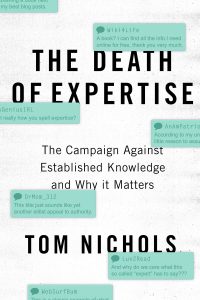
The philosophy book that I am reading at the moment is Hegel or Spinoza by Pierre Macherey, which is directly related to something that I am writing about. I am also reading The Death of Expertise by Tom Nichols. The latter is published by Oxford University Press, of which I am a delegate, and that is how the book was drawn to my attention. It is a very powerful analysis of how the whole idea of expertise has come under threat in recent years.


When you think about your childhood, what book comes to mind?
I adored The Little Grey Men by BB. I was also a big fan of Richmal Crompton’s William books.

What did you want to be when you were growing up?
I thought about social work. I also thought about teaching. It was when I was an undergraduate that the idea of writing books began to appeal. But it was not until I was a postgraduate that I thought seriously about pursuing a career in academia.
When did you fall in love with philosophy?
During the last two years of my time at high school, where I studied French. Voltaire’s Philosophical Letters was one of our set texts. I found that exciting enough, but what really got me hooked was some of the background reading that we had to do, Descartes in particular. I cannot now remember whether I read parts of his Discourse on The Method at that stage, or whether it was parts of his Meditations. Either way, I was thrilled by what I read – not least by the reassurance that all those doubts that I had been secretly harbouring about things that everyone else took for granted were not something to be ashamed of! I was also taught mathematics by a man who had himself studied philosophy at university, and he introduced me to some issues in the philosophy of mathematics as well as to some of the basics of formal logic and transfinite arithmetic.

What do you think your school aged self would think of the present day you?
I think he would have recognized a lot of himself in me, and I think he would largely have approved. Gosh, what does that say about my former self and about my present self? Perhaps it illustrates something that I have long maintained: that philosophers are people who have never really grown up. Just like children, we annoy everyone else by persistently asking “Why?” even when answers have been provided that satisfy most people.
If you could wrap up a single book and gift it to yourself as you left education – which book would it be?
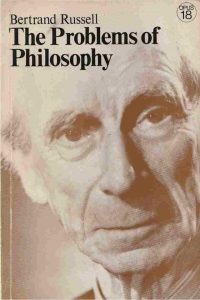
I think I could do a lot worse than give myself further work by Descartes. But I could also do a lot worse than give myself the next philosophical work that I did in fact read as I left education (and I am assuming, incidentally, that in this context “education” means secondary education) namely Problems of Philosophy by Bertrand Russell.

Does your reading have routine? Is there a particular time or place that you like to read?
It does have routine, but the routine is as much weekly as daily, and I find myself reading at various times of the day in various locations.
Which book has had the biggest impact on your career so far? How did it impact it?
I suppose I must single out my favourite philosophical work, which I also take to be the greatest philosophical work of all time: Kant’s Critique of Pure Reason. It is an extraordinary book, endlessly fascinating and continually surprising.

What advice would you give a novice, looking for an introduction to philosophy?
It is a good idea to look at some of the more accessible classics, like Meditations by Descartes or Meno by Plato. Any history of philosophy is always liable to act as a good introduction too. One further piece of advice that I would give would be not to worry about quantity. It is far better to read a small amount slowly and carefully, trying to understand as much as possible and being prepared to question as much as possible.


Who would you say are the three philosophers that continue to inspire you?
Kant and Wittgenstein are undoubtedly two of them. These are my two favourites philosophers and the two whom I have studied most closely. Over the years I would have given different answers for the third. But the philosopher I’m now inclined to add is Spinoza. I have always had some interest in his work, but it is only comparatively recently that I have begun to study it closely, and, although it is very difficult at times (as are the works of Kant and Wittgenstein), it is truly inspirational.
Do you have any books that you strongly associate with someone important in your life?
A close friend, who is also a philosopher, introduced me to the work of Gilles Deleuze, so I tend to associate anything by Deleuze with that friend. This is related to my previous answer. One of Deleuze’s most user-friendly and most important books is his wonderful and masterly study of Spinoza, entitled Expressionism in Philosophy, and it was this that directed me back to Spinoza himself.

What book have you recommended the most to friends and family?
My all-time favourite novel, The Brothers Karamazov by Fyodor Dostoyevsky. It’s a beast of a book, brimming with philosophical ideas. But I do also tend to wax lyrical about Iris Murdoch’s novels.

Do you prefer fiction or non-fiction?
I enjoy fiction very much, but I suppose I must say non-fiction, because my real passion – apart from writing philosophy – is reading it.
Do you think reading is important?
What’s the best book you’ve read in the last 6 months?
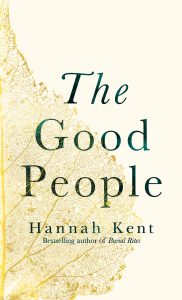
Probably The Good People by Hannah Kent, which I recently finished: I found it very moving.

Do you prefer real books or digital books?
I have no preference.
Name a book that you feel everyone would benefit from reading and explain why.
I really don’t think that there’s one single book that everyone would benefit from reading, because so much depends on a person’s individual circumstances. (For example, even though I am religious, I wouldn’t include any of the great sacred texts. These can appear very alien if the context isn’t right.) The closest that I can think of to a book that everyone would benefit from reading would be a book of inoffensive jokes. Mind you, that might amount to something quite profound: Wittgenstein is reputed to have said that “a serious and good philosophical work could be written consisting entirely of jokes”.
What is the book that you feel has had the single biggest impact on your life? What impact did it have?
I would have to give the same answer to this question as I gave to the analogous question about my career. Perhaps that just goes to show how important my career has been to my life!
Are there any books you haven’t mentioned that you feel would make your reading list?
If the question is whether there any books I haven’t mentioned that I think are classics, and that I would count among my favourites, then the answer is: hundreds.
What books or subject matter do you plan on reading in the next year?
I shall be reading more Spinoza, I’m sure. I am also an editor of one of the main philosophy journals, MIND, so I shall be reading lots of submissions for that.
If you were to write an autobiography – what would it be called?
Sadly, my life hasn’t been interesting enough to warrant an autobiography. But I am reminded of a wonderful cartoon that I saw recently in the magazine Private Eye. It depicted a publisher and an author facing each other on opposite sides of a desk. The publisher is tossing a fat typescript back to the author, and the caption has him saying, “I’m sorry, we can’t publish your autobiography: it’s utter crap.” The disgruntled author replies, “Story of my life.”
If you’d like to learn more about Adrian Moore, you can find him on his website.
Image Credit: Mim Saxl Photography
As an Amazon Associate we earn from qualifying purchases made through links on this page.


