The Most Important Books On Astronomy
In this list
24 books
- The Cosmos: Astronomy in the New MillenniumRecommended 3 times
- Astronomy 101
- The Astronomers
- The Evolving Universe
- Starlight Detectives: How Astronomers, Inventors and Eccentrics Discovered the Modern Universe
- Parallax: The Race to Measure the Cosmos
- Astronomy Saves the World: Securing our Future Through Exploration and Education
- De Revolutionibus · Nicolas Copernicus Jay Pasachoff
- Coming of Age in the Milky Way · Timothy Ferris Alan Hirshfeld
- Nightwatch: A Practical Guide to Viewing the Universe · Terence Dickenson Carolyn Collins Petersen
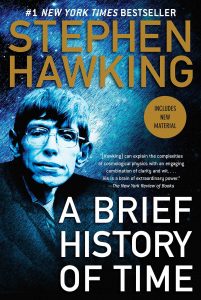
- A Brief History of Time · Stephen HawkingRecommended 5 times
- Dialogue Concerning the Two Chief World Systems · Galileo Richard C. Henry
- Black Holes and Time Warps: Einstein’s Outrageous Legacy · Kip Thorne
- Universe: The Definitive Visual Guide · Robert Dinwiddie Carolyn Collins Petersen
- Philosophiæ Naturalis Principia Mathematica · Isaac Newton Richard C. Henry
- The Cosmic Cocktail: Three Parts Dark Matter · Katherine Freese Donald Goldsmith
- Astronomia Nova · Johannes Kepler Jay Pasachoff
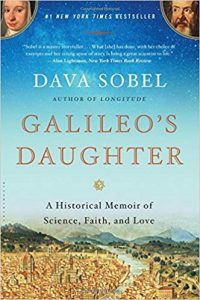
- Galileo’s Daughter · Dava Sobel
- Astronomy for Dummies · Steve Maran Carolyn Collins Petersen
- The Big Picture: On the Origins of Life, Meaning, and the Universe Itself · Sean Carroll Donald Goldsmith
- Siderus Nuncius · Galileo Jay Pasachoff
- The Internal Constitution of the Stars · Arthur S. Eddington Richard C. Henry
- The Demon-Haunted World: Science as a Candle the Dark · Carl SaganRecommended 4 times
- Black Hole: How an Idea Abandoned by Newtonians, Hated by Einstein, and Gambles on · Hawking Became Loved
When you look up at the night sky, it’s hard to not be blown away by the sheer vast blanket of space, sprinkled with stars. Whilst the beauty is undeniable, if you were to ask me what I was looking at specifically – my facial expression would resemble staring into a black hole. To understand the night sky, I want to assemble a list of the most important books on astronomy. Astronomy is the study of the sun, moon, stars, planets, comets, gas, galaxies, gas, dust and other non-Earthly bodies and phenomena. When considering the most important books on astronomy, the natural inclination would be to pick primary texts. However, as always – I asked each of the contributors to not discount secondary texts that might prove more accessible. To create this list of the most important books on astronomy, I reached out to a collection of some of the world’s leading experts on astronomy. Before we discover the most important books on astronomy, we must first meet that panel of experts…

Jay Pasachoff
Jay Myron Pasachoff is an astronomer, the Field Memorial Professor of Astronomy at Williams College and the author of textbooks and trade books in astronomy, physics, mathematics, and other sciences. He has been Chair of the Historical Astronomy Division of the American Astronomical Society. His books include The Cosmos: Astronomy in the New Millennium.

Carolyn Collins Petersen
Carolyn Collins Petersen is an award-winning science writer and astronomer whose books include Astronomy 101 and The New Solar System. Her work has appeared in domed theatres and observatory exhibits around the world, including Griffith Observatory in Los Angeles, NASA’s Jet Propulsion Laboratory, and the California Academy of Sciences in San Francisco.

Richard C. Henry
Richard Conn Henry is an Academy Professor of Physics and Astronomy at Johns Hopkins University, author of one book and over 200 publications on the topics of astrophysics and various forms of astronomy including optical, radio, ultraviolet, and X-ray. He was part of a team that discovered “vastly more baryons than had ever before been found in the universe”. He is cited for providing for black holes that are rotating, and/or are electrically-charged, the Kretschmann scalar, which characterizes their curvature.

Donald Goldsmith
Author of The Astronomers, the companion book to the popular PBS television series of the same name, Donald Goldsmith is an astrophysicist and the president of Interstellar Media. He is also the winner of the 1995 American Astronomical Society’s Annenberg Foundation Award for Education and the Klumpke-Roberts Prize for his contributions to the public understanding of astronomy. His books also include The Evolving Universe.

Eric Chaisson
Eric Chaisson is an astrophysicist best known for his research, teaching, and writing on the interdisciplinary science of cosmic evolution. He is also noted for his telescopic observations of interstellar clouds and emission nebulae of the Milky Way Galaxy. He conducts research at the Harvard-Smithsonian Center for Astrophysics and teaches natural science at Harvard University.

Alan Hirshfeld
Alan Hirshfeld is an astronomer at the University of Massachusetts Dartmouth and Chair of the American Astronomical Society’s Historical Astronomy Division. Among his books, Starlight Detectives: How Astronomers, Inventors and Eccentrics Discovered the Modern Universe and Parallax: The Race to Measure the Cosmos. He holds a BA in astrophysics from Princeton and a Ph.D. in astronomy from Yale.

Daniel Batcheldor
Daniel Batcheldor is an astrophysicist, a professor at Florida Institute of Technology, Head of the Department of Aerospace, Physics and Space Sciences, and Director of the Jacobus Kapteyn Telescope. He is a leading expert in the field of supermassive black holes and their relationships with galaxies. He is also the author of Astronomy Saves the World: Securing our Future Through Exploration and Education.
Now, let’s discover some of the best books on astronomy…
De Revolutionibus by Nicolas Copernicus

Jay Pasachoff:
Copernicus brought forward the heliocentric view of the universe, breaking with thousands of years of believing that the Earth was at the center. But Copernicus still had circular motion for the planets, which did not give adequate predictability for the positions of the planets in the sky.
Richard C. Henry:
Copernicus published his famous book only on his deathbed, so fearful was he of ridicule for making the Sun rather than the solid Earth beneath our feet the center of the universe. His calculations did not go where he wanted them to go, but at least he tried, and intellectuals throughout Europe began seriously debating his thesis, which he had copied from Aristarchus of Samos. His book was tremendously influential.
Coming of Age in the Milky Way by Timothy Ferris

Alan Hirshfeld:
This one-time bestseller ranges over the history of astronomers’ efforts to determine the structure of the universe and the arrangement and nature of its celestial bodies. Although now more than thirty years old, and missing developments like gravity-wave astronomy and the accelerating expansion of the universe, the book’s literary merit make it a worthwhile read. It’s inspiring to trace humanity’s epic exploratory thread and realize what our species is capable of when it sets its collective mind to solving a problem.
Nightwatch: A Practical Guide to Viewing the Universe by Terence Dickenson

Carolyn Collins Petersen:
I recommend this, along with H.A. Rey’s books (The Stars, and the Stars: A New Way to see them) to all the beginner and semi-experienced stargazers who ask me.
Daniel Batcheldor:
I read this as a teenager. It contains everything I didn’t know I wanted to know about our universe and begins by questioning whether or not you could explain things you think you know. Complex physics is broken down through understandable analogies, and then the inadequacies of those analogies are exposed. For example, a two-dimensional dog would not be aware of up or down, like we could not be aware of the curvature of our universe, but how could such a dog exist if it eats and excretes? One pipe connects both ends so the top of the dog is not connected to the bottom. This vivid example reminds me to argue with myself. How might I be wrong? This is the essence of the scientific method.
Dialogue Concerning the Two Chief World Systems by Galileo

Richard C. Henry:
Galileo was even more fearful of ridicule than was Copernicus; for decades he taught students the old system in which he no longer believed. But in the end, his book, in Italian rather than in Latin, was published, and it changed the world. He created the scientific method, even including measurement error analysis; he argued that the Earth rotated on its axis; he argued that the Earth goes annually around the Sun, and he … oops! … disputed Kepler’s view that it is the Moon’s attraction that causes the tides. Kepler did much better work on astronomy than did Galileo, but here we are talking influential books, not results. (Kepler wrote the worst science fiction novel ever written, except for the novel by American astronomer Simon Newcomb.)
Donald Goldsmith:
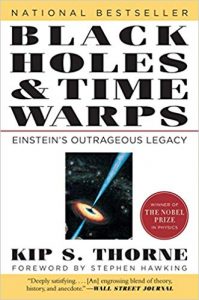 Everyone has heard about Einstein’s theory of relativity, and about the black holes that once seemed only a theoretical possibility but have proven to be entirely real and widely variegated. Thorne offers a chance to understand both the theory and the phenomenon, in writing as comprehensible as a great master can provide.
Daniel Batcheldor:
I read this almost immediately after finishing A Brief History of Time for the second time. It takes a deeper dive into the most astounding facts about our universe, and the objects in it. Thorne weaves together the history of discoveries, the background of the discoverers, the physics they uncovered, the politics of the time, and the impacts on society that the unveiling of extreme physics has had. Adding these together began my realization of why we must continually test our understanding of our universe in finer and finer detail; the more we know, the better we become.
Universe: The Definitive Visual Guide by Robert Dinwiddie

Carolyn Collins Petersen:
This one is one of my “go-to” books for quick reference. It’s concisely written, loads of information and facts, and is gorgeously illustrated.
Philosophiæ Naturalis Principia Mathematica by Isaac Newton

Richard C. Henry:
Newton created modern science and physics in particular. He was brilliantly mathematical. Everyone else had looked at the Moon and had concluded that it never fell; Newton showed that the Moon was always falling, just in the same way that a thrown baseball falls: throw that baseball fast enough, and it too will circle the Earth, endlessly, every 90 minutes (except of course for friction). His book is highly mathematical and no one reads it today.
The Cosmic Cocktail: Three Parts Dark Matter by Katherine Freese

Donald Goldsmith:
The past few decades have brought mind-bending news from the cosmology front: Most of the matter in the cosmos consists of “dark matter” of entirely unknown form, and most of the universe’s energy resides in mysterious “dark energy” that makes the universe expand at an ever-accelerating rate. Freese offers a highly readable guide to these startling results, including the observations that pointed the way for astronomers to reach their conclusions by deductive means.
Astronomia Nova by Johannes Kepler

Jay Pasachoff:
Johannes Kepler, using data meticulously collected especially for Mars by Tycho Brahe and his associates, figured out that the orbits of the planets are elliptical, with the Sun at one focus of the ellipse, and just how the planets moved fastest in their orbits when they were closest to the Sun, comprising his first two laws of planetary motion, with the third law following about a decade later. NASA’s recent exoplanet-hunting spacecraft was named Kepler.
Alan Hirshfeld:
With his homemade telescope, Galileo spied celestial sights no other human being had laid eyes upon since the dawn of civilization: lunar mountains and ravines, a crescent-phase Venus, the moons of Jupiter, and star-studded fields of the Milky Way. Dava Sobel has written an exquisite memoir of the man Einstein dubbed the “father of modern physics,” whose feisty personality, experimental prowess, and keen insights into nature launched Western science into the modern age. The lively correspondence between Galileo and his sharp-witted daughter Virginia, confined to a convent since age 13, makes one wonder how science might have developed if the other half of humanity had been allowed to participate in its study.
Astronomy for Dummies by Steve Maran

Carolyn Collins Petersen:
Steve is an old friend, long-time astronomer, and one of the better writers out there. This book may say it’s for “dummies” but it really is for anybody who wants to know about astronomy.
The Big Picture: On the Origins of Life, Meaning, and the Universe Itself by Sean Carroll

Donald Goldsmith:
Here a cosmologist not only describes how astronomy, biology, and chemistry have combined to produce living creatures that can understand their origins and evolution, but also provides a philosophical discussion of concepts such as free will and morality. There is no better “big picture” guide to contemplating the varied aspects of our existence.
Siderus Nuncius by Galileo

Jay Pasachoff:
In 1610, Galileo Galilei first pointed the newly invented telescope (not yet by that name) at the sky, and noticed that there were four “stars” orbiting Jupiter, something independently noticed one day later by Simon Marius. The notion that the Earth was not the only center of orbital motion strongly backed Copernicus’s heliocentric idea compared with the geocentrism of Aristotle and Ptolemy. One of the first exoplanets discovered was named Galileo, orbiting its parent star named Copernicus by the International Astronomical Union, following an international contest in 2015.
Eric Chaisson:
I’ve long learned not to quote in print any colleague now living. Academic politics and science jealousies are like no other, and all those I didn’t quote would go ballistic. Likewise, I would never list a book written by any living author. It’s just too risky to list one or a few when there are so many good books written by others still alive. No matter, there’s no need . . . . The single best astronomy book ever written was penned by Galileo Galilei, based on his pioneering observations made with one of the first, newly invented telescopes in the autumn of 1609. In Sidereus Nuncius, or The Starry Messenger, Galileo narrates in the first person principle and in less than a hundred pages what he saw in the cosmos—distant stars and wispy nebulae, craters on the Moon, the rings of Saturn, and the moons of Jupiter—better than anyone else on Earth ever had to date. In a few evenings, he overthrew Aristotelianism and began the first golden age of astronomy. The second golden age we are now living in.
The Internal Constitution of the Stars by Arthur S. Eddington

Richard C. Henry:
Science texts of the 1800’s (ridiculously) describe a cold dark body below the Sun’s fiery atmosphere, visible through holes in the atmosphere that we call sunspots. But from physics, Eddington deduced the temperature of the center of the Sun: millions of degrees; and the source of its energy: nuclear reactions. It was this book that created today’s field of astrophysics.
Daniel Batcheldor:
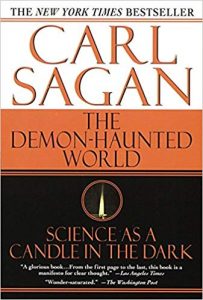
I read this after finishing my PhD and as I began to take stock of the world we live on and the way we treat each other. Growing up, I had never taken seriously magicians, astrologers, and others with big claims backed by no evidence. In fact, it was frustrating to see how well these types of persons fooled what appeared to me, at the time, to be the whole world. It was a relief to read this book at first, and then, as the chapters developed, the deep disappointment that came with the realization that shallow thinking truly was pervasive in society and having a detrimental impact on so many peoples lives. This book, Sagan’s last, reminds me to respectfully if possible speak out against obviously ridiculous ideas no matter the source.
Black Hole: How an Idea Abandoned by Newtonians, Hated by Einstein, and Gambles on by Hawking Became Loved by Marcia Bartusiak

Alan Hirshfeld:
No topic in astronomy elicits more questions from an audience than black holes. The end-product of stellar collapse, black holes are nature’s ultimate rebuke to a star’s luminescent flamboyance: clefts in the fabric of spacetime from which light cannot escape. This charming book, by award-winning science writer Marcia Bartusiak, details the surprisingly long run up (since 1783) to our modern-day understanding of black holes and their counterintuitive role in some of the most energetic phenomena in the universe.
What do you think are the most important books on astronomy? Let us know which books you’d nominate as the most important books on astronomy, on Facebook and Twitter. If you enjoyed this, don’t miss our recent reading list, The Best Books on Climate Change.
Image credit: Eric Chaisson Photo by Matt Cashore
As an Amazon Associate we earn from qualifying purchases made through links on this page.