
Mark Maslin: Help Save Our Beautiful Planet
Mark Maslin’s reading list
11 books mentioned in this interview
- Empireland · Sathnam Sanghera
- How to Blow Up a Pipeline · Andreas Malm
- Silent Spring · Rachel CarsonRecommended 3 times
- How to Save Our Planet
- The Art of War · Sun TzuRecommended 4 times
- Risen · Benedict Jacka
- The Origin of Species · Charles DarwinRecommended 6 times
- Paradise Lost · John Milton
- The Earth Transformed: An Untold History · Peter Frankopan
- The Silk RoadsRecommended 3 times
- The New Silk Roads
Mark Maslin is a Professor of Earth System Science at University College London, a Royal Society Industrial Fellowship, and the Executive Director of Rezatec Ltd and Director of The London NERC Doctoral Training Partnership. He is a leading scientist with expertise in past and future global climatic change, and has published over 175 papers in journals such as Science, Nature, and The Lancet. He has also supervised 15 research fellows, 20 PhD students, and over 40 MSc students.
Maslin is a member of the Cheltenham Science Festival Advisory Committee, sits on the Corporate Social Responsibility Board of the Sopria-Steria Group and Sheep Included Ltd, and has presented over 50 public talks over the last five years. He has also written 8 books, over 60 popular articles, and appeared on radio and television. He was included in Who’s Who in 2009 and was granted a Royal Society Wolfson Research Merit Award in 2011.
Please enjoy our interview with Mark Maslin…
What does a typical day look like for you?
A typical work day starts early. I go to the gym and listen to podcasts covering politics, history, economics and science. I then come back home have breakfast and feed our cat. Then I either walk to work or fire up the laptop at home. There is no real typical work day – as I have such varied commitments – as I teach undergraduates, masters and PhD students, I mentor colleagues, I undertake climate research, I write academic papers, I advise companies and NGOs on climate change, I help run a company I set up with colleagues 10 years ago, I give public talks, write popular articles and books. Evenings vary from quiet dinner with my partner and a good TV series to nights out at the theatre, concert hall or going to a popular talk by friends or colleagues.
Is there something about you that people might find surprising?
People assume because I am a Professor that I had some sort of privileged background. In fact my background was very humble with parents that left school at 16 and then studied at night school to improve themselves. I went through the state education system – and my children do not believe me that my infant and junior school (pre 12 years old) only had outside toilets – freezing in winter and smelly in summer. But the only thing that was not lacking in my childhood was books.
What are you reading at the moment and what made you want to read it?
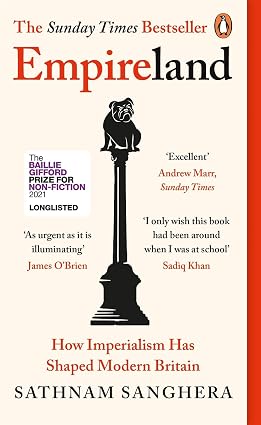
I am currently reading Empireland by Sathnam Sanghera – and I wanted to read it because one of the major emerging themes in climate change is climate justice. But I believe we can only discuss climate justice if we understand and acknowledge the injustices of colonialism. Unlike many other countries Britain has not engaged or faced the reality of the exploitative and brutality nature of the British Empire – and how other countries have not forgotten the oppression they suffered at the hands of the British. This is an excellent book examining how modern Britain avoids talking about, let alone dealing with its past.
When did you first become passionate about the topic of climate change?
I have always been interested in the environment – and went on to study geology and geography at University. But it was during my PhD at Cambridge that I got it excited about past climate change and what controlled long term changes in the environment and the causes of evolution. As climate change emerged as a major issue my knowledge of how the climate system work was useful in understanding the impacts of humans.
But what really drove my understanding and passion was when Oxford University Press asked me to write one of their ‘Very Short Introductions’ on ‘Global Warming’. I did a lot of research on the history, science, and politics of global warming and the first issue was published in 2004. Because so much changes in our knowledge and the politics of climate change I keep having to re-write the book. In 2021 I published the fourth edition now named Climate Change: A Very Short Introduction.
What was the last book you purchased, and why did you buy it?
The last book I purchased was How to Blow Up a Pipeline by Andreas Malm – and I bought it because I am interested how environmental and climate change protests have evolved and where it will go in the future. As there seems to have been four waves of recent environmental social movements.
The first was in 1970s and this growing environmental awareness can be traced back to a number of key markers such as the publication of Silent Spring by Rachel Carson in 1962. This environmental awareness focused mainly on pollution, pesticides, and destruction of local environments.
The second wave sprung up in the late 1980s and early 1990s when the discovery of the ozone hole showed humanity’s environmental impact was global. The third wave was in 2008 and 2009, focusing on the hope of a major climate deal at the Copenhagen climate conference. Copenhagen ended in failure due to a lack of international leadership, a change in direction driven by the US and China, lobbying by powerful climate change deniers and the global maelstrom of the 2008 global financial crash. The fourth wave of the global environmental social movement started in 2018 when Extinction Rebellion was founded in the UK. Using non-violent civil disobedience to compel governments around the world to avoid tipping points in the climate system and stem biodiversity loss to prevent both social and ecological collapse.
In August 2018, Greta Thunberg – at the age of 15 – began spending her school days outside the Swedish Parliament holding a sign saying Skolstrejk för klimatet (School strike for climate) calling for stronger action on climate change. Soon, other students from around the world started similar school strikes on one Friday per month and called the movement ‘Fridays for Future’. There is a school of thought that we have now entered a fifth wave of social movement – radical direct action. Borne out of the frustration that many climate campaigners feel from the lack of action by Government and many corporations. Andreas Malm discusses in his book direct action and why it is occurring and why it is essential.


What are perfect reading conditions for you?
Perfect reading conditions are a long train journey, a long leisurely bath, and a quiet evening in sitting on the sofa with a cat curled up on my lap.
How did you plan, research, and write your book, How to Save Our Planet?
I wrote this book in part because I was frustrated with other books on climate change – and there are lots out there. They are all doom and gloom – and they are what I call worthy books – ones you feel you should read but do not want to. And yes, I admit I have written one or two of these types of books. So, I wanted to write a book for everyone and anyone who wanted to understand and do something about the mass environmental crisis we are facing. I wanted to write a book that you can quote in the pub, at a dinner party, in a Board meeting or even in Parliament or Congress
The book is written in single or double sentences – just the facts – it distils down everything we know about climate change and how to solve it into a short handbook. The inspiration of the style came from listen to a podcast – which I do a lot of. BBC Radio 4 In Our Time had a brilliant programme on one of my favourite books The Art of War by Sun Tzu – now this book is over 2500 years old but is still a required reading of the US Marine Corp and the UK Army. It is the principles of war written down in simple statements “Do not put men on ridge with sun behind them”, Have more spies than the enemy, “do not attack unless you know you can win”. So, I thought why not write a book about how we can save our planet in the same style. Of course, when I finished the book and I was re-reading the each chapter, I realised that each one was like a very long Twitter thread – so I had used an ancient text to inspire me to write a book for the modern age of social media.
The book is non-linear – basically you do not have to start at the beginning – you can read any chapter you are interested in – so if you want suggestions of what an individual can do then you start at chapter 6. The first three chapters of the book tell you have we got into this mess, Chapter 4 was a suggestion of my Editor, and it counters all the lies spread by climate change deniers. Chapter 5 shows how bad it could be if we do nothing about climate change. And then there are four chapters which list what Individual, Companies, Governments, and the International Community can do to help save out beautiful planet. All these solutions are win-win or even win-win-win.


What’s the best book you’ve read in the last 6 months?
The best book I have read in the last 6 months must be Risen by Benedict Jacka. Because I read scientific papers and books for a living most of my free reading time is taken up with science fiction and fantasy – though an occasional brilliant crime novel slips in. So, Benedict Jacka has created Alex Verus who is a brilliant character up there with Gandalf or Harry Dresden.
Alex is a mage who starts life quietly running a shop the Arcana Emporium, in my part of North London, Camden Town. He is drawn into the politics of dark and light magic and by Risen, in the final book he must outwit all his enemies, save his girlfriend and his friends all of which he does while he thinks he is dying. Brilliant end to a brilliant series. I would also recommend all the Jim Butcher Harry Dresden books.

If you could name three things people could do to help save our planet, what would they be?
How to Save Our Planet: The Facts has chapters on what Individual, Companies, Governments and the International Community can do to help save our beautiful planet. As all of us have agency and a role to play. For me the easiest three for individuals are:
Talk about climate change – it is one of the greatest threats to humanity, but we are reluctant to talk about it. And if you talk about it, you will find that many of your colleagues and friends are also worried and this leads to collective support and many times real action.
Switch to a more plant based diet and definitely cut out all red and processed meat. First it will make you much healthier and live longer. If everyone in the world switch to a plant based diet, we could half the carbon emissions from food and half the amount of land and water used for farming.
Spend your money wisely – we are in a consumer society so your money drives companies so if you choose more sustainable products and slow fashion over fast fashion then the companies will follow your money. Also try only to buy stuff from companies you know are trying to reduce their carbon and environmental footprint.

If an alien landed in your garden; which three books would you gift them to showcase humanity in the best possible way?
It is very difficult to showcase the complexity and depth of the human experience – how do you show the very best of us and worst of us. I also struggle with whether aliens would understand our propensity to tell stories – if we gave them a novel would they think this is fact – something that actually happened. So, I have picked three books that show different aspects of humanity.
My first choice would be The Origin of Species by Charles Darwin – one of the most important and influential books every published. This book defines humans as part of the natural world and describes how all living things including humans evolved. This book shows aliens we understand the scientific method, the accumulation of observations and evidence and how to draw clear conclusions based on facts. It shows that we understand how humans evolved and our place on our planet.
My second choice would be Paradise Lost by John Milton. Though over 350 years old, this epic poem is about the rebellion of Satan against God and the eviction of humans from Eden. It is a story examining a divine creation and the consequences of this if it were real. It is about human ambition – both the strengths and weaknesses of the human condition. And it is about rebellion against a divine creator whether real or imaged.
My third choice would be of course How to Save Our Planet: The Facts – a quick read for an alien to show the history of how humanity got into such a mess. It also illustrates that we have the science to understand what we are doing and the consequences of our actions – so there is no excuse that we did not know. And then the book even gives clear simple lists of actions that would help save the beautiful planet we love on.


What is the book that you feel has had the single biggest impact on your life? What impact did it have?
There is no single book that I can pick that has had the most significant impact on my life. Rather I would say all of them; as the very act of writing, whether fiction or non-fiction, means the author has poured their ideas and thoughts into their work. Books always provide something to learn about life, the human condition, society, science, or the future. I would also add that some books have influence at different stages of one’s life and then we move on. For me as a child, books were an escape, to better and more exciting places. They showed me different ways of living and inspired me to learn and to try and change the world for the better.
Which book sat on your shelf are you most excited about reading next and why?
This book is not on my shelf, but I have it on order as it has not yet been published. It is The Earth Transformed: An Untold History by Peter Frankopan. The reason why I am so excited by this book is because Peter Frankopan’s previous books The Silk Roads and The New Silk Roads were deeply insightful examinations of the history of China and its relationships with the rest of the world.
Now he turns his attention to big history and how the relationship of humanity with our environment has altered and changed throughout history and how we are now in an environmental and climate crisis. This book is on the same large themes as I tackled in my book The Human Planet co-authored with Simon Lewis and of course How to save our planet and I am excited to see how Peter Frankopan approaches these important topics.


If you enjoyed our interview with Mark Maslin, make sure to visit his UCL faculty page and follow him on Twitter.
Feature image credit: ucl.ac.uk
As an Amazon Associate we earn from qualifying purchases made through links on this page.
You might also like

Andrew Knoll: Books Enable Us To Communicate Across Generations
Interview · 11 January 2017

Michael Shermer: A Scientific Masterclass of Books
Interview · 12 November 2016

Pedro Domingos: Exploring the Nexus of Reading and AI Innovation
Interview · 31 May 2023

Susan Ware: Speaking Louder Than I Can
Interview · 20 September 2022