James Mustich: To Spread Good Books About
James Mustich’s reading list
13 books mentioned in this interview
- The Haunted Bookshop · Christopher Morley
- The Metaphysical Club · Louis Menand
- The Human Comedy · William Saroyan
- Berta Isla · Javier María
- Middlemarch · George EliotRecommended 11 times
- The Surprise of Cremona: One Woman’s Adventures in Cremona, Parma, Mantua, Ravenna, Urbino, and Arezzo · Edith Templeton
- Constellations: Reflections from Life · Sinéad Gleeson
- The Oresteia · Aeschylus
- The Walls Came Tumbling Down · Henriette Roosenburg
- The Mouse and His Child · Russell Hoban
- Advertisements for Myself · Norman Mailer
- My Wicked, Wicked Ways · Errol Flynn
- Semicolon: The Past, Present, and Future of a Misunderstood Mark · Cecelia Watson
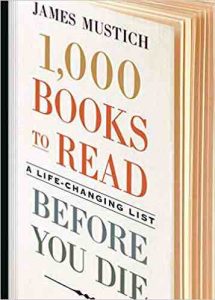
Books by James Mustich: 1,000 Books To Read Before You Die: A Life-Changing List
James Mustich began his career in bookselling at an independent book store in Briarcliff Manor, New York, in the early 1980s. In 1986, he co-founded the acclaimed book catalog, A Common Reader, and was for two decades its guiding force. James Mustich subsequently has worked as an editorial and product development executive in the publishing industry. Mustich’s book 1,000 Books To Read Before You Die: A Life-Changing List was published by Workman Publishing, receiving starred reviews from Publishers Weekly, Booklist, and Library Journal, as well as the praise of other notable independent reviewers. The Washington Post listed it as one of the 50 best nonfiction books of the year, and described it as “The ultimate literary bucket list”. Covering fiction, poetry, science and science fiction, memoir, travel writing, biography, children’s books, history, and more, 1,000 Books to Read Before You Die ranges across cultures and through time to offer an eclectic collection of works that each deserve to come with the recommendation, “You have to read this”.

Please enjoy my interview with James Mustich…
How do you describe your occupation?
Reader, writer, and former bookseller. I see my vocation as the one described by Roger Mifflin, the bookselling protagonist of The Haunted Bookshop by Christopher Morley: “to spread good books about, to sow them on fertile minds, to propagate understanding and a carefulness of life and beauty.”

What is something about you that people might find surprising?
I have six filing cabinets in my basement filled with letters and emails from readers championing their most treasured books and authors. They were sent to me during the years that I was publishing the book catalogue, A Common Reader, which I founded in 1986 and ran for two decades.
What are you reading at the moment and what made you want to read it?
The Metaphysical Club by Louis Menand. I first read it when it was published in 2001, and I decided to reread it recently when I realized what a profound effect it has had on my thinking, how well it articulates a way of looking at the world that is congenial to me.

What was your favourite book as a child and why?
The Human Comedy by William Saroyan, because it captured the whimsy and wonder of a child’s parsing of experience—and made writing about it seem romantic.

When did you fall in love with reading?
Before I can remember.
What was the last book you purchased, and why did you buy it?
Berta Isla by Javier Marías, whose work I admire for its distinctive style. Intimate, digressive, allusive, pondering, it conjures a kind of psychological and aesthetic acuity that Is seductive and hypnotic. As I write in my book, “Reading Marías has the ruminative intensity and meditative calm of smoking a cigarette, without the carcinogenic consequences.”

What are perfect reading conditions for you?
On a train (in the quiet car, if there is one).
What book have you found most inspiring, what effect did it have on you?
Middlemarch by George Eliot. I read it for the first time when I was in college and have read it in each of the four decades since. At 19, it seemed to be the wisest book I’d ever read, and my sense of its wisdom has only grown as my experience expanded. The narrative voice is animated by a combination of intelligence, sympathy, and magnanimity that gives earnestness a good name. Eliot’s vigilant soul taught me a lot about thinking and writing, but even more about living. The book’s central truth—“For there is no creature whose inward being is so strong that it is not greatly determined by what lies outside it”—is brilliantly pondered and dramatized across the novel’s 600 pages.

What’s the most obscure book you own; how did you discover it?
The Surprise of Cremona: One Woman’s Adventures in Cremona, Parma, Mantua, Ravenna, Urbino, and Arezzo by Edith Templeton, which a dinner companion once told me was the best travel book in English about Italy. Although I’d been a bookseller for three decades at the time, I’d never heard of either book or author. But my companion was right: it’s marvelous, albeit difficult to find.

What’s the best book you’ve read in the last 6 months?
Constellations: Reflections from Life by Sinéad Gleeson. Filled with the pain and scars that mark one woman’s incarnation, Gleeson’s book of essays is visceral in the way few books are, stained with blood and sustained by it, a heart buoyed with its beating. It’s also smart and funny and angry and tender, true to life, and to art, and to love, in vital ways.

What is your proudest achievement?
Raising our daughters, who are grown and resourceful women.
If you were trying to impress a visitor, which book that you own would you leave on the coffee table?
I’m embarrassed to admit it would be 1,000 Books To Read Before You Die: A Life-Changing List since it sums up a lot of what I’ve been doing for the past 40 years. It’s also a good conversation starter.
If an alien landed in your garden; which three books would you gift them to showcase humanity in the best possible way?


What is the book that you feel has had the single biggest impact on your life? What impact did it have?
I’m going to take the question materially rather than spiritually and mention the actual physical copy of Advertisements for Myself by Norman Mailer that I discovered when I was 11 or so. It belonged to a friend of my father who was at the time leading a somewhat transient life, and as a result storing some of his belongings in our attic. These included a box of books that held, among other forgotten treasures, My Wicked, Wicked Ways by Errol Flynn and a first edition of Advertisements for Myself that Mailer had inscribed as follows: “To Dick, who is never a phony and I guess there’s no greater compliment anyone can give. Norman.” Knowing Dick as I did, his intimacy with a writer surprised me.
Since even at that age I already thought of myself as a writer-in-training (under the influence of the aforementioned William Saroyan), this book, signed by a real live famous author and with a table of contents that was puzzling, beguiling, and spellbinding in its intricacy (I wouldn’t make it to the actual prose until some years later) became for me a powerful talisman. I would actually climb up into the attic some days just to pull it out of the box and ponder the inscription.


Are there any books you haven’t mentioned that you feel would make your reading list?
How much space do you have? There are at least 990 more!
Which book sat on your shelf are you most excited about reading next and why?
Semicolon: The Past, Present, and Future of a Misunderstood Mark by Cecelia Watson, because I am an acolyte of this particular form of punctuation and I fear it is under threat; if it disappears, with it will go the careful, measured perspective its use encourages, and demands.

If you’d like to learn more about James Mustich, you can find him on his website.
As an Amazon Associate we earn from qualifying purchases made through links on this page.