The Best Science Fiction Books of All Time
In this list
44 books
- Frankenstein · Mary ShelleyRecommended 5 times
- The Time Machine · H. G. WellsRecommended 6 times
- The War of the Worlds · H. G. WellsRecommended 4 times
- Brave New World · Aldous HuxleyRecommended 7 times
- Famous Science Fiction Stories: Adventures in Time and Space · Raymond J. Healy and J. Francis McComas
- Nineteen Eighty-Four · George Orwell
- I, Robot · Isaac AsimovRecommended 3 times
- The Martian Chronicles · Ray BradburyRecommended 3 times
- Foundation · Isaac AsimovRecommended 6 times
- Fahrenheit 451 · Ray BradburyRecommended 8 times
- Childhood's End · Arthur C. Clarke
- The Past Through Tomorrow · Robert A. Heinlein
- Solaris · Stanisław Lem
- Phoenix · Osamu Tezuka
- Dune · Frank HerbertRecommended 13 times
- Flowers for Algernon · Daniel KeyesRecommended 4 times
- Do Androids Dream of Electric Sheep? · Philip K. DickRecommended 7 times
- 2001: A Space Odyssey · Arthur C. Clarke
- The Left Hand of Darkness · Ursula K. Le GuinRecommended 4 times
- Slaughterhouse-Five · Kurt VonnegutRecommended 14 times
- Rendezvous with Rama · Arthur C. Clarke
- The Dispossessed · Ursula K. Le GuinRecommended 5 times
- The Forever War · Joe Haldeman
- Kindred · Octavia E. ButlerRecommended 4 times
- The Hitchhiker's Guide to the Galaxy · Douglas AdamsRecommended 20 times
- The Book of the New Sun · Gene Wolfe
- Stars in My Pocket Like Grains of Sand · Samuel R. Delany
- Neuromancer · William GibsonRecommended 4 times
- Ender's Game · Orson Scott CardRecommended 9 times
- The Handmaid's Tale · Margaret AtwoodRecommended 21 times
- Cyteen · C. J. Cherryh
- Hyperion · Dan SimmonsRecommended 4 times
- Parable of the Sower · Octavia E. ButlerRecommended 4 times
- Never Let Me Go · Kazuo IshiguroRecommended 4 times
- The Three-Body Problem · Cixin LiuRecommended 6 times
- The Martian · Andy WeirRecommended 7 times
- Leviathan Wakes · James S. A. Corey
- Ancillary Justice · Ann LeckieRecommended 4 times
- The Long Way to a Small, Angry Planet · Becky Chambers
- Children of Time · Adrian TchaikovskyRecommended 4 times
- All Systems Red · Martha Wells
- A Memory Called Empire · Arkady Martine
- Klara and the Sun · Kazuo IshiguroRecommended 4 times
- Project Hail Mary · Andy WeirRecommended 3 times
The best science fiction books do far more than imagine the future. They ask what it means to be human, what we might become, and what we could lose. This list brings together the greatest science fiction books of all time, from Frankenstein and Nineteen Eighty-Four to Dune, The Left Hand of Darkness and modern classics like Project Hail Mary.
We asked a panel of science fiction writers, including the Hugo and Nebula award winner Jo Walton and the historian and novelist Ada Palmer, to name the books they think are the best of all time. Their picks are below, in their own words (you can meet the panel at the end), together with the other classics and modern favourites we think every science fiction fan should read. The books are arranged by when they were first published.
Where to start
If you’ve never read much science fiction, start with The Hitchhiker’s Guide to the Galaxy or Project Hail Mary. Both are funny, gripping and easy to love. If you want the books that shaped the genre, read Frankenstein, Nineteen Eighty-Four and Dune.
Our top 3:
- Best science fiction book of all time: Dune by Frank Herbert
- Best classic: Nineteen Eighty-Four by George Orwell
- Best modern science fiction book: Project Hail Mary by Andy Weir
The best classic science fiction books

Victor Frankenstein, a young Swiss scientist, discovers how to bring dead matter to life, and builds a man. Horrified by what he has made, he abandons it. The creature, intelligent and desperately lonely, sets out to make his creator pay.
Mary Shelley began it at nineteen, during a ghost story contest with Lord Byron and Percy Shelley on Lake Geneva. It’s often called the first true science fiction novel, and its warning about science without responsibility has never dated.
David Pedreira says:
A lot of great science fiction has been written in the last forty years (heck, a lot of excellent work has been published in the past five years!), but I’m going to stick with the foundational stuff. And Frankenstein is foundational. I mean, it’s archetypal. It probably has influenced more novelists, musicians, comic book writers, playwrights, and filmmakers than any other novel—everything from Alien to Asimov to Stephen King. It’s been copied, spoofed, and spun off into new franchises and genres. I think it’s endured because it is beautifully written, and it stirs that ancient and abiding fear of what happens when humans play God.
Setting: Switzerland, Scotland and the Arctic · Genre: Gothic science fiction · Published: 1818

A Victorian inventor travels to the year 802,701 and finds humanity split in two: the gentle Eloi above ground, and the Morlocks, who live in the dark below and feed on them.
It’s short enough to read in an afternoon, and nearly every time travel story since owes it something. See our list of the best books about time travel for more.
Setting: England, and the far future · Genre: Science fiction classic · Published: 1895

Cylinders fall from the sky on Horsell Common in Surrey, and out of them come Martians in huge three-legged fighting machines. With heat rays and poison gas, they march on London, and nothing the British army has can stop them.
The first great alien invasion story, it’s still gripping and frightening, and it shaped every invasion story that followed. For more, see the best books about aliens.
Setting: Surrey and London, England · Genre: Alien invasion · Published: 1898

In the World State, babies are grown in bottles and conditioned for their place in society. Everyone is kept happy with sex, shopping and a drug called soma, and no one is ever unhappy or alone. Then Bernard Marx brings back John, a ‘savage’ raised outside it.
Where Orwell imagined control through fear, Huxley imagined control through pleasure, and many readers think he was closer to the truth.
Setting: London, England, in AD 2540 · Genre: Dystopian fiction · Published: 1932
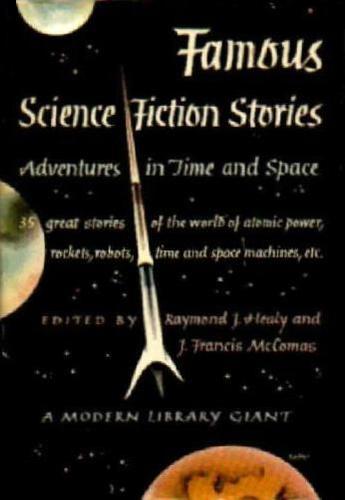
A classic anthology of stories from science fiction’s ‘golden age’ in the 1930s and 40s, first published as Adventures in Time and Space.
Jack McDevitt says:
An early anthology of gripping stories by Robert Heinlein, A. E. Van Vogt, Alfred Bester, Isaac Asimov, Anthony Boucher, L. Sprague de Camp, John W. Campbell (writing as Don Stuart), and others. Most of the stories were originally published by Campbell during the era when he was guiding SF to its golden days.
Setting: Various · Genre: Short stories · Published: 1946

Winston Smith works at the Ministry of Truth in London, rewriting history for the Party. Everywhere he goes, posters warn that Big Brother is watching him. When he starts a secret diary and a forbidden love affair with Julia, he knows that the Thought Police will come for him in the end.
The most influential dystopian novel ever written, and still the one to read first. For more like it, see the best dystopian books.
Ada Palmer says:
Big Brother, doublethink, thoughtcrime, the chocolate ration has been increased to two ounces; Orwell created a vocabulary for thinking and talking about totalitarianism and authoritarianism, which have disseminated around the world, far beyond the millions who have read the book itself. Orwell was right that the vocabulary in which we think and speak can make it harder or easier to express ourselves or even fully form ideas, both personal and political. Thus the inventor of Newspeak and its chilling project to make language incapable of expressing resistance gifted us just the opposite, language which lets us pack immensely sophisticated critiques of the darker turns of modern civilization into a single word: Orwellian.
Setting: London, in the superstate of Oceania · Genre: Dystopian fiction · Published: 1949

Nine linked stories, told by the robot psychologist Dr Susan Calvin, about robots that must obey the Three Laws of Robotics. Each story is a puzzle: why is a robot behaving strangely, when it can’t break the laws?
Asimov’s Three Laws are still discussed by people working on AI today, and the book is more relevant now than ever.
Setting: Earth and space, 1996–2052 · Genre: Short stories, robots · Published: 1950

Linked stories about humanity’s arrival on Mars, from the first doomed expeditions to the colonies that follow, and what happens to the Martians.
Jack McDevitt says:
Possibly Bradbury’s best work, which is probably saying enough. A collection of connected stories about our early years on Mars as we thought, during the 40’s and 50’s, they might actually occur. The Martians themselves are missing. The tales are wistful, framed with a sense of loss. My favorite moment depicts a family with three sons standing on the edge of a canal –yes, the canals are there—and when one of the boys asks, Daddy, where are the Martians? You told us they were here, he responds by saying they are here and invites them to look down at their reflections.
Setting: Mars, 1999–2026 · Genre: Short stories · Published: 1950

The Galactic Empire has ruled for 12,000 years, and the mathematician Hari Seldon has worked out that it’s about to fall. Thirty thousand years of darkness will follow, unless a group of scholars at the edge of the galaxy, the Foundation, can shorten it to one thousand.
A story about ideas, politics and history on a grand scale, and the first book in one of the most famous series in science fiction.
Setting: The planet Terminus, in a far future galaxy · Genre: Space opera · Published: 1951

Guy Montag is a fireman, but in his world, firemen don’t put out fires. They burn books, and the houses of anyone caught keeping them. Then he meets Clarisse, a strange young neighbour who asks him if he’s happy, and he starts to steal books from the fires.
Short, beautiful and angry, it’s a warning about censorship, television and a society that stops thinking.
Setting: An unnamed American city · Genre: Dystopian fiction · Published: 1953

Huge alien ships appear over every city on Earth. The Overlords, as they are called, end war, poverty and cruelty, and humanity enters a golden age. But they won’t show themselves, and no one knows what they want.
Clarke’s first great novel, and one of the most haunting first contact stories ever written.
Setting: Earth and the stars · Genre: First contact · Published: 1953

The collected stories of Heinlein’s ‘Future History’, which imagine the next few centuries of human life, from moving roads to the first colonies on the Moon.
Jack McDevitt says:
This is a collection is of glimpses at what life might look like as the world changes and technology moves on. Highways transport vehicles in “The Roads Must Roll.” Occupants of a space ship must stop an air leak by sitting on the problem in “Gentlemen, Be Seated.” A married couple living in Luna City yearn for the good old days on Earth in “It’s Great To Be Back.” When they do return, life is not the way they remembered and they’re ultimately relieved to get back to the Moon. Other stories are equally powerful. Also included in the collection is “The Green Hills of Earth,” which gets my vote as the best SF story ever.
Setting: Earth, the Moon and space · Genre: Short stories · Published: 1967 (stories from 1939–1962)
The best science fiction books of the 1960s and 70s

Kris Kelvin, a psychologist, arrives at a research station above Solaris, a planet covered by a vast ocean that may be a single living mind. The scientists there are falling apart, and soon Kelvin is visited by his dead wife, Rheya.
A strange, beautiful novel about how impossible it might be to understand a truly alien mind, and one of the great works of European science fiction.
Setting: A space station above the planet Solaris · Genre: Philosophical science fiction · Published: 1961

A twelve-volume manga epic, which jumps between the distant past and the far future, by the ‘god of manga’ who created Astro Boy.
Ada Palmer says:
A twelve-volume manga epic responding to World War II, that uses historical fiction and deep future science fiction to seek a way to understand how the Buddhist message that “All life is sacred” could be an honest description of our universe where living beings – humans – endure such suffering as World War brings and also commit such atrocities as genocide. The volumes alternate in time, the first taking place at the very beginning of the historical record, the second in the extreme far future as humankind is dying out on an exhausted Earth, the third in the slightly less archaic past, the fourth in a slightly less distant future, converging toward the present and reflecting on the life cycle of humanity as a species, but woven together with atemporal reincarnation so that sometimes sufferings people endure in the distant past turn out to be karmic justice for atrocities they committed in the distant future. The work asks whether a justice humans can never understand is truly justice, and what the sacredness of life means in a cosmos governed by the Phoenix and her “wise and cruel law” that “All things are born, and all things die.”
Setting: Japan, from ancient times to the far future · Genre: Manga, science fiction · Published: 1967–1988

Paul Atreides’s family is given control of Arrakis, a desert planet and the only source of spice, the most valuable substance in the universe. It’s a trap. When his family is betrayed, Paul flees into the desert and joins the Fremen, who believe he might be their messiah.
The bestselling science fiction novel of all time, and the start of a six-book series.
David Pedreira says:
Dune has so many layers. It is part sci-fi and part epic fantasy, and in my opinion it handles politics better than any other novel in the science fiction genre, because the political structures never feel forced or fabricated. For a book set millennia into the future, it remains incredibly timely and human, with its blend of mysticism, declining empires, environmental decay, and epic struggles over natural resources. But more than anything, it leaves behind a cinematic vision that never goes away. When I think of Dune, my mind goes orange. I can smell the spice in the sand, and feel the movement of sandworms under my feet.
Setting: The desert planet Arrakis · Genre: Space opera · Published: 1965

Charlie Gordon, a kind man with an IQ of 68, is chosen for an experimental operation that has already made a laboratory mouse, Algernon, a genius. Told through Charlie’s own progress reports, we watch his mind grow, and then watch what happens to Algernon.
One of the most moving books in science fiction, and one readers never forget.
Setting: New York (US) · Genre: Literary science fiction · Published: 1966

After a world war, most animals are extinct and owning a real one is a sign of status. Rick Deckard, a bounty hunter in San Francisco, is paid to ‘retire’ androids who have escaped from Mars, and who are almost impossible to tell apart from humans.
The book that inspired Blade Runner, and stranger, funnier and sadder than the film. It asks what it really means to be human.
Setting: San Francisco (US), 1992 · Genre: Cyberpunk, dystopian · Published: 1968

A black monolith found buried on the Moon sends a signal towards Saturn, and the ship Discovery is sent to follow it, with a crew of astronauts and HAL 9000, its intelligent computer.
Clarke wrote the novel alongside Stanley Kubrick’s film.
David Pedreira says:
This is one of the first science fiction novels I read as a kid, and it got me hooked. I don’t think the novel gets enough credit because it is so inextricably tied to the movie. Both are brilliant, especially because they take different paths to the same destination. The novel hits primordial nerves and leaves you with a sense of wonder and mystery about the universe. And it’s all told through the story of Earth, humanity, and the pros and cons of human invention. And, of course, it has Hal—still my favorite AI of all time.
Setting: Africa, the Moon and space · Genre: Hard science fiction · Published: 1968

Genly Ai is sent alone to the frozen planet Gethen to invite it to join an alliance of worlds. The Gethenians have no fixed sex: they can become male or female. As Genly is caught up in its politics and makes a desperate journey across the ice, he has to question everything he believes about gender.
A landmark of science fiction, and winner of both the Hugo and Nebula awards.
Setting: The ice planet Gethen · Genre: Social science fiction · Published: 1969

Billy Pilgrim has ‘come unstuck in time’. He jumps between his life in America, his time as a prisoner of war during the firebombing of Dresden, and his life in a zoo on the planet Tralfamadore.
Funny, sad and completely original, it’s one of the great anti-war novels.
Setting: Germany, the US and Tralfamadore · Genre: Literary science fiction · Published: 1969

In 2131, a huge cylinder fifty kilometres long enters the solar system. It’s an alien spacecraft, and the crew of the Endeavour have only a few weeks to explore it before it swings round the Sun.
A gripping story of exploration and wonder, and winner of the Hugo and Nebula awards.
Setting: Space, in 2131 · Genre: Hard science fiction · Published: 1973

Shevek, a brilliant physicist, leaves the anarchist moon of Anarres, where there is no property and no government, and travels to the rich planet Urras.
Jo Walton says:
The Dispossessed is written like a Maori spiral pattern, starting and ending in the middle. It follows the life of Shevek, a scientist from Anarres, a planet founded as a utopian experiment by dissidents from Urras, now a hundred and fifty years later it is something else. It’s the story of Anarres and Urras, which are each other’s moons and shadows, of politics and physics and communication. Le Guin wrote a number of wonderful hugely influential books, but I think this is her masterpiece, written at the top of her powers. You don’t even think of this as worldbuilding, it’s as if she’s reporting from somewhere real.
Setting: The planet Urras and its moon Anarres · Genre: Social science fiction · Published: 1974

William Mandella is drafted to fight an alien enemy across the galaxy. Because of time dilation, every mission that takes him months takes decades on Earth, and each time he returns, home is less recognisable.
Haldeman fought in Vietnam, and the novel is a powerful story about soldiers coming home to a world that has forgotten them. It won the Hugo and Nebula awards.
Setting: Earth and deep space, 1997–3143 · Genre: Military science fiction · Published: 1974

In 1976, Dana, a young Black writer in Los Angeles, is suddenly pulled back in time to a plantation in Maryland in the early 1800s, again and again, to save the life of the white son of a slave owner.
Butler uses time travel to make readers feel the reality of slavery in a way no history book can. Gripping, harrowing and essential.
Setting: California and Maryland (US) · Genre: Science fiction, historical fiction · Published: 1979

Seconds before Earth is demolished to make way for a hyperspace bypass, Arthur Dent is rescued by his friend Ford Prefect, who turns out to be from a small planet near Betelgeuse. Still in his dressing gown, Arthur sets off across the galaxy.
The funniest science fiction book ever written, and a great first sci-fi book for anyone.
Setting: Earth and across the galaxy · Genre: Comic science fiction · Published: 1979
The best science fiction books of the 1980s

Severian, a torturer’s apprentice, is exiled for showing mercy and walks across Urth, a far future Earth under a dying sun. Shadow & Claw collects the first two of its four books.
Ada Palmer says:
Deep Future, science fiction set so far down humanity’s path that every mountain on the planet has been carved into a famous face, and the days before First Contact and space empires are remembered only in mythology. In contrast with imagined worlds where readers have learned to expect and accept the Star Trek one-culture-per-planet, writing a long Earth history is a different kind of worldbuilding challenge, requiring the extra density of showing layered eras stacked like tree rings: ancient, Medieval, Renaissance, and many beyond, the cumulative complexity of a culture filling up the time between the present and the dimming of the sun. The Book of the New Sun set new standards for complexity of world, writing style, narration, and the reader’s relationship with the narrator, innovating in spheres far beyond plot and characters, and pushing the envelope of the genre’s ambition.
Setting: Urth, a far future Earth · Genre: Science fantasy · Published: 1980

Rat Korga, a slave from a planet that has been destroyed, and Marq Dyeth, an ‘industrial diplomat’, meet across a galaxy of six thousand worlds and turn out to be each other’s perfect erotic match.
Jo Walton says:
Rilke’s poem The Archaic Torso of Apollo ends “You must change your life” and reading Delany often makes me feel that way too. Stars in My Pocket is a kaleidoscopic immersion into a future that feels — unusually — as complex and diverse as the present. SF tends to give us worlds that are sparse and pared down, but Delany does not just full sensory but worlds that are full of the kinds of quirks, historical remnants, customs, expectations and culture clashes that we find in real history. Stars in My Pocket is about the possibility of entire world going into cultural fugue and spontaneously destroying themselves for reasons nobody understands, but it is also about aliens, economics and true love, and will make you think about feminism, sexuality, and the purpose of art.
Setting: A galaxy of six thousand worlds · Genre: Space opera · Published: 1984

Case was the best hacker in the world until he stole from his employers and they damaged his nervous system so he could never ‘jack in’ again. Then a mysterious man offers to cure him, in return for one last job.
Gibson invented the word ‘cyberspace’ and created cyberpunk. It was the first book to win the Hugo, Nebula and Philip K. Dick awards.
Setting: Japan, Istanbul and orbit · Genre: Cyberpunk · Published: 1984

Earth has been attacked by an alien race, and is preparing for the next invasion. Six-year-old Andrew ‘Ender’ Wiggin is sent to Battle School, an orbiting academy where gifted children are trained as soldiers through endless war games.
A gripping story with a twist readers never forget. It won the Hugo and Nebula awards.
Setting: Earth and Battle School, in orbit · Genre: Military science fiction · Published: 1985

In the Republic of Gilead, which has replaced the United States, women have lost all their rights. Offred is a Handmaid, forced to bear children for a powerful Commander and his wife. She remembers her old life, her husband and her daughter, and waits.
Atwood included nothing that hadn’t already happened somewhere in history. It’s frightening, and essential. Its sequel, The Testaments, won the Booker Prize.
Setting: Gilead (formerly Massachusetts, US) · Genre: Dystopian fiction · Published: 1985

On the planet Cyteen, the powerful scientist Ariane Emory is murdered, and her colleagues try to raise a clone of her, Ari, as an exact copy.
Jo Walton says:
Cyteen is the story of a powerful scientist and politician on a planet in the future, and the attempt to clone her and reproduce her life after her original is murdered. But that’s just the beginning because the issue of replicating a personality leads to the question of how to replicate a whole human society and its values. Cyteen deals head-on with identity, power, sexuality, psychology, sociology, and personal responsibility, spiralling in on what it means to be human. It also has excellent characters and an utterly absorbing world.
Setting: The planet Cyteen · Genre: Science fiction · Published: 1988
The best modern science fiction books

On the eve of war, seven pilgrims travel to the planet Hyperion to visit the Time Tombs and the Shrike, a terrifying creature of blades. On the way, each tells their story, and why they’ve come.
Structured like Chaucer’s Canterbury Tales, it’s six brilliant stories in one, each in a different style. It won the Hugo Award.
Setting: The planet Hyperion · Genre: Space opera · Published: 1989

In 2024, climate change and inequality have brought America to collapse. Lauren Olamina, a fifteen-year-old preacher’s daughter, lives in a walled community in Los Angeles. When it’s destroyed, she heads north on foot, with a new faith of her own.
Written in 1993, it predicted far too much of the world we now live in.
Setting: California (US), 2024–2027 · Genre: Dystopian fiction · Published: 1993

Kathy, Ruth and Tommy grew up at Hailsham, an English boarding school where the teachers were kind but strange, and the students were told they were special. As adults, they slowly come to understand what they were raised for.
A quiet, devastating novel by the Nobel Prize winner, and one of the best books of the century so far.
Setting: England, 1970s–1990s · Genre: Literary science fiction · Published: 2005

During China’s Cultural Revolution, a young astrophysicist sends a signal into space. Decades later, scientists in Beijing are dying mysteriously, and a nanotech researcher is drawn into a strange video game about a world with three suns.
Huge in its ideas and ambition, it was the first translated novel to win the Hugo Award, and the start of the Remembrance of Earth’s Past trilogy.
Setting: China, 1967 to today · Genre: Hard science fiction · Published: 2008

Six days into a mission to Mars, astronaut Mark Watney is left for dead in a dust storm. He’s alive, but alone, with no way to call home and not enough food to last until the next mission. So he has to ‘science the s*** out of this’.
Funny, clever and tense, and one of the most enjoyable science fiction books ever written. For more, see the best books about space exploration.
Setting: Mars · Genre: Hard science fiction · Published: 2011

Humanity has colonised the solar system. On an ice freighter, Jim Holden and his crew find an abandoned ship and a secret that could start a war. On the asteroid Ceres, a burnt-out detective is searching for a missing girl.
A fast, gripping space thriller, and the first book in The Expanse.
Setting: The asteroid belt · Genre: Space opera · Published: 2011

Breq was once a starship, an AI controlling thousands of soldiers’ bodies. Now she has just one body left, and she wants revenge on the ruler of the empire.
The only novel to win the Hugo, Nebula and Arthur C. Clarke awards, and the first of the Imperial Radch trilogy.
Setting: The Radch Empire · Genre: Space opera · Published: 2013

Rosemary Harper joins the crew of the Wayfarer, a ship that tunnels wormholes through space. Its crew includes a lizard-like pilot, a pair of tech geniuses and an AI, and they’re about to take a long, dangerous job.
A warm, kind, character-driven story, and the book that started the ‘cosy sci-fi’ trend.
Setting: The Galactic Commons · Genre: Space opera · Published: 2014

As Earth dies, a scientist tries to uplift monkeys on a terraformed planet. It goes wrong, and instead the virus she releases evolves the planet’s spiders. Thousands of years later, the last humans arrive, hoping to find a new home.
Told partly from the spiders’ point of view, it’s an extraordinary story about evolution and intelligence. It won the Arthur C. Clarke Award.
Setting: A terraformed planet · Genre: Science fiction · Published: 2015

A security robot has hacked its own controls, and could do whatever it wants. What it wants is to be left alone to watch TV. But when a survey team it’s protecting is attacked, it has to save them, and work out who’s trying to kill them.
A short, funny first book in The Murderbot Diaries, and winner of the Hugo and Nebula awards.
Setting: An alien planet · Genre: Science fiction, comedy · Published: 2017

Mahit Dzmare arrives in the capital of the Teixcalaanli Empire to find that the last ambassador of her small mining station is dead, and no one will say how. Alone, she must solve his murder and stop the empire from taking over her home.
A clever political thriller about empire, language and identity. It won the Hugo Award.
Setting: The Teixcalaanli Empire · Genre: Space opera · Published: 2019

Klara is an Artificial Friend, a robot that watches the world from a shop window, waiting for a child to choose her. When Josie, a sick teenager, takes her home, Klara will do anything to help her.
A gentle, heartbreaking story about love and AI, and Ishiguro’s first novel after winning the Nobel Prize.
Setting: The United States · Genre: Literary science fiction · Published: 2021

Ryland Grace wakes up on a spaceship with no memory of who he is. His crewmates are dead, and he’s light years from home. Slowly, he remembers that he’s a science teacher, and that Earth is about to be destroyed. Then he finds he isn’t alone.
Funny, clever and moving, it’s become one of the most-loved science fiction books of recent years.
Setting: Space, near the star Tau Ceti · Genre: Hard science fiction · Published: 2021
Science fiction books: FAQs
What is the best science fiction book of all time?
Dune by Frank Herbert is the bestselling science fiction novel of all time and the one most often named the greatest. Nineteen Eighty-Four, Frankenstein, The Left Hand of Darkness and Neuromancer are also frequently called the best.
What was the first science fiction book?
Frankenstein by Mary Shelley, published in 1818, is usually called the first science fiction novel, because its horror comes from science rather than the supernatural. Earlier works, like Johannes Kepler’s Somnium (1634) and Margaret Cavendish’s The Blazing World (1666), also imagined journeys to other worlds.
What are the best science fiction books for beginners?
The Hitchhiker’s Guide to the Galaxy by Douglas Adams, The Martian and Project Hail Mary by Andy Weir, and The Long Way to a Small, Angry Planet by Becky Chambers are funny, easy to read and great first sci-fi books.
What are the best classic science fiction books?
Frankenstein, The Time Machine, The War of the Worlds, Brave New World, Nineteen Eighty-Four, Foundation, Fahrenheit 451 and Dune are the classics most readers start with.
What are the best modern science fiction books?
The Three-Body Problem by Cixin Liu, Children of Time by Adrian Tchaikovsky, Ancillary Justice by Ann Leckie, A Memory Called Empire by Arkady Martine and Project Hail Mary by Andy Weir are among the best science fiction books of the last twenty years.
What are the best science fiction series?
Dune, Foundation, The Expanse (starting with Leviathan Wakes), Hyperion, The Three-Body Problem trilogy and The Murderbot Diaries are some of the best science fiction book series.
Meet the panel

Ada Palmer
Ada Palmer is an author and historian. Her first science fiction novels Too Like the Lightning, Seven Surrenders, and The Will to Battle explore how humanity’s cultural and historical legacies might evolve in a future of borderless nations and globally commixing populations. Too Like the Lightning was a Best Novel Hugo finalist, and won the Compton Crook Award, while Ada received the Campbell Award. She teaches history at the University of Chicago.

Jack McDevitt
Jack McDevitt is a science fiction author whose novels frequently deal with attempts to make contact with alien races and with archaeology or xenoarchaeology. McDevitt’s novels frequently raise questions which he does not attempt to answer. He prefers to leave ambiguities to puzzle and intrigue his readers: “Some things are best left to the reader’s very able imagination.” The novel Seeker won the 2006 Nebula Award for Best Novel, given by the Science Fiction and Fantasy Writers of America.

Jo Walton
Jo Walton is an author whose most recent book is entitled An Informal History of the Hugos, in which she takes a personal look back at science fiction’s Hugo Awards. She won the John W. Campbell Award for Best New Writer in 2002, the World Fantasy Award for Tooth and Claw in 2004, the Hugo and Nebula awards for Among Others in 2012*,* and in 2014 both the Tiptree Award for My Real Children and the Locus Non Fiction award for What Makes This Book So Great.

David Pedreira
David Pedreira is a science fiction author, who is also a former reporter for newspapers including the Tampa Tribune and the St. Petersburg Times. David won awards for his writing from the Associated Press, the Society of Professional Journalists and the American Society of Newspaper Editors. His most recent release, Gunpowder Moon, has been widely praised, and Barnes & Noble named it one of its 25 Sci-Fi/Fantasy Debuts to Watch for in 2018.
If you enjoyed this list, try the best fantasy books of all time, the best dystopian books or the best books about time travel.
This post contains affiliate links. If you click on one and make a purchase, The Reading Lists may earn a small commission. This comes at no additional cost to you and helps keep our site running. Thanks for your support!
As an Amazon Associate we earn from qualifying purchases made through links on this page.