The Best Books on Screenwriting
In this list
13 books
- Save the Cat · Blake SnyderRecommended 7 times
- The Structure of Story · Ross Hartmann
- The Writer’s Journey · Christopher VoglerRecommended 4 times
- Your First Screenplay · Adam Fiske
- The Hollywood Standard · Christopher Riley
- Story · Robert McKeeRecommended 8 times
- Into the Woods · John Yorke
- Screenplay · Syd Field
- Finish the Script · Scott King
- The Nutshell Technique · Jill Chamberlain
- The Screenwriter’s Bible · David Trottier
- The Screenwriter’s Workout · Will Hicks
- Screenwriting is Rewriting · Jack Epps Jr
The best books on screenwriting can make a big difference for any aspiring screenwriters. Screenwriting is an art form that requires a unique blend of storytelling skills, creativity, and technical know-how. For those interested in learning more about screenwriting and perfecting their craft, there are a plethora of books available that offer insight, tips, and techniques from experienced screenwriters and industry professionals.
From comprehensive guides to more specialized volumes, these books cover a range of topics including character development, plot structure, dialogue, formatting, and more. Many of these books also offer practical exercises and examples to help writers put their newfound knowledge into practice.
Whether you’re a seasoned screenwriter looking to fine-tune your skills or a complete beginner looking to get started in the industry, there’s a screenwriting book out there that can help you on your journey. So why wait? Start exploring the vast world of screenwriting today and take your storytelling skills to the next level.
Here are the best books on screenwriting…

“Save the Cat” is a bestselling book that has been used by screenwriters for over 15 years. Written by Blake Snyder, it offers a humorous and candid look at the film industry and provides valuable advice for making scripts more marketable and satisfying. The book covers a range of topics, including the four elements of a winning logline, the seven immutable laws of screenplay physics, the importance of genre in scriptwriting, and the role of the hero in relation to the overall idea.
Additionally, Snyder provides guidance on how to master the 15 beats of a script, create a “perfect beast” through the use of a board to map out 40 scenes with conflict and emotional change, and how to troubleshoot and fix problems in a script using proven rules. With insider knowledge and practical tips, “Save the Cat” is a must-read for anyone looking to break into the screenwriting industry.

“The Structure of Story” is a practical guide that delves into the writing tools used by successful authors to craft compelling stories. In this book, Ross Hartmann explores the patterns that can be found in all great stories and provides readers with a framework for identifying and utilizing these patterns in their own writing. Through a focus on storytelling tools rather than rules, Hartmann guides writers on how to keep readers engaged and deliver an emotional, meaningful narrative.
Specifically, “The Structure of Story” covers four dramatic tools that keep readers interested, the two elements that every story must include, how to create multi-dimensional characters that drive plot, the role of theme in character development, the importance of cause and effect in plot development, the key elements that should be included in the opening of a story, how to effectively structure the middle of a story, how to write an emotional climax, the use of subtext, the creation of twist endings, techniques for showing rather than telling, pacing considerations, the qualities of a satisfying and inevitable ending, and how to avoid a repetitive plot.
Whether you are a seasoned writer or just starting out, “The Structure of Story” offers valuable insights and techniques for improving your storytelling skills and taking your writing to the next level.

“The Writer’s Journey” by Christopher Vogler is a book that has had a significant impact on the way stories are told in Hollywood and beyond. Originally written as a memo for Walt Disney Animation executives during the development of “The Lion King,” this book outlines a twelve-stage method for crafting compelling stories that is inspired by myth.
Vogler’s approach to storytelling deviates from the traditional three-act structure and instead focuses on character development and story structure. To illustrate his method, Vogler uses examples from myths, fairy tales, and classic movies. This comprehensive theory of story structure and character development has met with universal acclaim and has been widely adopted by screenwriters around the world.
Over the past 25 years, “The Writer’s Journey” has transformed the way screenplays are written and continues to be a highly influential work in the field of screenwriting. Whether you are a seasoned writer or just starting out, this book offers valuable insights and techniques for crafting compelling stories that resonate with audiences.

“Your First Screenplay” by Adam Fiske is an essential guide for anyone looking to write their first movie or television script. Whether you are a beginner or a seasoned screenwriter, this book is packed with tips and techniques that will help you develop your ideas and craft a professional screenplay from start to finish.
In this book, you will learn how to find great ideas and how to get them out of your head and onto the page. You will also learn how to develop realistic and engaging characters, and how to craft later drafts that take your screenplay from good to great. Additionally, Fiske offers solutions to common problems such as writer’s block, self-confidence, and dealing with feedback.
With easy-to-follow instructions and a focus on practical strategies, “Your First Screenplay” is a valuable resource for anyone looking to kick off their screenwriting journey. Whether you are working on a comedy, drama, or any other genre, this book will provide you with the tools you need to succeed.
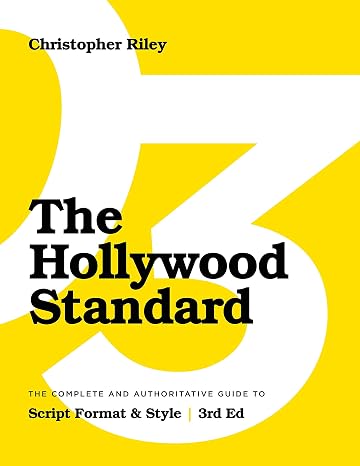
Hollywood Standard is a comprehensive guide to screenwriting format, written by Christopher Riley, an expert in the field. The book is designed to be an essential resource for screenwriters, providing clear, concise instructions and numerous examples on a wide range of formatting questions that can be confusing even for experienced writers.
The contents of the book cover topics such as when to use new scene headings, how to format shot headings, dialogue, direction, and transitions, how to control pace through formatting, how to make a script page visually appealing to the reader, what to capitalize and why, how to handle transitions between different points of view, and how to format text messages and Zoom meetings. The book also includes insights on how some of Hollywood’s most innovative screenwriters are experimenting with format and how formatting differs between animation and live action.
Overall, Hollywood Standard is a must-have reference for anyone looking to improve their screenwriting skills and make their scripts stand out in the competitive world of Hollywood.

Story is a book written by Robert McKee, a renowned screenwriting instructor who has gained international fame for his workshops, which have helped novice writers, refined works in progress, and rejuvenated the careers of established screenwriters. Many celebrities, including Quincy Jones, Diane Keaton, Gloria Steinem, Julia Roberts, John Cleese, and David Bowie, have taken McKee’s seminars, which are highly regarded within the industry as a valuable learning experience.
In Story, McKee builds upon the concepts taught in his $450 workshops, offering readers a comprehensive and integrated look at the craft of screenwriting. He is highly skilled at explaining how all the elements of a screenplay fit together and is uniquely qualified to teach readers about the “magic” of story construction and the relationship between structure and character. Overall, Story is a must-read for anyone interested in learning more about screenwriting and improving their craft.

In his book, Into the Woods, John Yorke presents a unique and innovative approach to understanding narrative structure, drawing on the fairytale journey of “into the woods” as a unifying theme. He uses examples from a wide range of media, including film, television, theater, and literature, to illustrate his points and applies the five-act structure of Shakespearean plays to analyze storytelling in all narrative forms, going beyond the traditional three-act approach.
The book covers various topics, including three-act and five-act structure, the importance of change, how stories are told, the inciting incident, character and characterization, exposition, and subtext. Yorke also delves into the historical, philosophical, scientific, and psychological aspects of storytelling, making Into the Woods a comprehensive and thought-provoking read.
Into the Woods is not intended to replace existing guides on dramatic writing by authors such as Aristotle, Lajos Egri, Robert McKee, or David Mamet, but rather to build upon their work and offer new insights and perspectives. It is a must-read for anyone interested in understanding the craft of storytelling and is destined to become a classic alongside other influential books on the subject such as Three Uses of the Knife, Story, Screenplay, and The Art of Dramatic Writing.

Screenplay, written by celebrated producer, lecturer, teacher, and bestselling author Syd Field, is a comprehensive guide to screenwriting that has been helping writers develop lucrative careers in film and television since 1979. In this revised edition of the book, Field reveals the fundamental elements of successful onscreen narratives in clear and practical language, making it an essential resource for screenwriters at all levels of experience.
Field is widely recognized as the first person to identify common structural elements that are unique to successful movies, and in Screenplay, he shares his insights on how to craft compelling characters, write authentic dialogue, build strong and flexible storylines, and overcome writer’s block, among other things. He also provides tips on adapting a novel, play, or article into a saleable script, and explains why the first ten pages of every script are crucial in keeping professional readers’ interest and how to “grab” their attention from the very first page.
In addition to these valuable tips and techniques, the book also includes insights on protecting your work and establishing legal ownership of your screenplays. Overall, Screenplay is considered the “bible” of screenwriting by The New York Times and is revered as the industry’s gold standard for learning the foundations of this craft.

In Finish the Script, Scott King provides a practical, step-by-step approach to screenwriting, based on actual class lectures and assignments. The book takes the reader on a journey as King writes a screenplay from scratch, providing insight into the creative process and offering helpful tips and techniques along the way.
Unlike other books that focus on theory, Finish the Script! is all about the actual process of writing, and it offers a comprehensive course on screenwriting packed into one book. The book includes exercises and sample assignments to help writers develop their skills, and it shows how to tackle first drafts and fix problems during the rewrite process.
Finish the Script! encourages writers to stop worrying about getting the perfect treatment, adhering to a specific structure, or fitting their story into a predetermined mold, and instead to focus on simply writing and getting their script finished. This hands-on approach is a valuable resource for anyone looking to improve their screenwriting skills and bring their stories to life.

The Nutshell Technique: Crack the Secret of Successful Screenwriting is a book written by veteran script consultant Jill Chamberlain, who has found that the vast majority of first-time screenwriters don’t know how to effectively tell a story. To address this problem, she developed the Nutshell Technique, a method that identifies eight interrelated elements that are necessary for telling a compelling story.
In The Nutshell Technique, Chamberlain presents her approach in a clear and easy-to-follow manner, using diagrams called “nutshells” to illustrate her points. She takes readers step-by-step through a range of classic and contemporary movies, showing how films with seemingly dissimilar storylines, such as Casablanca, Chinatown, Pulp Fiction, The Usual Suspects, Little Miss Sunshine, Juno, Silver Linings Playbook, and Argo, all utilize the same system to create a compelling narrative. She also provides practical guidance on how writers can apply these principles to their own screenplays.
Since its publication in 2016, The Nutshell Technique has become a go-to manual for many professionals and is used as a textbook in film schools around the world, including the prestigious screenwriting program at Columbia University. It has also been translated into Mandarin Chinese, Korean, and Italian.

The Screenwriter’s Bible is a comprehensive and authoritative guide to screenwriting, now in its 7th edition, which marks the 25th anniversary of this popular and highly regarded book. It has sold over 340,000 copies and has become a standard against which other screenwriting books are measured.
This updated edition includes everything that both aspiring and working screenwriters need, all under one cover, making it five books in one. It includes a screenwriting primer that provides a concise course in the basics of screenwriting, a screenwriting workbook that guides writers through the complete writing process, a formatting guide that covers the correct formats for screenplays and TV scripts, a spec writing guide that demonstrates current spec writing style through sample scenes and analysis, and a sales and marketing guide that offers proven strategies for creating a marketing plan.
In addition to this wealth of practical information, the book also includes sample query letters, useful worksheets and checklists, hundreds of examples, and clear explanations of screenwriting fundamentals. The 7th edition features new examples, the latest practices, and new material on non-traditional screenplay outlets. Overall, The Screenwriter’s Bible is an invaluable resource for anyone looking to improve their screenwriting skills and succeed in the competitive world of film and television.

The Screenwriter’s Workout is a comprehensive training program for screenwriters, designed to help them flex their creative muscles and improve their skills. The book includes over 75 exercises and hundreds of activities that are tailored to the needs of both new and experienced screenwriters.
Through a variety of exercises and activities, writers can learn how to create dynamic characters, explore structure, build compelling stories, redefine conflict, analyze their work, craft compelling loglines, and discover the art of interactive screenwriting. The book is written in a conversational style and offers a fun and interactive way to improve one’s craft and refine their storytelling skills.
Whether you are just starting out as a screenwriter or are an experienced pro looking to take your skills to the next level, The Screenwriter’s Workout is an invaluable resource that can help you strengthen your craft, hone your writing skills, and create compelling cinematic narratives.
Screenwriting is Rewriting by Jack Epps Jr.

Screenwriting is Rewriting is a book written by Jack Epps Jr., a seasoned screenwriter who has written for films such as Top Gun, Dick Tracy, and The Secret of My Success. In this comprehensive guide, Epps explores the critical skill of rewriting and offers a practical and tested approach to the process.
The book covers a range of topics, including how to organize notes, create a game plan, and execute a series of focused passes that address story, character, theme, structure, and plot issues. To illustrate his points, Epps includes sample notes, game plans, and beat sheets from his work on films such as Sister Act and Turner and Hooch.
In addition to Epps’ insights, the book also features exclusive interviews with Academy Award-winning screenwriters Robert Towne (Chinatown) and Frank Pierson (Dog Day Afternoon), as well as Academy Award nominee Susannah Grant (Erin Brockovich). These interviews provide valuable insights from some of the most respected screenwriters in the industry and offer further guidance on the art of rewriting.
Overall, Screenwriting is Rewriting is a must-read for screenwriters of all levels looking to improve their skills and succeed in the competitive world of film and television.
How to Become a Screenwriter
To become a successful screenwriter, it is essential to write as much as possible in order to develop your skills and style. Alongside writing, it is also important to learn the techniques and principles of screenwriting through classes, workshops, or by reading books on the subject. Building relationships with other screenwriters, agents, and industry professionals can be crucial to your success, so attending industry events, joining screenwriting organizations, and making an effort to connect with people in the industry is recommended.
As you write, be sure to keep a portfolio of your work, including samples of your screenplays and any other writing you have done, which will be a valuable tool when looking for work or trying to pitch your ideas. Pitching your ideas effectively is also crucial, whether you are looking for a writing assignment or trying to sell a finished screenplay. Practice your pitch, be prepared to answer questions, and be open to feedback to increase your chances of success.
How is a Screenplay Different to a Book?
A screenplay is a specific type of writing that is intended to be produced as a film or television show and is different from a book in several ways. Firstly, a screenplay is written in a specific format that includes elements such as scene headings, action descriptions, and character dialogue, whereas a book is typically written in paragraph form with chapters and sections used to break up the text. A screenplay is written for a visual medium and is meant to be interpreted through the medium of film or television, while a book is written for a reader and the action and characters are imagined in the reader’s mind.
Additionally, a screenplay is typically shorter than a book as it needs to be able to be produced within the time constraints of a film or television show, whereas a book can be any length and can take more time to tell a story. The style of a screenplay is also more condensed and efficient than that of a book, as it needs to convey a lot of information in a limited amount of space, while a book can have a more descriptive and leisurely style due to having more room to develop characters and plot.
Who are the Most Renowned Screenwriters?
There are many talented screenwriters who have made significant contributions to the film and television industry. Billy Wilder was a German-American screenwriter, film director, and producer who is widely regarded as one of the greatest screenwriters in the history of Hollywood. He wrote and directed classic films such as Some Like It Hot, The Apartment, and Double Indemnity.
Aaron Sorkin is a screenwriter, playwright, and television producer who is known for his fast-paced, dialogue-heavy writing style and has written highly acclaimed films and television shows such as The Social Network, Moneyball, and The West Wing.
Quentin Tarantino is a filmmaker and screenwriter known for his eclectic and unconventional style, having written and directed popular and critically acclaimed films such as Pulp Fiction, Reservoir Dogs, and Kill Bill.
Woody Allen is a writer, actor, and director known for his humorous and intellectual films, having written and directed classic films such as Annie Hall, Manhattan, and Blue Jasmine. Diablo Cody is a screenwriter and former blogger known for her unique voice and offbeat style, having written successful films such as Juno, Young Adult, and Tully.
If you enjoyed this reading list of the best books on screenwriting, you may also want to check out our list of the best books about Star Wars.
As an Amazon Associate we earn from qualifying purchases made through links on this page.