Sharon Mesmer: The Magic Of Books
Sharon Mesmer’s reading list
40 books mentioned in this interview
- The Fire’s Journey Part I
- Part II · Eunice Odio
- The Velveteen Rabbit · Margery WilliamsRecommended 3 times
- Her Smoke Rose Up Forever · James Tiptree Jr
- Howl · Allen GinsbergRecommended 3 times
- The Hour of the Star · Clarice Lispector
- The Hunter Gracchus and Other Papers on Literature and Art · Guy Davenport
- The Rings of Saturn · W.G. Sebald
- Her · Christa Parravani
- Patrick Melrose series · Edward St. Aubyn
- Suicide by Édouard Levé
- Nine Gates · Jane Hirschfield
- American Psycho · Bret Easton EllisRecommended 6 times
- The Da Vinci Code · Dan Brown
- Fifty Shades of Grey · E.L. James
- The Dhammapada
- Story of a Soul · St. Thérèse of Lisieux
- Palm-of-the-Hand Stories · Kawabata Yasunari
- Beauty and Sadness
- Corregidora · Gayl Jones
- Les Chants de Maldoror · Lautréamont
- Blinding · Mircea Cartarescu
- Nostalgia
- On the Heights of Despair
- Tears and Saints · E. M. Cioran
- Open City · Teju Cole
- The Wild Boys · William Burroughs
- Collected Poems of St. John of the Cross , translated · John Frederick Nims
- VALIS · Philip K. DickRecommended 4 times
- In Pursuit of VALIS · Lawrence Sutin
- Fun Home · Alison BechdelRecommended 3 times
- Jazz · Toni Morrison
- The Temple of the Golden Pavilion · Mishima Yukio
- Three Steps on the Ladder of Writing · Hélène Cixous
- The Pilgrimage sequence · Dorothy Richardson
- The Sorrows of Priapus · Edward Dahlberg
- By Grand Central Station I Sat Down and Wept · Elizabeth SmartRecommended 3 times
- Engravings Torn from Insomnia · Olga Orozco
- Wide Sargasso Sea · Jean RhysRecommended 3 times
- A Small Revolution · Jimin Han
Books by Sharon Mesmer: Half Angel, Half Lunch
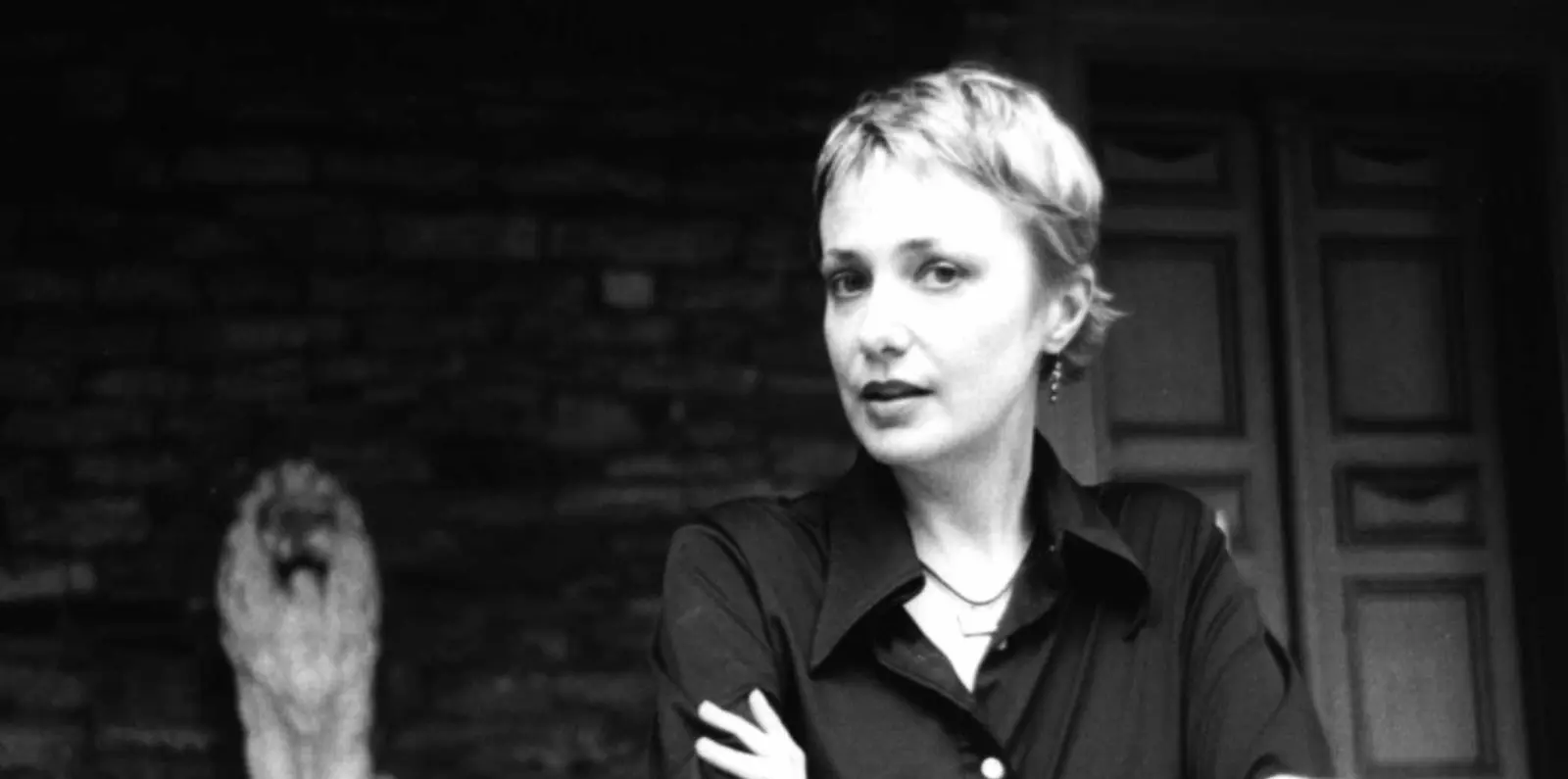
Sharon Mesmer is a Polish-American poet, fiction writer, essayist and professor of creative writing. Sharon Mesmer received a B.A. in Writing/English from Columbia College, where she and other female students of the poet Paul Hoover, notably Lydia Tomkiw and Deborah Pintonelli, became instrumental in galvanizing the links between the Chicago poetry and punk music scenes. After Sharon Mesmer left Chicago for New York, she became a student of Allen Ginsberg in the Brooklyn College MFA poetry program. Through Ginsberg’s nomination, she was awarded a MacArthur Scholarship and represented the college in the Poetry Society of America’s “Best of New York Writing Programs.” Writing about Mesmer’s first book, Half Angel, Half Lunch, Ginsberg characterized her work as “always interesting, beautifully bold and vivaciously modern.” Sharon Mesmer lectures and performs her work widely: at the 2010 Iceland Wave Festival in Reykjavik, Iceland; at a reading and panel discussion sponsored by the Danish Writers’ Union in 2010; and at the Ovidius Festival at Neptun Beach, Romania, in 2009. Her work has appeared in Poetry, the Wall Street Journal, New American Writing, the Evergreen Review, Eleven Eleven, and the Brooklyn Rail, among others. Please enjoy my interview with Sharon Mesmer.

How do you describe your occupation?
I take the most problematic aspects of my personality and background — things other people generally don’t like to deal with about themselves — and try to alchemize that lead into gold. Hopefully. Sometimes it ends up poetry, sometimes fiction, sometimes an essay. Once it ended up a letter of complaint to the Department of Motor Vehicles. I don’t know what happened there.
What is something about you that people might find surprising?
I’m an albino assassin for Opus Dei. But some people might not find that surprising.
What are you reading at the moment and what made you want to read it?
I am reading poems by forgotten – or “underknown” – women poets of the Americas. I’m also researching their lives, writing poems for them, and creating a collection of my own dedicated to them. My interest in them was sparked about two years ago, as I was reviewing two poetry collections: The Fire’s Journey Part I and Part II by Eunice Odio. Her voice felt like a combination of Sappho, Dickinson, Whitman and Blake — both ancient and contemporary. I’d never heard of her before; I’d found her books at a big literary conference book fair here. She was born in 1919 and is now considered “the mother of Costa Rican poetry in the twentieth century.” But her work never saw publication in her home country until after she’d died alone in Mexico City at age 54, her body undiscovered for days. Despite having published poems, essays, and short stories, there were only a few examples of her work on the Internet. The books I was reviewing were making their English language debuts, the first two volumes of a 456-page epic that Odio had completed in 1957.
As a poet myself, I felt desperate to know this brilliant, neglected woman — and how she’d come to that tragic end. So I obsessively Googled and ordered anthologies of Latin-American poetry and sourcebooks of Spanish-American women writers. As I researched Odio, I was shocked to discover many other talented female poets who’d suffered similar fates. Paging through one anthology I found the work of Delmira Agustini, shot by her estranged husband (who then turned the pistol on himself) in a hotel room in Montevideo, Uruguay in 1914. She was only 27. She’d published her first collection at 21 and was praised by critics of the time (for her beauty as much as for her work).
In the same book I came across this biographical note for a poet named Alfonsina Storni: “Depressed and in bad health, she walked into the sea in October 1938.” She was only 46. Born in Switzerland in 1892, she’d come to Argentina with her Swiss-Italian parents when she was three. Her first book was published when she was only 24. Like Agustini, she’d frankly depicted female desire and depression. Pages later, I read the lyrics to “Gracias a la vida” (“Here’s to Life”) by Violeta Parra, born in Chile in 1917. The version in the anthology was co-translated by Joan Baez. An activist like Baez, Parra had collected and performed Chilean folk songs. She toured Europe for four years, introducing her audiences to regional singers and local customs. In 1963 she founded a performance space in Santiago called La Carpa de La Reina — the Queen’s Tent. The following year, she became the first Latin-American artist to have a solo exhibition of her paintings, sculptures and arpilleras (patchwork pictures constructed from scraps of cloth and burlap) at the Museum of Decorative Arts of the Louvre.
Unfortunately, the public’s response to the Queen’s Tent was not positive. Feeling abandoned, Parra shot herself in the head in 1967, in the space she’d created. I was reminded, of course, of Plath and Sexton. And I’d always wondered whether it was an artistic sensitivity that created the conditions for depression, or was depression the gateway to great art. And why did women seem to succumb more than men? So, I read their work and made notes. I compiled everything I could find on the Internet about them and ordered more books. I felt like I was following a breadcrumb trail: the more I read, the more women I discovered. Soon, I had a growing stack of books next to my reading chair and a list of thirty-six “underknown” women poets from throughout the Americas, from Canada to Argentina. I started writing furiously: poems that incorporated details of their lives, that spoke directly to them. At times, I could feel my language blurring into theirs. It was the only thing I wanted to do, and I rose at dawn every day and wrote for hours. One day I realized I was creating a new manuscript, one poem for each woman. I decided to include their biographies and call it (after a line by Agustini) Even Living Makes Me Die. I would honor them using the art form we shared. I’ve completed about fourteen of the poems so far. I wish I had more time to spend on this. It’s pretty much the only thing I want to do these days.


What was your favourite book as a child and why?
The Velveteen Rabbit by Margery Williams – even though I never owned it. It made me cry when I heard it read on “Romper Room” when I was 4. My mother wouldn’t buy it for me because it upset me so much. I was haunted by it for years. Somehow, though, I forgot about it, and at age 37 saw it in a bookstore. After I opened it again (and why did I even open it again?) and arrived at that beautiful last page I cried the same way I did when I was 4. I still haven’t quite put my finger on why that book had such an effect on me. Something about how the selfless love of a child made the toy “real.” Or because the beloved toy was lost, then redeemed by love. Or perhaps because the older child and the toy, now “real,” recognized each other, years later. Or because something lost from my own childhood had been restored – and that something was a book? Well, maybe that’s the magic.

Can you remember the first poem you ever wrote?
Yes. It was a Petrarchan sonnet for my First Holy Communion ceremony. Okay, no it wasn’t. It was a poem about a robin for a fifth grade English class assignment.
What was the last book you purchased, and why did you buy it?
Her Smoke Rose Up Forever by James Tiptree Jr., a science fiction writer who was actually a woman named Alice Sheldon writing under a male pseudonym. She couldn’t get published under her own name, but when she started sending out as a man she received the recognition she deserved. Her work is so compelling and amazing – she was like a poet who understood narrative and story structure. She’s one of the women in my “underknowns” collection — the only fiction writer. She died in a murder-suicide: she killed her husband and then herself.

What two pieces of advice would you give a young aspiring poet?
Stay in school and don’t do drugs. Or, stay in drugs and don’t do school. Honestly, I’m not the best person to ask for advice.
What book have you found most inspiring, what effect did it have on you?
In poetry, Howl by Allen Ginsberg; in short fiction, The Hour of the Star by Clarice Lispector; in the novel, anything by James Baldwin; in essays, The Hunter Gracchus and Other Papers on Literature and Art by Guy Davenport; in the category “undefinable,” The Rings of Saturn by W.G. Sebald.
- Howl by Allen Ginsberg
 Howl by Allen Ginsberg
- The Hour of the Star by Clarice Lispector
 The Hour of the Star by Clarice Lispector
- The Hunter Gracchus and Other Papers on Literature and Art by Guy Davenport
 The Hunter Gracchus and Other Papers on Literature and Art by Guy Davenport
- The Rings of Saturn by W.G. Sebald
 The Rings of Saturn by W.G. Sebald
What’s the most obscure book you own; how did you discover it?
Most of the books I own are obscure. It would be hard to pin that down. But maybe my favorite is a compendium of the utterances of the oracle at Delphi that I found in a flea market fifteen years ago.
What’s the best book you’ve read in the last 6 months?
“Best” is a tricky concept. Each genre has its own requirements. The best novel is different from the best poetry collection, the best memoir, short fiction, autobiography, essays, etc. For me, the best poetry would be The Fire’s Journey Parts I and Part II by Eunice Odio; best memoir, Her by Christa Parravani; novel would be the Patrick Melrose series by Edward St. Aubyn; short fiction goes to Alice Sheldon; “undefinable” is Suicide by Édouard Levé, and essay is definitely A Living Thing by Toni Morrison. It was her Nobel lecture, but I found it in a Zen practitioner’s journal called Mountain Record (published by the monastery where I did a silent retreat for my 50th birthday).


What is your proudest achievement?
I made Henny Youngman laugh.
If someone who’s never got into poetry asks you for a tip on a good poetry book to start with, what would you recommend?
Anything at all by Gwendolyn Brooks.
If you were trying to impress a visitor, which book that you own would you leave on the coffee table?
See the answer to the question about the most obscure book I own.
If an alien landed in your garden; which three books would you gift them to showcase humanity in the best possible way?
American Psycho by Bret Easton Ellis, The Da Vinci Code by Dan Brown, and Fifty Shades of Grey by E.L. James. Oh, wait – I misread the question. I thought it was “to showcase humanity in the worst way.” Okay, so, the actual answer then: The Dhammapada (collection of sayings of the Buddha in verse form), Story of a Soul by St. Thérèse of Lisieux, and Nine Gates by Jane Hirschfield. I know, Nine Gates might seem odd there. But she writes so beautifully about poetry that an alien might think – and rightly so – that poets are the most brilliant and wonderful of humans.
- Nine Gates by Jane Hirschfield
 Nine Gates by Jane Hirschfield
- American Psycho by Bret Easton Ellis
 American Psycho by Bret Easton Ellis
- The Da Vinci Code by Dan Brown
 The Da Vinci Code by Dan Brown
- Fifty Shades of Grey by E.L. James
 Fifty Shades of Grey by E.L. James
- The Dhammapada
 The Dhammapada
- Story of a Soul by St. Thérèse of Lisieux
 Story of a Soul by St. Thérèse of Lisieux
Who would you say are the three poets that continue to inspire you?
Allen Ginsberg, Gwendolyn Brooks, Eunice Odio.
Are there any books you haven’t mentioned that you feel would make your reading list?
There are many:
Palm-of-the-Hand Stories by Kawabata Yasunari (also Beauty and Sadness); Corregidora by Gayl Jones; Les Chants de Maldoror by Lautréamont; Blinding by Mircea Cartarescu (also his short fiction collection, Nostalgia); On the Heights of Despair and Tears and Saints by E. M. Cioran; Open City by Teju Cole; The Wild Boys by William Burroughs; Collected Poems of St. John of the Cross, translated by John Frederick Nims; VALIS by Philip K. Dick (and In Pursuit of VALIS by Lawrence Sutin); Fun Home by Alison Bechdel; Jazz by Toni Morrison; The Prose Poem: An International Anthology, edited by Michael Benedikt; The Temple of the Golden Pavilion by Mishima Yukio; Three Steps on the Ladder of Writing by Hélène Cixous; The Pilgrimage sequence by Dorothy Richardson; The Sorrows of Priapus by Edward Dahlberg; By Grand Central Station I Sat Down and Wept by Elizabeth Smart; Engravings Torn from Insomnia by Olga Orozco; Wide Sargasso Sea by Jean Rhys …
…there are just too many, really. And I’m ruling out books by my friends because I don’t want to show favoritism.
- Palm-of-the-Hand Stories by Kawabata Yasunari
 Palm-of-the-Hand Stories by Kawabata Yasunari
- Beauty and Sadness
 Beauty and Sadness
- Corregidora by Gayl Jones
 Corregidora by Gayl Jones
- Les Chants de Maldoror by Lautréamont
 Les Chants de Maldoror by Lautréamont
- Blinding by Mircea Cartarescu
 Blinding by Mircea Cartarescu
- Nostalgia
 Nostalgia
- On the Heights of Despair
 On the Heights of Despair
- Tears and Saints by E. M. Cioran
 Tears and Saints by E. M. Cioran
- Open City by Teju Cole
 Open City by Teju Cole
- The Wild Boys by William Burroughs
 The Wild Boys by William Burroughs
- Collected Poems of St. John of the Cross, translated by John Frederick Nims
 Collected Poems of St. John of the Cross, translated by John Frederick Nims
- VALIS by Philip K. Dick
 VALIS by Philip K. Dick
- In Pursuit of VALIS by Lawrence Sutin
 In Pursuit of VALIS by Lawrence Sutin
- Fun Home by Alison Bechdel
 Fun Home by Alison Bechdel
- Jazz by Toni Morrison
 Jazz by Toni Morrison
- The Temple of the Golden Pavilion by Mishima Yukio
 The Temple of the Golden Pavilion by Mishima Yukio
- Three Steps on the Ladder of Writing by Hélène Cixous
 Three Steps on the Ladder of Writing by Hélène Cixous
- The Pilgrimage sequence by Dorothy Richardson
 The Pilgrimage sequence by Dorothy Richardson
- The Sorrows of Priapus by Edward Dahlberg
 The Sorrows of Priapus by Edward Dahlberg
- By Grand Central Station I Sat Down and Wept by Elizabeth Smart
 By Grand Central Station I Sat Down and Wept by Elizabeth Smart
- Engravings Torn from Insomnia by Olga Orozco
 Engravings Torn from Insomnia by Olga Orozco
- Wide Sargasso Sea by Jean Rhys
 Wide Sargasso Sea by Jean Rhys
Which book sat on your shelf are you most excited about reading next and why?
I’d have to say A Small Revolution by Jimin Han, which I’ll be teaching in a few months.
p.s. I just found this, on the site Open Culture:
“ . . . there’s the Japanese word tsundoku, which perfectly describes the state of my apartment. It means buying books and letting them pile up unread. The word dates back to the very beginning of modern Japan, the Meiji era (1868-1912) and has its origins in a pun. Tsundoku literally means reading pile. Tsunde oku means to let something pile up. Some wag around the turn of the century swapped out that oku in tsunde oku for doku – meaning to read. Then since tsunde doku is hard to say, the word got mushed together to form tsundoku.”

If you’d like to learn more about Sharon Mesmer you can find her on her website and Twitter.
As an Amazon Associate we earn from qualifying purchases made through links on this page.