
Daniel McNeil: Tools to Situate and Critique
Daniel McNeil’s reading list
58 books mentioned in this interview
- Representation: Cultural Representations and Signifying Practices edited · Stuart Hall
- Frames of War: When is Life Grievable? · Judith Butler
- The Candidate: Jeremy Corbyn’s Improbable Path to Power · Alex Nunn
- The Black Jacobins · C.L.R. James
- Redwall series · Brian JacquesRecommended 4 times
- Playing it Right · Tony Drake
- The Ideologies of Class: Social Relations in Britain 1880-1950 · Ross McKibbin
- The Inner Game of Tennis · Timothy Gallwey
- The Cheese and the Worms · Carlo Ginzburg
- The Great War and Modern Memory · Paul Fussell
- The Dark Continent · Mark Mazower
- Postcolonial Melancholia · Paul Gilroy
- The Quest of the Folk: Antimodernism and Cultural Selection in Twentieth-Century Nova Scotia · Ian McKay
- The Second Biggest Disappointment: Honeymooning and Tourism at Niagara Falls · Karen Dubinsky
- How We all Swiftly · Don Coles
- Performance Bond · Wayde Compton
- Absent Minds: Intellectuals in Britain · Stefan Collini
- Insomniac City · Bill Hayes
- The Black Atlantic: Modernity and Double Consciousness · Paul Gilroy
- Sex and Race series of books · J.A. Rogers
- Of Revelation and Revolution · Jean and John Comaroff
- I Write What I Like · Steve Biko
- Bad Faith and Antiblack Racism · Lewis Gordon
- ImmortalityRecommended 3 times
- The Unbearable Lightness of BeingRecommended 7 times
- Slowness
- Against the Double Blackmail: Refugees, Terror and Other Troubles with the Neighbours · Slavoj Žižek
- I n Search of the Black Fantastic · Richard Iton
- White Sands · Geoff Dyer
- How I Escaped My Certain Fate: The Life and Deaths of a Stand-up Comedian · Stewart LeeRecommended 6 times
- I, Partridge
- Nomad · Neil and Rob Gibbons and Steve Coogan
- Red or Dead · David Peace
- Miscegenation: The Theory of the Blending of the Races, applied to the American White Man and Negro · David Croly
- From Superman to Man · J.A. Rogers
- Quicksand · Nella Larsen
- Crime and Punishment · Fyodor Dostoevsky
- Are Prisons Obsolete? · Angela Davis
- Discourse on Colonialism · Aimé Césaire
- Autobiography of Malcolm X · Malcolm XRecommended 4 times
- Narrative of the Life of Frederick Douglass · Frederick Douglass
- The Cultural Studies Reader edited · Simon During
- Mothers and Sons · Colm Tóibín
- Martin Beck series · Maj Sjöwall and Per Wahlöö
- Capitalist Realism · Mark Fisher
- Remainder · Tom McCarthy
- The Making of the English Working Class · EP Thompson
- A Seventh Man: the Story of a Migrant Worker in Europe · John Berger and Jean Mohr
- Planet of the Apes · Pierre Boulle
- Fantasia: An Algerian Cavalcade · Assia Djebar
- A Short Account of the Destruction of the Indies · Bartolomé de las Casas
- Political Writings · Francisco de Vitoria
- The Foundations of Modern Political Thought · Quentin Skinner
- Vanity Fair · W.M. ThackerayRecommended 4 times
- Beyond a Boundary · C.L.R. James
- Culture and Imperialism · Edward Said
- The Resistance: Ten years of pop culture that shook the world · Armand White
- Film criticism as cultural institution · Huw Walmsley-Evans
Books by Daniel McNeil: Sex and Race in the Black Atlantic: Mulatto Devils and Multiracial Messiahs
Daniel McNeil is the inaugural Visiting Public Humanities Faculty Fellow at the University of Toronto and an Associate Professor of History at Carleton University in Canada. He has previously held the Ida B. Wells-Barnett Professorship of African and Black Diaspora Studies at DePaul University in the United States and taught Media and Cultural Studies at the University of Hull and Newcastle University in the United Kingdom. His award-winning book, Sex and Race in the Black Atlantic: Mulatto Devils and Multiracial Messiahs brings together African and Black Diaspora Studies, Media and Cultural Studies and other related fields of inquiry to map the cultural and intellectual histories of Black identities that work within, across, outside and against the nation-state. Please enjoy my interview with Daniel McNeil.

When someone asks you ‘what do you do for a living?’ – How do you respond?
I may trot out something safe and vanilla about my position as a Professor of History. In more formal settings I may even borrow the rather stilted language of management consultancy to talk about my role as a strategic hire tasked with enhancing the university’s teaching, research and program development in Migration and Diaspora Studies.
If I’m honest, I’m more interested as to why it’s so common for us to use ‘what do you do?’ – or something along the lines of ‘where are you from?’ – to kick off our small talk. Are such questions innocuous ways to break the ice? Are they delivered unreflexively? Or are they always already an attempt to ascertain status, trust, or value? Maybe we could generate some ‘medium talk’ by asking people what they think about Marx’s line about the need to imagine a society in which we might hunt in the morning, fish in the afternoon, rear cattle in the evening, and criticise after dinner without ever becoming saddled with the labels hunter, fisherman, herdsman or critic?
What are you reading at the moment?
I’m rereading Representation: Cultural Representations and Signifying Practices edited by Stuart Hall, and Frames of War: When is Life Grievable? by Judith Butler, while I draft an introduction to a new volume on migration, representation and stereotypes.
I’m also finishing up The Candidate: Jeremy Corbyn’s Improbable Path to Power by Alex Nunn. I haven’t read much about the book, although I did come across a couple of reviews in British newspapers and magazines that framed it as a hagiography of Jeremy Corbyn for the twitter generation. Such reviews may have been written in bad faith, but they weren’t completely plucked out of the journalists’ imaginations. After all, Nunn isn’t shy about depicting Corbyn as a sincere and ethical socialist – or ‘a Christian socialist without the Christian’ – who secured the leadership of the Labour Party by transcending the overwhelmingly hostile reaction to his candidature amongst the British press and his colleagues. Readers are also treated to tributes to the creativity of young activists who used Facebook to share memes, set up online campaigns and contribute to large-scale social movements that brought together people from diverse backgrounds.
Even if you don’t share Nunn’s faith in Corbyn or social media, there’s a lot to admire in the book. I’m particularly impressed by its sardonic takedowns of ‘establishment moves’ (diverting movements that threaten to rock the system into ‘dry and technical debates’). It also has some important things to say about politicians on the right of the Labour Party who assumed Corbyn’s leadership and commitment to radical egalitarianism was a daft and dangerous threat to Labour’s ability to win general elections.
Perhaps the most interesting sections of the book involve biting analysis of mainstream media pundits. It rejects the presumptions of journalists who repeat the talking points of gutless, career politicians as pragmatic realities necessary to win the centre ground and achieve ‘meaningful change’ (rather than, say, the ideology of a narrow and closed-minded group of political and media figures in London who believe that the only opinions that matter are those of their like-minded colleagues). It does an excellent job highlighting the ‘anti-democratic arena of the TV studio’ and the ‘confected personalised tittle-tattle and bullshit posing as analysis’ that usually dominates the printed press and broadcast news.
It’s also worth noting that the book doesn’t just shoot fish in a barrel and go after obnoxious right-wing newspapers. It sticks a knife into journalists at the purportedly progressive Guardian newspaper who dismissed Corbyn as a crassly inept politician, prone to the wrong call on everything. As Nunn observes – with a sneer that is understandable, albeit out of keeping with the magnanimous rhetoric of Corbyn to behave without malice in victory – these claims were made in columns in which ‘nearly every sentence … was ultimately proved wrong.’
In combination with the drivel that The Guardian published about the royal wedding, particularly the idiotic articles claiming it as a triumph of multicultural, progressive Britain, Nunn’s book has given me the final push to ‘consciously uncouple’ from a paper I’d that I’d been with for the past twenty years.
- Representation: Cultural Representations and Signifying Practices edited by Stuart Hall
 Representation: Cultural Representations and Signifying Practices edited by Stuart Hall
- Frames of War: When is Life Grievable? by Judith Butler
 Frames of War: When is Life Grievable? by Judith Butler
- The Candidate: Jeremy Corbyn’s Improbable Path to Power by Alex Nunn
 The Candidate: Jeremy Corbyn’s Improbable Path to Power by Alex Nunn
When you think about your childhood, what book comes to mind?
I was extremely fortunate to have access to some amazing public libraries, art galleries and museums as a child. I fondly recall travelling to Liverpool reference library with my Nan, reading The Guardian from cover to cover, and then going to an art gallery or museum. I loved browsing the stacks of the library and working through collections, whether it was the classics of Russian literature or the Mark Fox series of books by Michael Hardcastle, which followed the trials and tribulations of youth football teams.
My family didn’t buy a lot of books, but I remember that we bought The Black Jacobins by C.L.R. James at the museum of slavery and that I often received one of the new books in the Redwall series by Brian Jacques as a Christmas present. I also remember buying Playing it Right by Tony Drake and Frankie’s Dad by Jean Ure from a second-hand store, and I often read these beautiful stories about the creativity and resilience of young, gifted, Black British protagonists on the last day of summer before returning to school.


If you could wrap up a single book and gift it to yourself as you left education – which book would it be and why?
This is a great question. I’ll cheat and select three graduating moments.
I graduated from secondary school in 1998. If I was going to gift myself something that would prepare me to deal with the distilled Englishness of Oxford and put what I learned there at the disposal of the working-class community I grew up in, I think I’d go with The Ideologies of Class: Social Relations in Britain 1880-1950 by Ross McKibbin. If I were going to work harder at assimilating into the middle and upper levels of British society via sport, I’d gift myself The Inner Game of Tennis by Timothy Gallwey. If I were going to prepare better for the type of courses I read as a student of History, I’d probably go with The Cheese and the Worms by Carlo Ginzburg, The Great War and Modern Memory by Paul Fussell or The Dark Continent by Mark Mazower.
Just before graduating from Oxford in 2001, I accepted a Canadian Rhodes Scholars’ Foundation Scholarship to complete an MA in History at the University of Toronto. I was remarkably ignorant about Canada so I’d gift myself books that would provide me with some tools to situate and critique the representations of simple, homely, family values that are framed as quintessentially Canadian (unlike the UK, which has ironic adverts that feature young and single people having some risqué fun and games during its sports broadcasts, Canadian broadcasters try to sell cars, beer and coffee during the ad breaks with sentimental appeals featuring shiny, happy families). I’d probably go with The Quest of the Folk: Antimodernism and Cultural Selection in Twentieth-Century Nova Scotia by Ian McKay or The Second Biggest Disappointment: Honeymooning and Tourism at Niagara Falls by Karen Dubinsky. But other good options include collections of poetry such as How We all Swiftly by Don Coles and Performance Bond by Wayde Compton.
I returned to the UK after receiving my PhD from the University of Toronto in 2007. Postcolonial Melancholia by Paul Gilroy, which he wrote while ‘in exile’ in North America and processing his ambivalent relationship to the UK, would be a nice gift to help me work through my attachments to British culture. I’d also be happy to receive Absent Minds: Intellectuals in Britain by Stefan Collini.
- The Ideologies of Class: Social Relations in Britain 1880-1950 by Ross McKibbin
 The Ideologies of Class: Social Relations in Britain 1880-1950 by Ross McKibbin
- The Inner Game of Tennis by Timothy Gallwey
 The Inner Game of Tennis by Timothy Gallwey
- The Cheese and the Worms by Carlo Ginzburg
 The Cheese and the Worms by Carlo Ginzburg
- The Great War and Modern Memory by Paul Fussell
 The Great War and Modern Memory by Paul Fussell
- The Dark Continent by Mark Mazower
 The Dark Continent by Mark Mazower
- Postcolonial Melancholia by Paul Gilroy
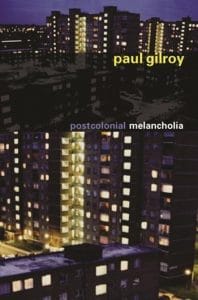 Postcolonial Melancholia by Paul Gilroy
- The Quest of the Folk: Antimodernism and Cultural Selection in Twentieth-Century Nova Scotia by Ian McKay
 The Quest of the Folk: Antimodernism and Cultural Selection in Twentieth-Century Nova Scotia by Ian McKay
- The Second Biggest Disappointment: Honeymooning and Tourism at Niagara Falls by Karen Dubinsky
 The Second Biggest Disappointment: Honeymooning and Tourism at Niagara Falls by Karen Dubinsky
- How We all Swiftly by Don Coles
 How We all Swiftly by Don Coles
- Performance Bond by Wayde Compton
 Performance Bond by Wayde Compton
- Absent Minds: Intellectuals in Britain by Stefan Collini
 Absent Minds: Intellectuals in Britain by Stefan Collini
Does your reading have routine? Is there a particular time or place that you like to read?
I feel wonderfully at home reading a novel on a long train journey. On shorter trips, I like to dip in and out of books like Insomniac City by Bill Hayes, which are attentive to the beauty of convivial multicultures and public transportation. I used to love moving from carriage to carriage on the subway to read the poems that the Toronto Transit Commission used to carry on its trains.

Which book has had the biggest impact on your career so far? How did it impact it?
It’s probably The Black Atlantic: Modernity and Double Consciousness by Paul Gilroy, which eloquently describes a translocal cultural formation that was forged, in the first instance, by the transatlantic slave trade. It helped carve out theoretical and political space in academia for those of us interested in writing about the utopian aspirations of individuals and groups that cannot be contained within the nation-state.
I also like what Gilroy has described as the ‘neurotic energy’ of the book. You can read it as an academic text (it was published by Harvard University Press) in which he tries to smuggle in the liveliness of writers with an ambivalent relationship to academia and his supplementary career as journalist and musician. You can also read it as a radical text about a counterculture of modernity (it was also published by Verso, which describes itself as the largest independent, radical publishing house in the English-speaking world) in which Gilroy inserts various academic idioms and signposting as part of his desire to secure a ‘proper job’ as a scholar
I mashed up Gilroy’s seminal work with the Sex and Race series of books by J.A. Rogers – a wonderfully idiosyncratic history of mixing in all ages and lands – in the title of my first book: Sex and Race in the Black Atlantic: Mulatto Devils and Multiracial Messiahs. A less obvious influence was Of Revelation and Revolution by Jean and John Comaroff. The introduction of volume one was the most engaging and beautifully written piece of writing that was assigned for graduate students in the core course in the History MA at the University of Toronto. Their graceful sentences were a welcome respite from work that moved from so many academic books that feature an introductory section written as an overview for the general reader (or an interdisciplinary grant committee) and then moves straight into rather drab, dull and prosaic writing that churns out one’s research. One of the nicest compliments I received after the publication of Sex and Race in the Black Atlantic came from a fellow grad student who told me that she had placed it next to Of Revelation and Revolution on her bookshelf because its language, style and analysis reminded her of the Comaroff’s.
- The Black Atlantic: Modernity and Double Consciousness by Paul Gilroy
 The Black Atlantic: Modernity and Double Consciousness by Paul Gilroy
- Sex and Race series of books by J.A. Rogers
 Sex and Race series of books by J.A. Rogers
- Of Revelation and Revolution by Jean and John Comaroff
 Of Revelation and Revolution by Jean and John Comaroff
Do you have any books that you strongly associate with someone important in your life?
I remember spying a copy of I Write What I Like by Steve Biko on the shelf of my grandmother’s bookcase. The halo and tie on the jacket cover conveyed the moral imagination of a passionate and purposeful Sunday school teacher. The smiling eyes, mini Afro and van Dyke suggested a certain maverick charm. The uncompromising title, etched in white on a stark black background, bluntly announced Biko’s frank talk. Suffice to say; the cover appealed to a diffident child raised by films and music about rugged individuals fighting the system as well as a religious education system that veiled the violence of the British empire. I eagerly turned to the inside cover of the book and discovered a note of love and affection that my grandmother had dedicated to ‘we blacks.’ It’s difficult for me to think about the words of the South African freedom fighter without imagining how she might debate Biko’s strident critique of white liberalism, his claim that African cultural values were similar to those of a European working-class, and his definition of Black Consciousness as a mental attitude that reflected one’s willingness to fight neocolonialism wherever it may be in the world.

What book have you recommended the most to friends and family?
For graduate students, I like to recommend two unpublished dissertations: Always a little different: A politics of blackness by Naomi Pabst and Let that be your last battlefield: Hegemony and the construction of biraciality in situation comedy, soap opera, and science fiction television by Sarah Michelle Foss-Snowdon. They are both rich with stimulating detail and analysis.
For postdoctoral students and early career scholars looking to turn their dissertation into a book, I often recommend Bad Faith and Antiblack Racism by Lewis Gordon (see Lewis Gordon’s interview). The book was inventive, insightful and, most importantly, willing to take real risks. It’s a welcome antidote to the risk-aversion of narrow scholasticism and the types of disciplinary decadence – the presumption that the methodological assumptions of one’s discipline apply with a scope that encompasses all reality – that Lewis has gone on to do so much to identify, contest and profane.
I often recommend Milan Kundera’s novels to friends and family and even sent copies of The Unbearable Lightness of Being, Slowness and Immortality to my partner when we embarked on a long-distance relationship,and she kept teasing me about my ‘European flair’.
If I’m going to try and rouse Canadians into some fresh thinking, I like to recommend Against the Double Blackmail: Refugees, Terror and Other Troubles with the Neighbours by Slavoj Žižek and In Search of the Black Fantastic by Richard Iton. Žižek’s book has some wonderfully incisive things to say about the pretences of Canada (what he ironically describes as ‘liberal society at its best’). Iton’s magisterial book about cultural politics is scandalously underappreciated and overlooked in his home and native land.
- Bad Faith and Antiblack Racism by Lewis Gordon
 Bad Faith and Antiblack Racism by Lewis Gordon
- Immortality
 Immortality
- The Unbearable Lightness of Being
 The Unbearable Lightness of Being
- Slowness
 Slowness
- Against the Double Blackmail: Refugees, Terror and Other Troubles with the Neighbours by Slavoj Žižek
 Against the Double Blackmail: Refugees, Terror and Other Troubles with the Neighbours by Slavoj Žižek
- In Search of the Black Fantastic by Richard Iton
 In Search of the Black Fantastic by Richard Iton
Do you prefer fiction or non-fiction?
I’d say that I’m drawn to a lot of writing that is frank about being a mixture of fiction and nonfiction. White Sands by Geoff Dyer starts out with a delicious line about straddling fiction and nonfiction, and I’d consider Dyer a great example of the acerbic writing that I adore. My favourite writers not only blur the lines between fiction and non-fiction, they also tend to be people who come from working-class backgrounds who 1) are open to writing suggestive, explorative and provocative essays and books that avoid the perils of superficial journalism as well as narrow scholasticism, and 2) went to elite universities and found themselves distanced from the people they grew up from without ever fully assimilating or wanting to feel at home in middle-class worlds.
I find writers such as Julie Burchill, Pauline Kael, Armond White and Paul Morley a bit better at reflecting a sentiment that is more combative and less willing to settle down into a certain genre, approach or class. My favourite book to break down the barriers of fiction and non-fiction and speak to working-class kids who want to know what they can do after they leave Oxford and Cambridge with a degree in the humanities (and don’t want to become investment bankers, lawyers, doctors or management consultant), is How I Escaped My Certain Fate: The Life and Deaths of a Stand-up Comedian by Stewart Lee. It’s aggressively witty, and it uses footnotes with nuance, sophistication and ironic pretension


What’s the best book you’ve read in the last 6 months?
The most enjoyable books were probably I, Partridge and Nomad by Neil and Rob Gibbons and Steve Coogan. They are just brilliantly funny dissections of the character ‘Alan Partridge’ and white, male, middle-aged entitlement.
I also loved Red or Dead by David Peace. If you were to construct a Venn diagram of avid football fans and lovers of literary modernism, there might not be many of us in the middle. But we’re well catered for in Peace’s story of the bloody-mindedness, severity and the aggressive wit of Bill Shankly, the manager who transformed Liverpool football club into champions. I’d always loved Shankly’s famous line: ‘The socialism I believe in isn’t really politics. It is a way of living. It is humanity. I believe the only way to live and to be truly successful is by collective effort, with everyone working for each other, everyone helping each other, and everyone having a share of the rewards at the end of the day. That might be asking a lot, but it’s the way I see football and the way I see life.’ It was wonderful to read Peace and feel how this way of living impacted Bill’s relationships with his family and working-class communities in Scotland and the North of England.


Name a book that you feel everyone would benefit from reading and explain why.
For readers who are focused on ‘fake news’ in our contemporary moment, or just appreciate the ironies of history, I’d suggest Miscegenation: The Theory of the Blending of the Races, applied to the American White Man and Negro by David Croly. This tract was published anonymously in 1864 and was part of a political hoax to try and ascribe anti-Irish sentiment and love of social equality to Abraham Lincoln and the Republican Party. I’d probably follow up with a recommendation to pair that political hoax with exemplary examples of deliberative democracy such as the Lincoln-Douglas debates and From Superman to Man by J.A. Rogers.


Are there any books you haven’t mentioned that you feel would make your reading list?
I’d also include:
Quicksand by Nella Larsen, Crime and Punishment by Fyodor Dostoevsky, Are Prisons Obsolete? by Angela Davis, Discourse on Colonialism by Aimé Césaire, Autobiography of Malcolm X by Malcolm X, Narrative of the Life of Frederick Douglass by Frederick Douglass, The Cultural Studies Reader edited by Simon During, Mothers and Sons by Colm Tóibín, Any of the books in the Martin Beck series by Maj Sjöwall and Per Wahlöö, Capitalist Realism by Mark Fisher, Remainder by Tom McCarthy, The Making of the English Working Class by EP Thompson, A Seventh Man: the Story of a Migrant Worker in Europe by John Berger and Jean Mohr, Planet of the Apes by Pierre Boulle, Fantasia: An Algerian Cavalcade by Assia Djebar.
Some books that are nice to read alongside each other;
A Short Account of the Destruction of the Indies by Bartolomé de las Casas Political Writings by Francisco de Vitoria, and The Foundations of Modern Political Thought by Quentin Skinner.
Another nice trifecta to connect;
Vanity Fair by W.M. Thackeray, Beyond a Boundary by C.L.R. James, and Culture and Imperialism by Edward Said.
- Quicksand by Nella Larsen
 Quicksand by Nella Larsen
- Crime and Punishment by Fyodor Dostoevsky
 Crime and Punishment by Fyodor Dostoevsky
- Are Prisons Obsolete? by Angela Davis
 Are Prisons Obsolete? by Angela Davis
- Discourse on Colonialism by Aimé Césaire
 Discourse on Colonialism by Aimé Césaire
- Autobiography of Malcolm X by Malcolm X
 Autobiography of Malcolm X by Malcolm X
- Narrative of the Life of Frederick Douglass by Frederick Douglass
 Narrative of the Life of Frederick Douglass by Frederick Douglass
- The Cultural Studies Reader edited by Simon During
 The Cultural Studies Reader edited by Simon During
- Mothers and Sons by Colm Tóibín
 Mothers and Sons by Colm Tóibín
- Martin Beck series by Maj Sjöwall and Per Wahlöö
 Martin Beck series by Maj Sjöwall and Per Wahlöö
- Capitalist Realism by Mark Fisher
 Capitalist Realism by Mark Fisher
- Remainder by Tom McCarthy
 Remainder by Tom McCarthy
- The Making of the English Working Class by EP Thompson
 The Making of the English Working Class by EP Thompson
- A Seventh Man: the Story of a Migrant Worker in Europe by John Berger and Jean Mohr
 A Seventh Man: the Story of a Migrant Worker in Europe by John Berger and Jean Mohr
- Planet of the Apes by Pierre Boulle
 Planet of the Apes by Pierre Boulle
- Fantasia: An Algerian Cavalcade by Assia Djebar
 Fantasia: An Algerian Cavalcade by Assia Djebar
- A Short Account of the Destruction of the Indies by Bartolomé de las Casas
 A Short Account of the Destruction of the Indies by Bartolomé de las Casas
- Political Writings by Francisco de Vitoria
 Political Writings by Francisco de Vitoria
- The Foundations of Modern Political Thought by Quentin Skinner
 The Foundations of Modern Political Thought by Quentin Skinner
- Vanity Fair by W.M. Thackeray
 Vanity Fair by W.M. Thackeray
- Beyond a Boundary by C.L.R. James
 Beyond a Boundary by C.L.R. James
- Culture and Imperialism by Edward Said
 Culture and Imperialism by Edward Said
What books or subject matter do you plan on reading in the next year?
I’m going to be on sabbatical from July and will be completing several articles on aesthetics, activism, and cultural work that riff on C.L.R James’s idea that ordinary people do not need an intellectual vanguard to tell them what to do or how to think.
I’ll also be finishing up A tale of two critics: From young soul rebels to grumpy old men, a book that will examine the journeys of intellectual discovery taken by Paul Gilroy and Armond White. I’m looking forward to rereading Gilroy’s books, The Resistance: Ten years of pop culture that shook the world by Armand White as well as books such as Film criticism as cultural institution by Huw Walmsley-Evans, which is an important intervention for anyone who tires of the discussions about film criticism in crisis (film critics as part of a precariat, film critics losing their jobs, cultural cache, etc.) and wants to consider how we may perceive crisis as one part of the ecology of film criticism.


If you’d like to learn more about Daniel McNeil, you can find him on his site.
As an Amazon Associate we earn from qualifying purchases made through links on this page.