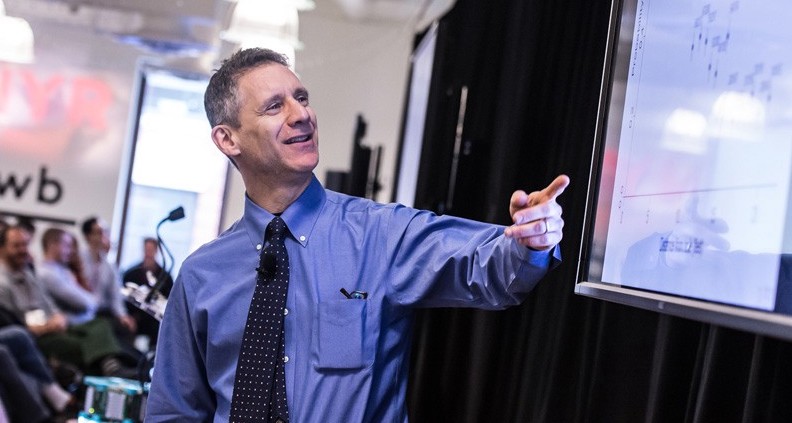
Andrew Gelman: How to Learn Statistics
Andrew Gelman’s reading list
7 books mentioned in this interview
- The Committed
- The Sympathizer · Viet Thanh NguyenRecommended 5 times
- Fire on the Prairie · Gary Rivlin
- Bill James Baseball Abstracts
- Our Country Friends · Gary Shteyngart
- All the Devils are Here · David Seabrook
- Time Out of Joint · Philip K. Dick
Andrew Gelman is a professor in the fields of statistics and political science at Columbia University. He has been awarded many times by different organizations for his work on statistical applications, including the best article published in American Political Science Review; Mitchell & DeGroot Prizes given out from International Society Bayesian Analysis; and Council Presidents of Statistical Societies Awards.
Andrew Gelman’s research has spanned a wide range of topics, including why it is rational to vote; why campaign polls are so variable when elections are so predictable; the effects of incumbency and redistricting; reversals of death sentences; police stops in New York City, the statistical challenges of estimating small effects; the probability that your vote will be decisive; seats and votes in Congress; social network structure; arsenic in Bangladesh; radon in your basement; toxicology; medical imaging; and methods in surveys, experimental design, statistical inference, computation, and graphics.
Please enjoy my interview with Andrew Gelman…
When did you first become interested in statistics?
I ran out of math courses in high school so I took classes at the local college. I took probability and stochastic processes because they were offered at 5 pm and didn’t conflict with my schedule. Then in college, I took a class in applied statistics and it was so amazing: using math to solve real problems, not just prove theorems. For more background see here.
Talk us through a typical day for you…
Skipping all the family stuff; when I’m working I will jump between projects, trying to stay amused. Sometimes I’m coding and that takes focus: to find bugs and make sure your program is working the way it’s supposed to, you’ll typically have to write additional programs just to test your code. In statistics and programming, it’s not enough to get the right answer; you also need to know it’s right; you need to build a web of trust.
What are you reading at the moment and what made you want to read it?
I’m on sabbatical in Paris this year and am trying to work on my French by reading bandes dessinées (comic books): the pictures help me understand while I read the words. I recently read L’Éntreinte by Jim and Laurent Bonneau. I picked it out at the library because the style of the drawings appealed to me, also I’d read previous BD’s by Jim.
But, to be honest, I do almost all my reading in English, and I recently finished The Committed, the gangster-novel sequel to the spy novel The Sympathizer by Viet Thanh Nguyen. Both books have so much over-the-top praise in their blurbs that I was prepared to be contrarian and hate them, but they’re excellent. The main character has such a great voice, also I liked some of the larger themes.


Are you a page folder or a bookmarker?
Neither! If I can’t remember where I stopped in the middle of a book, then I’ll just dive in and figure out where I was.
Which two books would you recommend to a complete novice who is interested in exploring the topics of statistics and political science?
Start from what you’re interested in. If you like baseball, read one of the classic Bill James Baseball Abstracts from the 1980s. If urban politics is your thing, Fire on the Prairie by Gary Rivlin is a great book about Harold Washington’s moves as mayor of Chicago. The appeal of both the fields of political science and statistics is how broadly they apply.


If you could invite 5 authors (dead or alive) to a dinner party – who would they be and why?
Meg Wolitzer, Sam Lipsyte, David Byrne, Colson Whitehead, Lucy Sante. I choose them, among so many authors whose books I love, because I think they all live in New York or nearby, at least some of the time, so maybe we actually could have all of them over for dinner sometime.
What was the last book you purchased, and why did you buy it?
Our Country Friends by Gary Shteyngart. Preparing for our trip to France and I wanted a fun book to read, just for relaxation.

What is your proudest achievement from your impressive academic career?
There’s this longstanding challenge in statistics of monitoring the convergence of the stochastic algorithm. A stochastic algorithm is a kind of random walk that solves a problem by traversing the space of possible solutions, and there’s always this question of whether you’ve run the algorithm long enough to have seen enough.
Back when I was a graduate student, a friend of mine was using one of these algorithms and he was trying to figure out when it would be ok for him to stop. I read through the literature and found this paper from 1959 that had a method that worked for one particular problem, and I figured out a way to extend the method so it could be applied more generally. Sounds kinda dry and technical, and I guess it is, but once I worked it out, I realized then and there that this would be the most important thing I’d ever do in my career.
What’s the best book you’ve read in the last 6 months?
I guess I’d have to say The Committed, which I mentioned above, but that’s kind of a boring choice so instead I’ll say All the Devils are Here, by David Seabrook, which I picked up at a bookstore because there was something intriguing about it—it’s a kind of outsider-art nonfiction book where this guy muses over some historical episodes from some towns in the south of England. There’s something compelling about it, partly the stories and partly the mysterious way it’s written.

If you could insert yourself into any book, which would you pick and why?
Time Out of Joint by Philip K. Dick, because it seems so real!

What are you working on at the moment that you’re most excited about?
I taught a course on applied statistics last year to political science students, and I tried to make this the most active course ever: there were two classes a week, and for every class, we had a story, a class-participation activity, a computer demonstration, and problems for the students to work on.
I wrote it all up while it was happening, and now I’m putting it all together as a book, which at first I was going to call How to Teach Statistics, but I think a better title is How to Learn Statistics. I’m really excited about having all these stories and activities in one place.
What is the book that you feel has had the single biggest impact on your life? What impact did it have?
In my late teens, I read Orwell’s collected essays, letters, and journalism, four volumes where he works through his literary and political ideas. Orwell is a model as a writer, and as a thinker, there’s something appealing about how straightforward he is. Some writers leave you impressed by their brilliance, but Orwell leaves me with the impression that you—anyone—could do what he does if you could just keep your eye on the ball.
And, of course, the political insight, as in the Professionally, though, I guess the books that had the most impact on my thinking are the aforementioned Bill James Baseball Abstracts, which don’t use any statistical methods I would use today but which are amazing examples of analytical work, even more, impressive because he works out everything from scratch.

Which book sat on your shelf are you most excited about reading next and why?
I have an old collection of essays and book reviews by Kingsley Amis and another by Anthony Burgess. I love this sort of thing, just reading these cranky guys go on about obscure topics. It’s the literary equivalent of junk food for me.
If you enjoyed this interview with Andrew Gelman, you may also enjoy our interview with Cedric Villani.
As an Amazon Associate we earn from qualifying purchases made through links on this page.
You might also like
Maya Ajmera: Moments of Obligation
Interview · 5 April 2022

Lisa See: A Window Into Other Worlds, Cultures, and Lives
Interview · 29 November 2016
Phil Rosenzweig: The Books of a Business Professor
Interview · 29 September 2016
M.T. Anderson: More Reflection, More Comparison, More Questioning
Interview · 28 May 2017