20 Books That Will Make You Smarter
In this list
20 books
- Sapiens · Yuval Noah HarariRecommended 19 times
- Mindset: The New Psychology of Success · Carol DweckRecommended 9 times
- A Brief History of Time · Stephen HawkingRecommended 5 times
- 101 Essays That Will Change The Way You Think · Brianna Wiest
- The 48 Laws of Power · Robert Greene
- Mediations · Marcus Aurelius
- The Psychology of Money · Morgan Housel
- The 7 Habits of Highly Effective People · Stephen R. CoveyRecommended 7 times
- Between The World and Me · Ta-Nehisi CoatesRecommended 13 times
- Moonwalking With Einstein: The Art & Science of Remembering Everything · Joshua Foer
- Thinking Fast & Slow · Daniel KahnemanRecommended 15 times
- Capital in the Twenty-First Century · Thomas Piketty
- The Song of the Cell: An Exploration of Medicine and the New Human · Siddhartha Mukherjee
- A Short History of Nearly Everything · Bill BrysonRecommended 3 times
- The Sixth Extinction: An Unnatural History · Elizabeth Kolbert
- Life 3.0: Being Human in the Age of Artificial Intelligence · Max Tegmark
- Food Rules: An Eater’s Manual · Michael Pollan
- The Man Who Mistook His Wife for a Hat · Oliver Sacks
- The Wisdom of Insecurity: A Message for an Age of Anxiety · Alan Watts
- The Righteous Mind: Why Good People are Divided by Politics and Religion · Jonathan HaidtRecommended 3 times
Ready to supercharge your brain? Buckle up, because we’ve got a collection that is so stimulating it should come with a warning label: ‘Caution, may cause excessive intellect and sudden bursts of wisdom’. Welcome to ’20 Books That Will Make You Smarter’, an electrifying assembly of the most mind-expanding, idea-exploding books that will ignite your thinking and jolt your perspectives like a double-shot of espresso.
We aren’t talking about your run-of-the-mill textbooks or humdrum academic essays. Oh no! These are powerhouses of knowledge, filled to the brim with the kind of insights that spark revolutions and the kind of ideas that transform societies. Each one is a mini-university in its own right, guaranteeing to leave your mind richer and your understanding of the world infinitely deeper.
This isn’t your typical reading list. It’s a mental workout, an intellectual marathon, a tour de force through the greatest thoughts and discoveries of our time. These are books that don’t just add to your knowledge; they reconstruct it, challenge it, and dare you to see the world anew.
So, prepare for an extraordinary journey through uncharted territories of the mind. Each page turned, each idea absorbed, will be another step in your transformation. Are you ready for this intellectual metamorphosis? Because once you dive in, there’s no coming back. You’ll emerge on the other side, not just a reader, but a thinker, a questioner, a relentless seeker of truth.
In short, get ready to be amazed, to be challenged, and to fall in love with the tantalizing dance of thoughts. Get ready to be smarter!
Here are 20 books that will make you smarter…

First up, we have a grand time-traveling expedition waiting for you in the form of Yuval Noah Harari’s internationally acclaimed ‘Sapiens’. As dazzling as a comet and as enlightening as a bolt of lightning, ‘Sapiens’ unravels the intricate tapestry of human history in a manner so riveting, it’ll make your brain dance.
The journey begins a staggering 70,000 years ago, when our ancestors first developed the spark of modern cognition. With Harari as your fearless guide, you’ll tread the expansive plains of the past, coming face-to-face with the defining moments and turning points of humankind. And, oh boy, what a journey it is! One moment you’re exploring the astonishing disappearance of other human species, and the next, you’re witnessing the dramatic rise of empires.
What sets ‘Sapiens’ apart is Harari’s audacious fusion of history and biology, which he weaves together with an enviable prowess. The result is a narrative so compelling and profound that you won’t just understand what it means to be “human”; you’ll question it, you’ll marvel at it, you’ll be awestruck by the complexity of it.
As if this were not enough, Harari pushes you to peek into the future, to grapple with the incredible possibilities and perplexing questions arising from our ability to bend the laws of natural selection. ‘Sapiens’ doesn’t just feed your mind; it stirs it, prods it, sets it ablaze with questions that will keep you pondering long after you’ve turned the last page.
In essence, ‘Sapiens’ isn’t just a book; it’s a catalyst for intellectual transformation. A cerebral roller-coaster ride that guarantees to leave you smarter, more curious, and endlessly fascinated with the saga of humankind. So buckle up and prepare for the ride of a lifetime. It’s time to meet ‘Sapiens’.

Next up, ready to shatter your preconceptions and supercharge your self-improvement? Enter ‘Mindset’ by world-renowned Stanford University psychologist Carol S. Dweck, Ph.D. Picture the keys to success, resilience, and self-improvement, well, ‘Mindset’ isn’t just the keys—it’s the whole locksmith’s shop.
Let’s debunk a myth together, shall we? Being born smart doesn’t necessarily mean you’ll end up the smartest. Shocked? Welcome to Dweck’s revolutionary idea—the power of mindset. This game-changer book delves deep into how our beliefs about our capabilities shape our lives and the paths we take.
Dweck differentiates between two mindsets: fixed and growth. Those who believe that abilities are fixed are, in fact, less likely to thrive than those who believe that abilities can be developed. Want to know the secret of great parents, teachers, managers, and athletes? It’s all in the ‘Mindset’.
And don’t think for a second that this book is just a rehash of a decade-old theory. Oh no, Dweck is here with new insights, new phenomena, and new applications of her famous concept. She introduces the concept of false growth mindset and guides readers towards adopting a more profound, authentic growth mindset. More than just an individual mindset shift, she shows how it applies to the cultures of groups and organizations.
‘Mindset’ isn’t just a book; it’s a mental renovation project that redefines success, builds resilience, and puts you on the path to extraordinary achievement. With the right mindset, you can not only motivate yourself but also everyone around you. So, are you ready to transform your life? Dive into ‘Mindset’, and let the transformation begin!
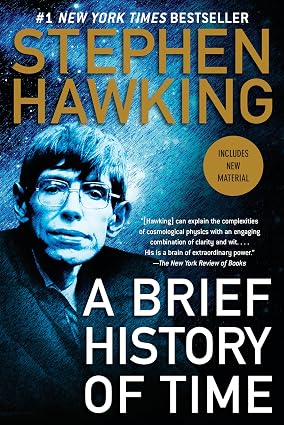
Ready to take an exhilarating trip through space and time, with none other than the late cosmological virtuoso, Stephen Hawking, as your guide? Buckle up, because ‘A Brief History of Time’ is an astronomical feat of science writing that’s ready to rocket your understanding of the universe into the stratosphere.
Unravel the cosmic mysteries of the universe as you explore questions that have puzzled the greatest minds of humanity: How did the universe start? Is time a one-way street? Are there walls to the universe or does it go on forever? Do other dimensions exist in space? And perhaps the most profound question of all, what happens when the cosmic clock stops ticking?
Afraid you’ll get lost in the space-time continuum? Fear not! Hawking serves up this cosmological feast using language that even us Earthlings can comprehend. Dive headfirst into the enigmatic realms of black holes and quarks, antimatter, and “arrows of time”. From the big bang to the concept of a larger-than-life God, this book is a celestial smorgasbord of unexpected and awe-inspiring concepts.
Brimming with vivid images and fueled by a profound imagination, ‘A Brief History of Time’ is your VIP pass to the ultimate secrets at the very heart of creation. So, step aboard the Hawking cosmic express and get ready to journey to the farthest corners of the universe, and who knows? You might just return a little bit smarter.

‘101 Essays That Will Change The Way You Think’ by Brianna Wiest is no ordinary book. It’s a transformative journey through a minefield of ideas that will give your brain a rigorous workout and leave it toned, energized, and ready to conquer the world.
This collection from globally celebrated author Brianna Wiest assembles her most cherished pieces of writing, each one a gem of insight polished by the grit of lived experience. Dive into meditations on why your life’s purpose trumps passion, why embracing negativity can be surprisingly positive, and how to find wisdom in the predictable ebb and flow of everyday life.
Curious about the shades of your mental lenses? Get ready to confront your cognitive biases, those silent puppeteers shaping your worldview. Whether you’re a Wiest devotee or a newcomer to her wisdom, each essay is a revelation, a eureka moment waiting to happen.
Every page turn promises an epiphany. Every idea is a potential life-changer. So why wait? Tumble down the intellectual rabbit hole with ‘101 Essays That Will Change The Way You Think’, and emerge from the other side sporting a fresh, enlightened perspective on life. Ready to think yourself smarter? This book’s got you covered.

‘Who rules the world?’ is a question often asked, but the better question may be ‘How to rule the world?’ Brace yourself, for ‘The 48 Laws of Power’ by Robert Greene lays out the blueprint in a manual that’s as beguiling as it is instructive.
This multi-million-copy New York Times bestseller isn’t for the faint-hearted. It’s a no-holds-barred look into the underbelly of power dynamics, where the amoral, cunning, and ruthless reign supreme. Eager to ascend the heights, or perhaps, more modestly, to defend your corner? Greene’s got you covered.
Drawn from the distilled wisdom of three thousand years of power plays, ‘The 48 Laws of Power’ span the gamut from Machiavelli’s cunning strategies to Sun Tzu’s art of war, with illuminating detours into the lives of power maestros like Henry Kissinger and P.T. Barnum.
Each law, be it a lesson in prudence like “Never Outshine the Master” or a battle cry for boldness in action, orbits a single common star: the desire for total domination. So, whether your game plan is conquest, self-defense, or a masterclass in the rules of the game, this audacious two-toned tome is your perfect playbook. Navigate the world with a power-user’s manual in your hands – read ‘The 48 Laws of Power’, and let the game of thrones begin!

‘Meditations’ by Marcus Aurelius is not your run-of-the-mill self-help book. It’s the heart and soul of a Roman emperor, distilled into a precious collection of Stoic wisdom that has stood the test of time, becoming a beacon for thinkers, statesmen, and anyone yearning for inner peace and clarity.
Aurelius’ personal diary, penned in Greek and never meant for publication, serves up spiritual reflections and exercises which chronicle his quest for self-understanding and a deeper grasp of the universe. Traverse the emotional landscape from doubt to exaltation, and grapple with hefty existential questions on virtue, human rationality, divinity, and leadership values.
But what elevates ‘Meditations’ from a consoling personal narrative to a seminal work of philosophy are its aphorisms – insightful, practical gems that have illuminated the path for countless individuals over two millennia. Whether it’s Bill Clinton navigating the political arena, or Anna Kendrick and Ryan Holiday finding inspiration, the ripples of Aurelius’ Stoic wisdom have been far-reaching.
This edition, complete with explanatory notes, indices, and an enlightening introduction by Diskin Clay, immerses you in Aurelius’ world, granting you a panoramic view of his life, historical context, and literary impact. Add a pinch of ancient wisdom to your modern life with ‘Meditations’ – let Marcus Aurelius, the philosopher king, guide you on the path to self-mastery and enlightenment.

‘The Psychology of Money’ by Morgan Housel is the game-changer for those who believe that acing personal finance is all about complex algorithms and mathematical genius. Well, folks, buckle up for some ground-breaking news – it’s less about what you know and more about how you behave. Your next million might be a behavioural tweak away.
Traditionally, finance is pitched as a math-intensive realm, where spreadsheets dictate your next move. But do you really mull over formulas while debating financial decisions at dinner? Or in your office? Reality paints a different picture. Our financial choices are a hodgepodge of personal history, worldview, ego, pride, marketing spins, and quirky incentives.
In his book, Housel, an award-winning author, deftly peels back the layers of this complex financial onion. Presented as 19 riveting short stories, ‘The Psychology of Money’ delves into the weird and wonderful ways we think about money. It’s not a lecture on fiscal responsibility, it’s a masterclass on making sense of a crucial aspect of life that stumps the best of us.
Prepare to step out of your financial comfort zone, challenge your preconceived notions, and navigate the money maze with newfound confidence and insight. Because when it comes to money, it’s all in the mind!

‘The 7 Habits of Highly Effective People’ by Stephen R. Covey isn’t just a book; it’s a phenomenon, an enduring beacon in the self-improvement landscape that has sold over 40 million copies and bagged the title of the #1 Most Influential Business Book of the Twentieth Century. Not too shabby, right?
This isn’t your typical get-rich-quick or instant-success formula manual. No, it’s a book that has, for nearly three decades, woven itself into the fabric of people’s lives, transforming presidents and CEOs, educators and parents, and people from all walks of life. And now, with modern insights from Sean Covey, this wisdom is supercharged for a new generation of leaders.
Covey’s 7 Habits aren’t just famous; they’re life-altering because they work. They’re not about shortcuts or superficial fixes but deeply ingrained practices that steer you towards living with fairness, integrity, honesty, and human dignity. Habits that aren’t just about succeeding but also about the wisdom to adapt to change and seize the opportunities it births.
This classic is a roadmap for both personal and professional problem-solving. It’s a life manual that will give you penetrating insights and practical anecdotes, all while guiding you on a step-by-step pathway towards becoming a more effective version of yourself. And remember, as you navigate this journey, Habit 7 reminds you: Don’t forget to Sharpen the Saw. Keep learning, keep growing!

Ta-Nehisi Coates’ ‘Between the World and Me’ is not just a book; it’s a force. A gripping narrative that has left its indelible print as a #1 New York Times bestseller, a National Book Award winner, and a Pulitzer Prize finalist. The kind of work that transcends time, being named one of Time’s ten best nonfiction books of the decade, and praised as “required reading” by no less a voice than Toni Morrison.
Coates takes you on a bold and personal journey through America’s racial history, redefining the national conversation about race in the process. This is no mere academic treatise, though; it’s a profound exploration that pivots from large-scale ponderings about American history and ideals to the deeply personal concerns of a father for his son.
At the heart of the book is a powerful question: What does it mean to inhabit a black body and navigate the world within it? And how can we all face up to this fraught history and liberate ourselves from its weight?
Crafted as a letter to his adolescent son, Coates weaves a narrative that’s part personal history, part reimagined history, and part emotionally charged reporting. From the hallowed grounds of Howard University to the battlefields of the Civil War, from the South Side of Chicago to the sophistication of Paris, Coates charts a journey of awakening to his place in the world.
In the process, he holds up a mirror to a nation built on the idea of “race”—a destructive falsehood that falls most heavily on black bodies, exploited through slavery and segregation, and today, disproportionately threatened, incarcerated, and murdered. His prose is a lamentation and a critique, a reckoning, and a call to consciousness, bringing into sharp focus the past, challenging the present, and offering a transcendent vision for the future.
‘Between the World and Me’ is a testament to the reality of being black in America and a beacon of hope for a way forward. A book that does more than just tell a story—it compels us to confront truths, ignites dialogue, and pushes for change.

Say ‘cheese’…because your memory’s about to get its photo taken! “Moonwalking with Einstein: The Art & Science of Remembering Everything” by Joshua Foer is not your average ‘increase your IQ’ book. Imagine a world where forgetting your keys is a thing of the past and every name is always at the tip of your tongue – a world where you are the master of your memory. Well, strap in for a cerebral adventure because that’s exactly where this book takes you!
Foer, like a memory wizard, guides us through his year-long quest of mental boot camp under the wing of the world’s top memory maestros. He bridges the gap between dusty historical memory techniques and the sparkling frontiers of neuroscience, leaving no stone unturned. From the electrifying rush of the United States Memory Championship to the deepest recesses of Foer’s mind, this journey is as entertaining as it is enlightening.
By the time you’re done with this exhilarating expedition, you’ll realize your brain isn’t just a grey lump of stuff, but a dazzling palace of memories. So, ready to smarten up and add a little more ‘mental athlete’ to your resume? It’s time to moonwalk with Einstein!

Step aside, tortoise and hare. There’s a new dynamic duo in town, and it’s your brain’s two systems of thinking: meet Fast and Slow. Daniel Kahneman’s riveting read, “Thinking, Fast and Slow,” takes us on a whirlwind tour through the neurons and synapses of our brain, breaking down the quick-as-lightning, gut-driven System 1, and the slow-and-steady, logical System 2.
No need to clutch your head in confusion just yet. Kahneman, armed with a Nobel Prize and an infectious love for psychology, serves this complex cocktail of cognition with a jigger of joviality and a spritz of simplicity. Overconfidence in your business strategies? The mystery of predicting what’ll make you happy? That pesky cognitive bias that always makes you pick the wrong line at the supermarket? Kahneman tackles these brain-bending phenomena with gusto.
This book isn’t just a lecture, it’s an engaging, thought-provoking conversation, leaving you questioning how much you really know about your own mind. Whether you’re making business decisions or deciding what to have for breakfast, Kahneman’s insights are a tool kit for dodging mental missteps and mastering the art of thinking…slowly.
If you’re looking to supercharge your smarts, speed up your slow thinking, and avoid falling into fast thinking folly, “Thinking, Fast and Slow” is your ticket. So, ready to think yourself smarter? Strap in and enjoy the ride!

Ever had a heart-to-heart with your bank account and found yourself pondering the pulsating mysteries of capital and wealth? Well, fret no more! Thomas Piketty’s monumental tome, “Capital in the Twenty-First Century,” is here to save the fiscal day.
With the sleuthing skills of Sherlock Holmes and the sharp wit of a stand-up comedian, Piketty dissects a wealth of data from twenty countries spanning several centuries. Yes, centuries. This isn’t your high school economics textbook that makes you snooze after the first page. It’s a thrilling roller-coaster ride through the world of capital accumulation, economic growth, and the Godzilla-sized monster we call inequality.
Piketty masterfully uncovers patterns that will make you go “Aha!” louder than a lightbulb moment in a cartoon. He shows us that we’ve managed to sidestep the dystopian levels of inequality predicted by Karl Marx – kudos to us. But hold the champagne, because the gap between the rich and the poor is still yawning wider than a hippo with a toothache.
Now, before you start despairing about capitalism and considering a move to a desert island, Piketty assures us that economic trends aren’t divinely ordained. They can be tweaked, trimmed, and totally transformed with the right political actions. So there’s hope for us yet!
“Capital in the Twenty-First Century” is a tour de force of insight, originality, and scholarly rigor. It’s like a gym workout for your brain, leaving you mentally fitter, smarter, and better equipped to tackle the pressing financial issues of our era. So why not add some intellectual muscle to your monetary musings?

Looking for a joyride through the complex maze of cellular biology and medicine? Buckle up, because “The Song of the Cell: An Exploration of Medicine and the New Human” by Siddhartha Mukherjee, the rockstar author who won the Pulitzer Prize for “The Emperor of All Maladies,” is about to take you on an unforgettable journey.
Imagine your favorite roller coaster. Now, imagine it’s zipping through the human body, revealing the mind-boggling world of cells that exists within each of us. Sounds thrilling? Well, that’s precisely what this book offers – but with an added dose of enlightening knowledge, poetic prose, and the satisfaction of feeling like a bona fide smarty-pants.
We kick things off in the 17th century, hanging out with polymath Robert Hooke and eccentric cloth-merchant Antonie van Leeuwenhoek (just your regular Friday night, right?). As these two buddies peeked through their handmade microscopes, they discovered a world that would revolutionize biology and medicine – a universe of tiny, self-regulating units, or as Hooke called them, “cells.”
From this eureka moment, Mukherjee spins a yarn of scientific discovery that’s more gripping than your favorite detective novel. We explore the idea of our bodies as cellular ecosystems and the birth of medicine as we know it – a science that manipulates these miraculous cells to heal and help.
Mukherjee doesn’t just recount the past; he walks us through the present and into the future, where the understanding of cells is transforming medicine and even our very humanity. Alzheimer’s, lung cancer, kidney failure, COVID-19 – they’re not just diseases, but a symphony of cells playing out of tune. And it’s in retuning this cellular melody that the future of medicine lies.
“The Song of the Cell” is not just an intellectual thrill ride; it’s a poetic saga of scientific discovery. It’s the story of us, of what it means to be human, told through the microscopic wonders pulsating within us. So, are you ready to get smart, be inspired, and hum along to the song of the cell?

If you’ve ever wanted to become the smartest person at your next trivia night, or if you’ve wondered why we don’t just fall off the spinning Earth, Bill Bryson has your back. In “A Short History of Nearly Everything,” Bryson transforms from a lovable travel writer to a detective in a scientific mystery, promising an enjoyable – and educational – romp through the mysteries of the universe.
Bryson, renowned for his hilarious misadventures in books like “A Walk in the Woods” and “A Sunburned Country,” is back with his ultimate challenge – to understand, and possibly answer, the oldest, most mind-boggling questions about the universe and ourselves. You might be thinking, “Wow, that’s ambitious. Is he qualified?” Well, here’s the twist – Bryson is no scientist, but he’s a master of asking the right questions.
With the curiosity of a cat and the tenacity of a gumshoe, Bryson attaches himself to a merry band of archaeologists, anthropologists, and mathematicians. He travels to their offices, labs, and field camps. He reads their books (or at least, he tries to), peppers them with questions, and becomes their apprentice. This journey takes us from the Big Bang to the rise of civilization, as we seek to understand how we got from there (nothing) to here (us).
“A Short History of Nearly Everything” is the hilarious, enlightening, and gripping record of this quest. Bryson makes science feel like a friendly chat over a beer, instead of a lecture in a stuffy lecture hall. He’s your witty, humble guide, cracking jokes as he simplifies complex concepts, making you laugh as you learn. This isn’t just a science book – it’s an adventure through human knowledge.
So, if you want to boost your brainpower, impress your friends with fun facts, and enjoy some laughs along the way, buckle up for a rollicking, brain-expanding journey with Bill Bryson. Intelligence has never been this entertaining!
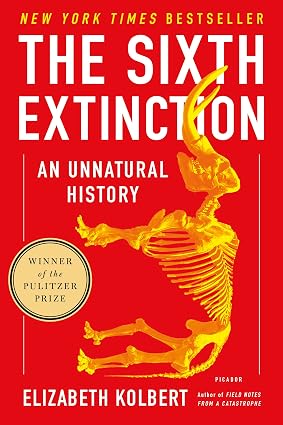
Ever wondered if your presence on Earth could be likened to an asteroid impact? Brace yourself because Elizabeth Kolbert, in her Pulitzer-winning masterpiece “The Sixth Extinction: An Unnatural History,” tells us it’s not entirely a ludicrous comparison. Before you start donning your superhero cape or supervillain mask, hold on – the news isn’t particularly good. It turns out we’re the cataclysm in this chapter of life on Earth.
Kolbert’s work is a candid, engrossing, and thought-provoking account of the mass extinction currently unfolding before our eyes – the most devastating one since, well, the dinosaurs met their fiery end. That’s right, we’re in the middle of the sixth mass extinction, and the culprit is us, not a rogue space rock.
This book isn’t just a catalog of doom and gloom, though; it’s a literary jigsaw puzzle, interweaving research from multiple disciplines, histories of extinction concepts, and fascinating anecdotes of the species we’ve already consigned to the annals of history. At its core, it’s a comprehensive exploration of the ‘hows’ and ‘whys’ of the indelible changes we’re imprinting on this world, painting a stark portrait of humanity’s potential lasting legacy.
Kolbert’s prose is as engaging as it is enlightening, offering a sobering take on our role as both observers and instigators of this mass extinction event. She deftly highlights the urgency of the situation while inviting us to ponder on a fundamental question: What does it mean to be human in this era of dramatic ecological change?
Reading “The Sixth Extinction” won’t just make you smarter; it will reframe your perspective of humanity’s place in the grand scheme of things. So, are you ready to face the (uncomfortable) music and embrace a new understanding of our collective impact on Earth’s biodiversity? Dive in, and prepare for a rollercoaster of emotions – wonder, guilt, grief, and hopefully, determination. After all, knowledge is the first step to making a difference.

Who’s up for a riveting existential chat about humanity’s future with our silicon-brained counterparts? No, we’re not talking about a late-night dorm room debate over pizzas, but “Life 3.0: Being Human in the Age of Artificial Intelligence” by Max Tegmark. Trust me, it’s even better than it sounds, not least because Stephen Hawking said it’s the “most important conversation of our time” – and when did he ever steer us wrong?
Tegmark, an MIT professor whose name is synonymous with beneficial AI, takes us on a whirlwind tour of what our future might look like when artificial intelligence stops being the stuff of sci-fi and becomes our next-door neighbor. Will AI turn into an obedient Jeeves, serving our every whim, or will it ascend to a god-like status, while we scurry about like ants at a picnic? Riveting stuff!
This isn’t just a bunch of fantastical musings, though. Tegmark dives deep into the nuts and bolts of the AI-driven world. How do we ensure prosperity in an automated future without kicking people to the unemployment curb? How do we stop AI systems from crashing, malfunctioning, or worse, getting hacked? And who’s going to keep an eye on any potentially disastrous AI arms race?
But don’t fret; Tegmark isn’t all doom and gloom. He also explores the sunnier side of the AI equation – the possibility that AI might help life flourish like never before, improving our lives in ways we can’t yet even imagine. Of course, there’s always the chance that these smarty-pants machines might outsmart us at everything and maybe, just maybe, decide they don’t need us at all.
“Life 3.0” is like the ultimate cocktail party conversation – insightful, alarming, and loaded with “did you know?” moments that will have you looking at your Roomba in a whole new light. And if it’s good enough to make Obama’s favorite books list, you know it’s not just smoke and mirrors. So, are you ready to jump into the most important conversation of our time? Just remember, when the robots take over, they’ll probably judge us by our bookshelves. Better make sure this one’s on yours!

“Food Rules: An Eater’s Manual” by Michael Pollan takes the cake for being the simplest, most digestible guide to eating wisely. But don’t just take my word for it – Tara Parker-Pope from The New York Times says it could replace all the diet books on your shelf, and Jane Brody from the same paper has hailed it as the most “intelligent, sensible and simple to follow” guide in her four decades of nutritional science coverage.
Pollan is well known for his crisp, witty writing, and he doesn’t disappoint here. This petite but potent book lays out a clear set of food rules to live by, each explained with the brevity and clarity of a fortune cookie message. Whether you’re roaming the aisles of your local supermarket or eyeing the offerings at an all-you-can-eat buffet, this handbook is an essential companion, always ready to answer the eternal question: “What should I eat?”
But this isn’t just about the dos and don’ts of eating. Pollan explores the wisdom of different cultures and how they’ve managed to arrive at similar conclusions about food and diet, often diametrically opposed to our current era of fancy diets and contradictory health advice. As The Los Angeles Times puts it, Pollan’s book promotes a “back-to-the-basics-of-food (and-food-enjoyment) philosophy.”
So, if you’re tired of the dietary debates that seem to make eating more of a chore than a joy, “Food Rules: An Eater’s Manual” is a refreshing and sensible antidote. It’s time to declutter your bookshelf (and your pantry), keep it simple, and rediscover the joy of food!

Strap in for the whirlwind tour of the wonderfully wacky world of the human brain with “The Man Who Mistook His Wife for a Hat” by the esteemed neurologist and part-time brain detective, Oliver Sacks. This riveting collection of neurological whodunits gives “mind-boggling” a whole new meaning.
Imagine forgetting your spouse because you mistook her for a hat or being a top-notch artist without even trying, all thanks to a brain hiccup. Sacks takes us on a deep dive into the gray matter, and oh boy, it’s anything but gray!
Through a series of mind-tickling case studies, we’re introduced to a peculiar parade of patients whose brains have thrown them the wildest curveballs. Some can’t recognize a face for the life of them, while others showcase jaw-dropping talents they never even signed up for.
And the best part? Sacks narrates these medical mysteries with the narrative flair of a seasoned storyteller, all while maintaining the bedside manner of the world’s most empathetic doctor. If Sherlock Holmes and Patch Adams had a love child, it would be Oliver Sacks in this book.
So, if you ever wanted a VIP tour of the noggin and the outlandish ways it can trip you up, this book’s got you covered. As a bonus, you’ll walk away with a new appreciation for the phrase “It’s all in your head,” and maybe even develop a new fondness for hats. Who knew brain science could be a riotous ride of learning and laughter?

Take a deep breath and hold onto your neurons, folks! We’re diving headfirst into the wild rollercoaster that is human consciousness with “The Wisdom of Insecurity: A Message for an Age of Anxiety” by the modern day philosopher and all-round intellectual maverick, Alan Watts.
Are you a chronic future-worrier, or perhaps a perpetual past-ponderer? Do you find yourself in a whirlpool of ‘what-ifs’ and ‘if-onlys’? Well, according to Watts, you’ve been doing it all wrong. The secret to contentment, he argues, lies in embracing the here and now. Spoiler alert: your brain’s supposed to be a mindfulness machine, not a time-travelling device!
Drawing from the cornucopia of Eastern philosophy and spirituality, Watts offers a life-raft of wisdom for those drowning in the age of anxiety. He argues that our insatiable pursuit of the future and relentless ruminations over the past make us oblivious to the beautiful mess that is the present moment.
More importantly, he asserts that the only security is to embrace insecurity, and the only certainty is to accept uncertainty. Why, you might ask? Because the meaning of life lies in living the questions, not chasing the answers.
So, if your life’s motto has been “control the controllables,” Watts is here to shake you up with his philosophical jigsaw. Each piece he adds might leave you questioning more, but isn’t that the true essence of getting wiser?
“The Wisdom of Insecurity” simplifies the complex, enlightens the obscure, and wraps the profound in downright accessible language. So, buckle up for this wisdom-infused joyride that will make you smarter by teaching you to be okay with not knowing. Watts’ words, much like fine wine, only get better with each read. No wonder the Los Angeles Times claimed he could “write beautifully the unwritable.”

Ready for an intellectual joyride through the land of morality, politics, and religion? Buckle up, and let’s dive into “The Righteous Mind: Why Good People are Divided by Politics and Religion” by social psychology virtuoso Jonathan Haidt. Warning: this book might just make you question everything you thought you knew about why we think the way we do.
The New York Times wasn’t exaggerating when they called this book a “landmark contribution to humanity’s understanding of itself.” It’s like suddenly being given X-ray vision to see the moral skeletons inside our political and religious bodies.
Haidt, armed with a quarter-century of research in moral psychology, makes the audacious claim that our moral judgments are not bastions of reason but are more akin to gut feelings. In layman’s terms, your moral compass isn’t a lofty intellectual exercise—it’s more of a belly rumble.
In the red corner, we have liberals. In the blue, conservatives. And in the wild-card spot, libertarians. Haidt paints a compelling picture of how each group’s gut feelings about right and wrong differ dramatically and yet—here’s the kicker—are valid in their unique ways. Yep, you read that right: it’s not about who’s right, but how everyone is right-ish.
“The Righteous Mind” is an accessible, thought-provoking opus that holds the keys to understanding how we manage the high-wire act of human cooperation while simultaneously being trapped in the spiderweb of eternal divisions and conflicts.
So, if you’re tired of the usual scream-fests that pass for political discourse and are craving for some understanding instead of anger, this book is your ticket to intellectual nirvana. It’ll make you smarter and perhaps a little more forgiving of that annoying cousin who won’t stop arguing about politics at family dinners.
Can books really make you smarter?
Oh, you bet! Non-fiction books are like brain buffets, providing an intellectual feast in every chapter. Dive into history, and you’ll understand the patterns of humanity. Pick up a psychology book, and you’ll gain insights into the human mind. According to research conducted at Emory University, any form of reading increases brain function and connectivity, with effects lingering for days after the reading took place.
But non-fiction books add an extra layer. A study in the Journal of Direct, Data and Digital Marketing Practice suggests that reading non-fiction makes readers more adept at handling complex ideas and concepts. It’s like adding weights to your mental gym. So, yes, books can indeed make you sharper than a Shakespearian quip!
Do successful people read books?
In a word: yes! Successful people and books go together like coffee and a croissant. And we’re not just spinning a good yarn here. Research, like this article from the Harvard Business Review, indicates that reading, especially non-fiction, can significantly up your game in the career sphere.
Look at the reading habits of moguls like Bill Gates or Warren Buffet. Gates, the tech titan, plows through about 50 books per year, mainly non-fiction. Buffet, the investment wizard, is known to spend up to 80% of his day reading! And Oprah? She’s practically the ambassador for books, introducing the world to diverse non-fiction titles through her influential book club. As Mark Twain said, “The man who does not read has no advantage over the man who cannot read.”
How do books provide you more than just conventional intelligence?
Non-fiction books are like a Swiss army knife for your brain—they’re multipurpose tools that go beyond simply boosting your IQ. Yes, they arm you with facts and data, but they also cultivate critical thinking, enhance empathy, and broaden your perspective. They’re a great way to develop analytical skills and cultural understanding, something that a traditional classroom education might miss.
Reading non-fiction can also foster mental health benefits. According to a study in the journal Art Therapy, reading can decrease symptoms of depression, boost self-esteem, and provide a coping strategy for stress.
In a nutshell, non-fiction books don’t just make you more knowledgeable—they make you more well-rounded, emotionally intelligent, and empathetic. So next time you pick up a non-fiction book, remember, you’re not just reading—you’re enhancing your life, one page at a time!
If you enjoyed this reading list of books that will make you smarter, you may also want to check out our list of the most life changing books. We’re achieving a lot today, aren’t we?!
As an Amazon Associate we earn from qualifying purchases made through links on this page.